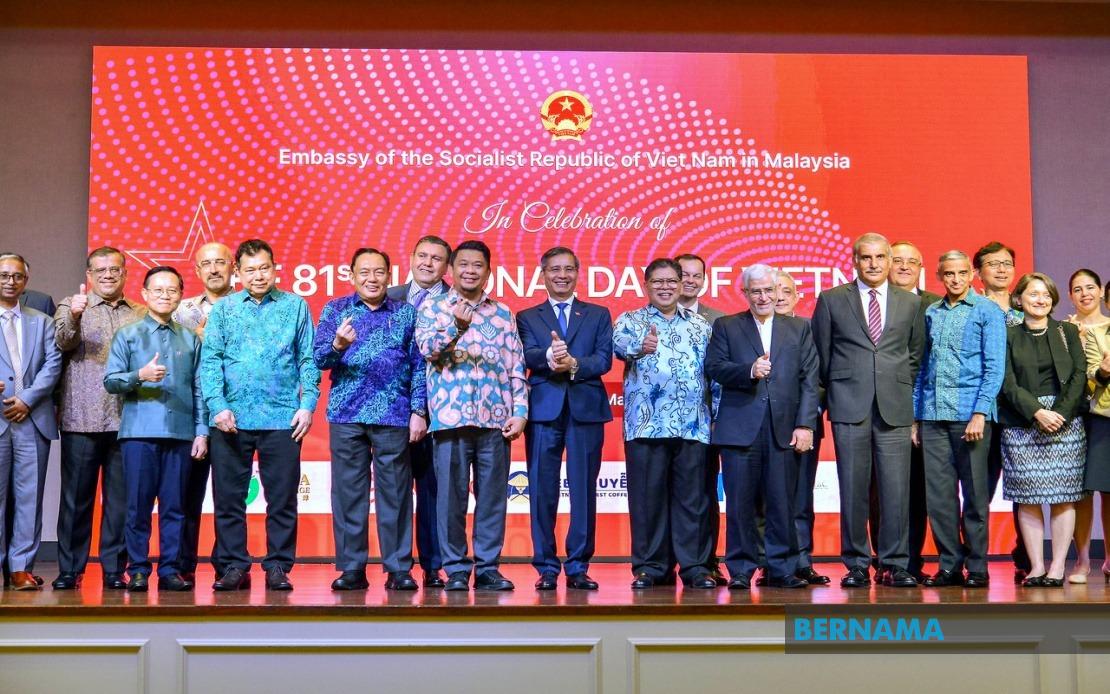
Vietnam and Malaysia are entering a transformative chapter in their relationship, anchored by the Comprehensive Strategic Partnership that was formally elevated in November 2024. Speaking at Vietnam's 81st National Day celebration in Kuala Lumpur, Vietnam's Ambassador to Malaysia Dinh Ngoc Linh underscored how this upgraded framework reflects deepening political confidence and alignment on key regional issues, positioning both Southeast Asian neighbours as increasingly important anchors for each other amid geopolitical uncertainty.
The ambassador's remarks illuminate a partnership that has matured significantly since formal diplomatic ties were established in 1973. Over five decades, Vietnam and Malaysia have constructed a multifaceted relationship spanning trade, investment, cultural exchange, and security cooperation. The elevation to strategic partnership status represents not merely ceremonial recognition but a substantive commitment to navigating shared challenges in an era when regional stability faces mounting pressures from competing great-power interests and economic volatility.
Bilateral economic engagement has accelerated considerably over the past year, with commercial flows expanding across traditional sectors including agriculture, manufacturing, and tourism, while new avenues in technology and digital innovation are opening. Malaysian investors maintain a growing presence in Vietnam's dynamic economy, while Vietnamese workers and entrepreneurs contribute meaningfully to Malaysia's labour market and business ecosystem. This economic interdependence creates mutual incentives for stability and cooperation that transcend political fluctuations.
Defence and security cooperation stands as a critical pillar of the relationship, as both nations navigate complex maritime security challenges in Southeast Asian waters and confront transnational threats including terrorism, human trafficking, and drug smuggling. The ambassador's emphasis on defence collaboration signals that Hanoi views Malaysia not as a peripheral partner but as a strategic ally whose military cooperation contributes to regional confidence-building and predictability. For Malaysia, deeper security ties with Vietnam provide additional hedging options amid great-power competition and contribute to a balanced regional equilibrium.
Parliamentary exchanges have emerged as important channels for people-to-people understanding, allowing legislators from both countries to build personal relationships that transcend formal diplomacy. These legislative connections can prove particularly valuable during periods of tension, as they provide informal communication channels and foster cross-cutting interests that resist politicization. The ambassador highlighted these exchanges as essential for strengthening societal bonds across generations, recognizing that state-to-state relations ultimately rest upon public understanding and support.
Within the ASEAN framework, Vietnam and Malaysia have increasingly aligned their strategic thinking on key regional issues including the maintenance of ASEAN centrality, the management of South China Sea disputes, and the promotion of inclusive regional architecture. The ambassador's articulation of commitment to ASEAN unity and resilience reflects broader Vietnamese policy prioritizing collective Southeast Asian agency in addressing transnational challenges. For Malaysia, this alignment offers opportunities to amplify ASEAN's voice on issues ranging from maritime security to climate change and pandemic preparedness.
Education and cultural exchanges represent often-underestimated dimensions of bilateral cooperation, fostering long-term people-to-people connections that survive political changes. Vietnamese students studying at Malaysian universities, and conversely Malaysian scholars in Vietnam, create networks of mutual understanding that pay dividends decades later when these individuals assume leadership roles. Cultural diplomacy, encompassing everything from traditional arts exchanges to culinary appreciation, builds emotional and psychological foundations for sustained cooperation.
The ambassador's approaching conclusion of his three-year tenure provides an opportune moment to assess the trajectory of bilateral relations and anticipate future directions. His personal commitment to the relationship, extended beyond his formal diplomatic posting, exemplifies how individual actors shape institutional ties. His successor will inherit a partnership framework already strengthened by two years of CSP implementation, offering greater flexibility for innovation in cooperation across emerging domains such as green energy transition and digital transformation.
Regionally, the Vietnam-Malaysia partnership gains significance as part of broader ASEAN dynamics. While the bloc faces internal divisions on various issues, the bilateral relationship between these two middle-power Southeast Asian states demonstrates that substantive strategic convergence remains achievable when countries identify shared interests and demonstrate political will. This relationship model offers lessons for other ASEAN pairs seeking to upgrade cooperation amid regional complexity and extraregional pressure.
Looking forward, the partnership faces both opportunities and challenges. Opportunities include expanded economic integration through trade agreements, technological cooperation in emerging sectors, and joint responses to transnational challenges requiring coordinated action. Challenges encompass managing South China Sea sensitivities where both countries hold different positions, addressing potential labour migration issues, and ensuring that strategic partnership elevations translate into concrete policy coordination rather than remaining rhetorical flourishes.
The presence of Deputy Foreign Minister Datuk Lukanisman Awang Sauni as guest of honour at the celebration signalled official Malaysian endorsement of the partnership's trajectory. His participation underscored that the upgraded CSP enjoys wholehearted government backing, not merely diplomatic courtesy. This high-level engagement indicates Malaysia's strategic commitment to deepening ties with Vietnam and strengthening the bilateral relationship as a core element of Malaysia's Southeast Asian diplomacy.
The timing of this reaffirmation of commitment coincides with a period of significant global realignment, where traditional power structures face challenge and middle powers like Vietnam and Malaysia are recalibrating their strategic positioning. By publicly reinforcing their partnership at both ceremonial and substantive levels, both nations are signalling to their respective publics, regional neighbours, and the broader international community their intention to deepen cooperation and chart an autonomous course anchored in regional solidarity.
As Vietnam and Malaysia progress through implementation of their Comprehensive Strategic Partnership, the relationship will likely serve as a stabilizing force in Southeast Asia, demonstrating that pragmatic cooperation between nations with different political systems, historical experiences, and strategic preferences remains not only possible but mutually beneficial. The ambassador's confidence in the friendship's ability to grow stronger across generations reflects recognition that these ties transcend any individual leader or political cycle, grounded instead in sustained material interests and shared commitment to regional peace and prosperity.

