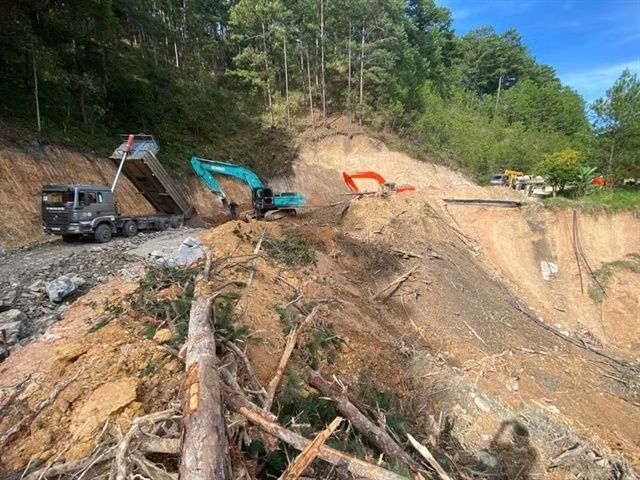
Vietnam's Ministry of Construction has activated emergency protocols on a critically damaged section of Ho Chi Minh Road, the nation's primary north-south transport artery, following devastating rainfall that struck Tuyen Quang Province during June. The declaration targets the intersection of Ho Chi Minh Road and National Highway 2C at the Km115+000 mark, where infrastructure deformation has reached levels considered hazardous to public safety and vehicular traffic.
The damage stems from a relentless sequence of heavy rainfall events that pummelled the Tuyen Quang area throughout June, according to data compiled by the Tuyen Quang Provincial Hydrometeorological Station and the National Centre for Hydrometeorological Forecasting. This sustained wet weather pattern overwhelmed drainage systems and destabilised road surfaces across the region, with the Ho Chi Minh Road intersection with National Highway 2C bearing the brunt of the structural strain. The infrastructure failure poses immediate risks to the thousands of vehicles that traverse this strategic corridor daily, connecting northern Vietnam's industrial regions with Ho Chi Minh City and southern economic zones.
The emergency declaration represents a significant escalation in Vietnam's response to the summer weather crisis, signalling that conventional maintenance protocols are insufficient to address the scale of deterioration. By invoking emergency status, the Ministry of Construction activates expedited procurement and deployment procedures that would normally require lengthy bureaucratic processing. This mechanism allows the Department for Roads of Vietnam (DRVN) and Road Management Zone I to mobilise resources rapidly and bypass standard tendering processes to restore functionality to this essential transport corridor.
Responsibility for the remediation effort falls squarely on the DRVN and Road Management Zone I, which have been directed to conduct immediate comprehensive assessments of the structural damage, develop detailed repair strategies and issue Emergency Construction Orders authorising swift intervention. These organisations must move beyond damage documentation to formulate engineering solutions that restore structural integrity while minimising disruption to traffic flow. The technical complexity of repairing a major road intersection during the monsoon season presents additional challenges, as continued rainfall could compromise repair work and necessitate repeated interventions.
A secondary crisis point demands parallel attention approximately nine kilometres south along the same corridor. Between Km124+600 and Km128, where Ho Chi Minh Road overlaps with National Highway 2, localised flooding has created congestion bottlenecks that threaten supply chain continuity. Road and Transport Safety Division officials face mounting pressure to implement congestion management measures, potentially including traffic diversions, lane restrictions or temporary one-way systems to maintain vehicular flow through the waterlogged section. The economic consequences of prolonged disruption extend beyond inconvenienced drivers to affect manufacturing export schedules and agricultural product movement during a critical seasonal window.
Accountability mechanisms embedded within the emergency framework place senior officials on notice. The Director General of the Department for Roads of Vietnam and the Director of Road Management Zone I face direct ministerial scrutiny regarding both the damage assessment and the effectiveness of remedial actions. This structural accountability requirement reflects Vietnam's efforts to ensure emergency protocols do not devolve into bureaucratic inertia, a risk that exists when lower-ranking officials control crisis response. By anchoring responsibility at directorate level, the Ministry of Construction applies pressure to mobilise resources and prioritise rapid restoration over protracted planning cycles.
The emergency status remains provisional, subject to revision once reconstruction activities conclude. The DRVN must prepare completion reports documenting both the remedial work undertaken and its effectiveness before the Ministry of Construction will formally declare the emergency concluded. This staged approach prevents premature declarations while allowing for adaptive management should initial repair efforts prove inadequate. Seasonal weather patterns suggest that completed repairs must withstand September and October rainfall before the emergency framework can be confidently lifted.
For regional supply chains and Southeast Asian trade corridors, the Ho Chi Minh Road disruption carries implications beyond Vietnam's borders. Malaysian and Thai exporters routing goods through northern Vietnam toward southern ports face potential delays, while importers dependent on southern Vietnamese ports face extended transit times for goods sourced through the northern regions. The emergency declaration, while necessary, signals that monsoon infrastructure resilience remains a vulnerability for logistics networks spanning mainland Southeast Asia.
The rainfall sequence affecting Tuyen Quang raises broader questions about climate adaptation in Vietnam's transport infrastructure planning. As hydrological patterns intensify due to climate change, emergency declarations may become recurrent rather than exceptional occurrences along major corridors. Long-term infrastructure resilience likely demands not just repair of immediate damage but fundamental redesign of drainage systems, embankment reinforcement and elevated construction standards that anticipate more extreme seasonal variations. The current emergency response addresses immediate safety risks, but sustained vulnerability suggests Vietnam must undertake systematic infrastructure audits across its national road network to identify and preemptively remediate similar weak points before successive storms create cascading crises.

