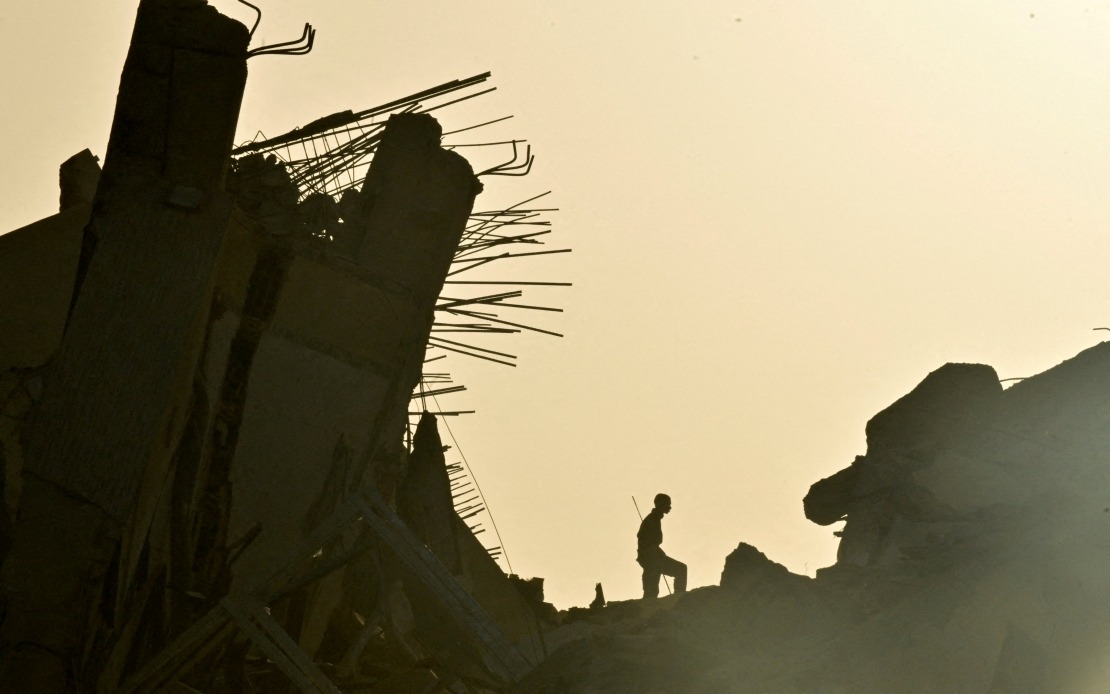
A pair of powerful earthquakes that struck Venezuela on Wednesday have claimed at least 1,450 lives, with authorities reporting over 3,200 injured and thousands more feared trapped in collapsed structures. The back-to-back tremors, measuring 7.2 and 7.5 in magnitude, have unleashed one of the most severe natural disasters to hit the South American nation in recent years, prompting an unprecedented international rescue response and raising urgent questions about disaster preparedness in seismically vulnerable regions across Latin America and the Caribbean.
According to Jorge Rodríguez, President of the National Assembly, the initial pair of earthquakes were followed by a relentless sequence of 430 aftershocks that hampered rescue operations and heightened the danger for workers sifting through rubble. The continuous tremors have complicated efforts to locate survivors and extract those trapped beneath tonnes of concrete and steel, as structural instability persists throughout affected areas. The sheer volume of seismic activity following the main quakes underscores the geological complexity of Venezuela's position along major fault lines and the prolonged threat posed by such natural events to recovery efforts.
The most catastrophic damage has been concentrated in two critical areas: the coastal state of La Guaira and Caracas, the nation's capital. Entire blocks of high-rise residential and commercial buildings have been completely levelled, reducing modern urban infrastructure to rubble fields. Eyewitness accounts and preliminary assessments reveal scenes of urban devastation comparable to major earthquake events elsewhere, with apartment complexes and office towers reduced to skeletal remains. The concentration of destruction in these densely populated urban centres has significantly amplified the human toll, as residents had little time to evacuate before structures collapsed.
The scale of the mobilised response reflects the gravity of the situation. Approximately 30,000 Venezuelan emergency and rescue personnel have been deployed alongside 2,700 specialist rescue experts dispatched from 24 other nations. This combined force of roughly 33,000 workers represents a substantial commitment of international resources, demonstrating global solidarity in response to the crisis. Teams have been working systematically through debris fields, employing specialised detection equipment and manual excavation techniques to locate and extract survivors. The coordination required to manage such a multinational effort, particularly in a country facing significant governance challenges, has itself become a logistical undertaking of considerable complexity.
However, rescue officials and disaster management experts are acutely aware of a sobering biological reality that governs survival in earthquake rubble. The critical window for locating and extracting living survivors typically narrows dramatically after 72 hours from the initial collapse. As days elapsed since the Wednesday earthquakes, the likelihood of discovering people still alive beneath the debris diminished significantly. This harsh temporal constraint has infused rescue operations with urgency and, inevitably, a creeping sense of futility. Rescue coordinators have had to balance the psychological imperative to continue searching with the practical recognition that the probability of finding survivors decreases exponentially with each passing hour.
Assessments of physical damage paint a picture of comprehensive infrastructure destruction. More than 2,500 residential buildings and other structures have either completely collapsed or sustained severe damage that renders them uninhabitable or unsafe. Particularly alarming is the destruction of medical facilities: 38 hospitals have been damaged or destroyed, severely compromising the nation's ability to respond to the massive influx of injured survivors. Additionally, approximately 780 homes have been destroyed, displacing thousands of families and creating an immediate humanitarian crisis requiring emergency shelter, food, and medical assistance. The damage to hospitals is particularly consequential in a nation already grappling with healthcare system challenges, as it eliminates critical capacity precisely when demand is greatest.
For Malaysian and Southeast Asian observers, the Venezuelan catastrophe carries sobering lessons about vulnerability and preparedness. Several countries in Southeast Asia, including Indonesia, the Philippines, and parts of Malaysia itself, sit along similarly active seismic zones where comparable earthquakes remain possible. The Venezuelan experience demonstrates how rapidly natural disasters can overwhelm even coordinated international responses and how critical pre-existing infrastructure resilience becomes when disaster strikes. The scale of destruction in Caracas and La Guaira underscores the importance of earthquake-resistant building codes, early warning systems, and pre-positioned emergency resources in tectonically active regions.
The disaster also raises questions about reconstruction and long-term recovery planning for Venezuela, a nation already facing severe economic and political challenges. Beyond the immediate humanitarian crisis of locating survivors and treating the injured, Venezuela faces an enormous task of rebuilding destroyed housing stock, repairing healthcare infrastructure, and supporting displaced populations. International aid will likely prove essential, yet Venezuela's complicated relationships with various nations may complicate the flow of assistance. The earthquake, while a natural phenomenon, intersects with existing state fragility and governance constraints in ways that could significantly protract recovery timelines compared to similar disasters in more economically stable nations.
The incident serves as a stark reminder that natural disasters respect no borders and that preparedness mechanisms in one country's region can offer valuable lessons for others. The mobilisation of rescue personnel from across the Americas and beyond reflects both the international community's capacity for rapid response and the limitations of such responses when facing the sheer scale of devastation produced by powerful earthquakes. As rescue operations continue against lengthening odds and as the human cost becomes clearer, the focus will inevitably shift toward understanding what lessons can be drawn and applied to improve resilience across the Americas and globally.

