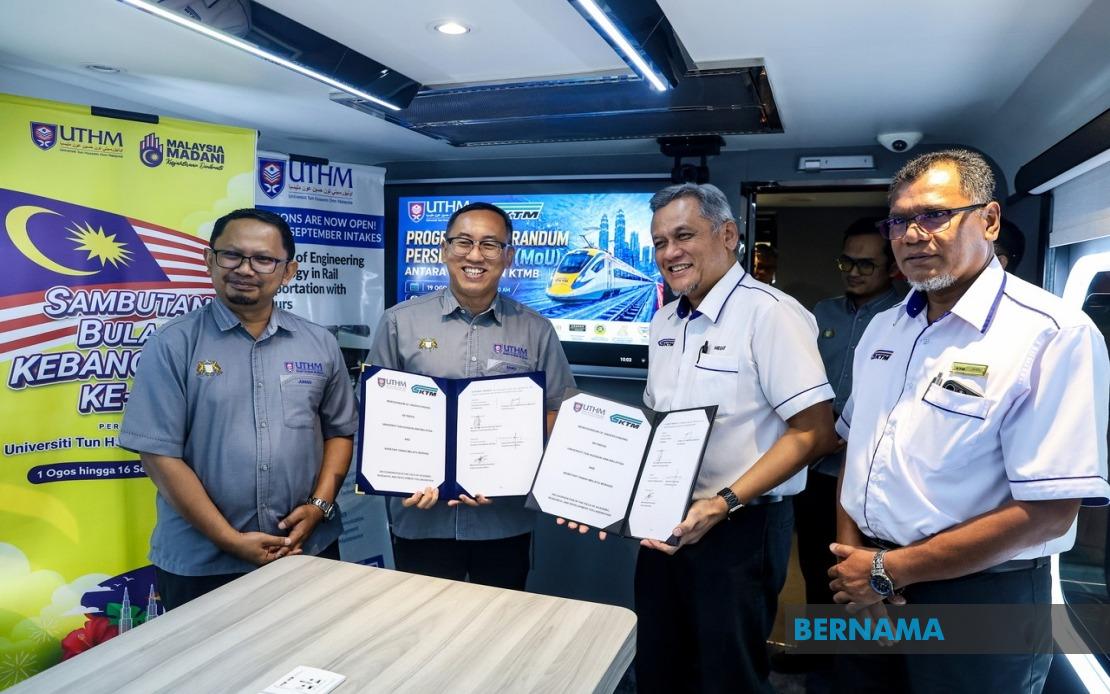
Malaysia's push to develop home-grown expertise in rail technology received fresh impetus this month when Universiti Tun Hussein Onn Malaysia (UTHM) and Keretapi Tanah Melayu Bhd (KTMB) formalized an extended partnership spanning October 2026 to July 2029. The renewed commitment builds on a foundational agreement signed in 2019, signalling deepening recognition within both government-linked sectors that sustained cooperation between academia and industry remains vital to building a competitive workforce in specialized engineering fields.
The collaboration framework encompasses several complementary dimensions. Work-based learning stands as the centrepiece, providing UTHM students with practical immersion in KTMB's operational environment. This experiential approach enables undergraduates to contextualize classroom instruction within the realities of railway management, technology deployment, and the tangible constraints facing Malaysia's national rail operator. By rotating students through KTMB facilities and active service areas, the partnership bridges the persistent gap between theoretical knowledge and industrial application—a challenge that has long hampered graduate readiness in technical sectors across Southeast Asia.
Prof Dr Mas Fawzi Mohd Ali, UTHM's vice-chancellor, underscored the educational value during the partnership agreement exchange, which took place aboard a KTMB chartered train travelling between Kluang Station and KL Sentral. He emphasized that the arrangement fulfills UTHM's positioning as a Global Technopreneur University 2030 (GTU2030), an institutional vision that weaves together knowledge creation, technological application, innovation pathways, and entrepreneurial thinking within a single coherent development strategy. This pedagogical alignment means rail engineering students at UTHM are not merely acquiring technical competencies but are being cultivated as problem-solvers capable of identifying commercial opportunities within Malaysia's transport infrastructure ecosystem.
The track record of the previous iteration merits attention. Nearly 200 graduates from UTHM's Bachelor of Rail Transportation Engineering Technology with Honours programme have entered the workforce since 2019, with placement spanning not only Malaysian operations but also positions in Singapore and Saudi Arabia. This geographic distribution of UTHM-trained professionals suggests that Malaysian rail engineering education has achieved sufficient quality to attract regional and international demand, a milestone that reflects positively on both the university's curriculum design and KTMB's willingness to mentor emerging talent.
Beyond classroom preparation, the renewed agreement encompasses substantive research collaboration. UTHM will contribute its academic infrastructure, specialized laboratories, and research methodologies, while KTMB will supply operational datasets, technical challenges grounded in real-world service delivery, and access to aging and contemporary rail systems. This complementary pairing creates opportunities to develop innovations addressing persistent pain points—from asset maintenance protocols to safety system upgrades to energy efficiency improvements. For a rail operator serving a nation where transport infrastructure development remains a policy priority, such research partnerships can accelerate the adoption of cost-effective technological solutions.
Megat Khairulazhar Khairodin, KTMB's chief corporate officer, articulated the operator's perspective by noting that the partnership grants access to UTHM's specialized expertise, research facilities, and technological capabilities to resolve operational and technical difficulties. This framing suggests KTMB views the university not merely as a training ground but as a potential supplier of solutions to its operational challenges. In Malaysia's context, where state-owned enterprises have historically faced pressure to improve efficiency and service quality, such academia-industry linkages represent a cost-conscious alternative to procuring foreign consulting services.
The agreement also encompasses professional development pathways for KTMB personnel themselves. The company has sponsored five staff members to pursue master's-level studies in rail-related disciplines at UTHM, a modest but symbolically important investment in upskilling the operator's own workforce. This reverse flow of learning—from practitioner to academy—acknowledges that KTMB employees bring irreplaceable institutional knowledge that enriches graduate-level instruction and research supervision. Furthermore, the collaboration includes provisions for academic consultation involving KTM Academy (MyRA), the operator's designated training institution, enabling curriculum alignment across diploma, bachelor's, and postgraduate rail engineering programs.
The timing of the partnership renewal coincides with broader policy currents. Malaysia's transport sector continues to attract government investment and attention, particularly in light of urban mobility challenges and the long-term viability of regional rail networks. By institutionalizing academic-industry cooperation, both UTHM and KTMB position themselves as central to the national capacity-building agenda in this domain. For students, employers, and policymakers, the arrangement reduces the historical friction between education and employment, enabling more efficient transitions and more targeted skill development.
Additionally, the partnership carries implications for Malaysia's standing within Southeast Asia's technical education landscape. Countries across the region compete for recognition as hubs of engineering excellence. By demonstrating sustainable collaboration between universities and major industrial operators, UTHM and KTMB contribute to a narrative of institutional maturity and regional competitiveness. The placement of UTHM graduates in GCC nations and neighbouring Singapore speaks to the portability and marketability of Malaysian rail engineering credentials—an asset that extends beyond domestic borders.
The modalities outlined—industry forums, academic visits, and competency development workshops—may appear administrative in nature but serve as essential connective tissue. These mechanisms facilitate informal knowledge transfer, allow practitioners to identify emerging talent pools, and help academics remain abreast of industry evolution. In rapidly changing technical fields, such regular touchpoints prevent the curricular drift that often occurs when educational programmes operate in isolation from industry realities.
Looking forward, the three-year timeframe provides a natural checkpoint. At the conclusion of this renewed agreement in July 2029, both institutions will possess data on graduate outcomes, research productivity, and operational improvements attributable to the partnership. This evidence base will inform decisions about extension, expansion, or recalibration of collaboration terms. For Malaysian higher education and state enterprise management, such performance-oriented partnership frameworks offer a replicable model applicable across other technical disciplines and industry sectors where similar gaps between academic preparation and workplace requirements persist.

