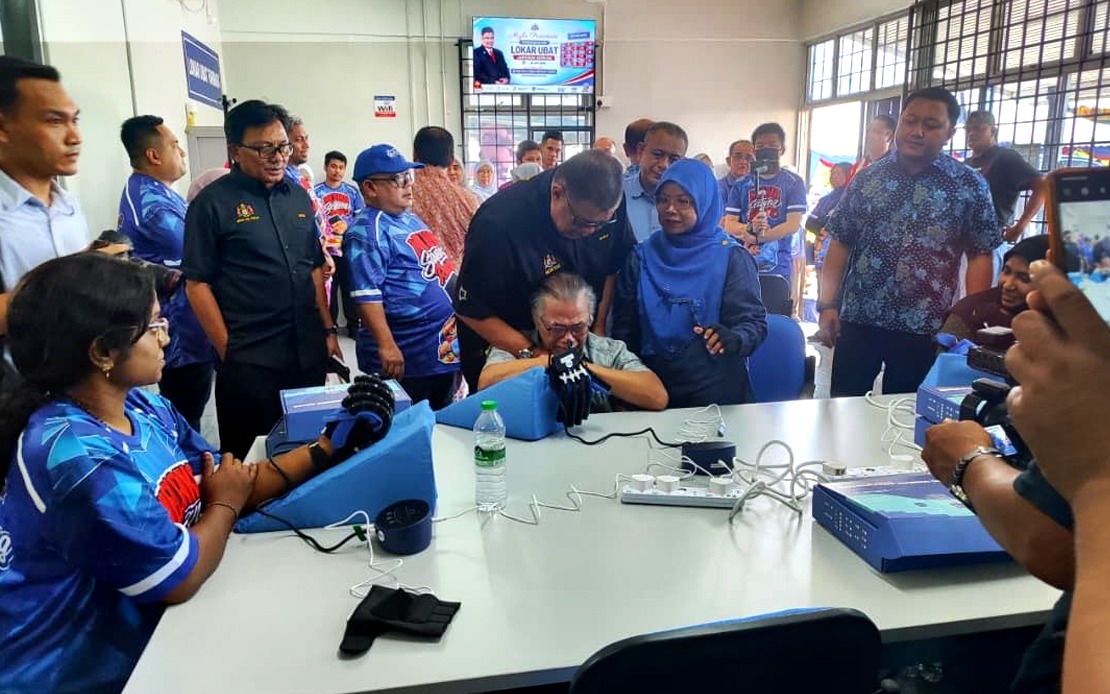
Universiti Teknikal Malaysia Melaka has inaugurated an innovative rehabilitation facility that signals a significant shift in how recovery services reach underserved communities. The MADANI Community Rehabilitation Centre and Gymnasium, located in Serkam within Jasin district, represents a tangible example of academic research translating into practical healthcare applications. Funded through the Finance Ministry's UniMADANI 2024 Grant, the centre combines technological sophistication with accessibility, addressing a critical gap in rehabilitation services across rural and semi-urban Melaka.
The facility's distinguishing feature lies in its integration of proprietary technologies developed by UTeM researchers. Rather than relying on conventional physiotherapy methods alone, the centre deploys the Roboglove system, which provides structured hand rehabilitation training through robotic assistance. Complementing this innovation is the Assistive Lower Limb Chair, an automated apparatus enabling systematic lower limb exercises without requiring constant manual intervention from therapists. An exoskeleton system rounds out the technological arsenal, offering enhanced movement training that researchers believe improves rehabilitation outcomes compared to traditional approaches.
These innovations address specific patient populations that Malaysian healthcare systems have historically struggled to serve efficiently. Stroke survivors, individuals recovering from traumatic injuries, and those experiencing progressive mobility limitations all stand to benefit from consistent, technology-supported training regimens. In Malaysia's aging society and amid rising traffic and workplace injury rates, such facilities become increasingly vital infrastructure. The ability to provide automated, repeatable therapeutic exercises reduces dependency on specialist physiotherapist availability, a perpetual constraint in regional medical provision.
The centre's establishment emerged from deliberate institutional collaboration, demonstrating how universities can function as bridges between government policy and community needs. Associate Professor Dr Mariam Md Ghazaly spearheaded the project, while partnerships encompassed multiple stakeholders including the Serkam State Constituency Development and Coordination Committee, local village development bodies, the Social Welfare Department, and the Social Security Organisation. This multi-layered approach ensured the facility addressed not merely technical specifications but also accessibility, funding sustainability, and integration with existing social welfare frameworks.
Chief Minister Datuk Seri Ab Rauf Yusoh's official launch underscores political recognition that rehabilitation innovation warrants high-level attention. Such endorsement typically signals future resource allocation and policy support, potentially enabling the model's replication across additional constituencies. UTeM Vice-Chancellor Prof Datuk Dr Massila Kamalrudin emphasised the centre as a catalyst for scaling technology-based rehabilitation services, framing it within broader university commitments to community engagement and practical application of research.
The centre's significance extends beyond Melaka's borders. Southeast Asian nations face comparable demographic and epidemiological pressures. Population aging, urbanisation-related injuries, and non-communicable disease prevalence create sustained demand for rehabilitation services throughout the region. Malaysia's universities, positioned as innovation hubs, can either replicate this model or adapt its principles to other healthcare domains. For policymakers across ASEAN, the Serkam centre demonstrates viability of technology-enabled healthcare delivery within resource constraints typical of developing and middle-income countries.
From a patient perspective, the centre addresses quality-of-life considerations that conventional rehabilitation struggles to accommodate. Consistent, structured exercise availability reduces recovery timelines and improves functional outcomes. Robotic systems provide objective performance data, enabling clinicians to track progress rigorously and adjust protocols accordingly. For patients, particularly those in rural settings facing transportation obstacles, localised access to advanced rehabilitation represents transformative opportunity for independence restoration.
Economic dimensions warrant consideration as well. While initial capital investment in robotic systems appears substantial, per-patient treatment costs potentially decline through automation, reduced physiotherapist time requirements, and improved treatment efficiency. For PERKESO and other social security entities funding rehabilitation, such efficiency gains translate into expanded coverage within fixed budgets. Malaysian insurers and healthcare administrators evaluating similar investments will likely scrutinise this facility's performance metrics closely.
The collaboration model itself merits emphasis for Malaysian governance discussions. Government-university-community partnerships function most effectively when objectives align and accountability mechanisms ensure sustained commitment. The Serkam centre's multi-institutional structure, if properly maintained, creates resilience against funding fluctuations or administrative transitions that frequently undermine Malaysian public health initiatives. Institutionalising such partnerships through formal memoranda and dedicated funding streams could prevent reversion to fragmented, less efficient service delivery.
However, replication faces predictable obstacles. Not all universities possess equivalent robotics research capacity or funding access. Community acceptance requires public education regarding technology benefits. Therapist training demands investment and potentially retrains workforce anxieties. Geographic variations in patient demographics and transportation infrastructure require model customisation rather than simple duplication. Nevertheless, successful implementation in Serkam provides proof-of-concept justifying expansion efforts despite these complications.
Looking forward, the MADANI centre exemplifies how strategic government investment in academic research yields societal returns. For Malaysian policymakers considering university funding allocations, this facility illustrates concrete outcomes that justify research expenditure. For Southeast Asian nations evaluating healthcare innovation strategies, Malaysia's model demonstrates feasible pathways toward technology integration without requiring first-world infrastructure or budgets. The Serkam centre ultimately represents not merely a local rehabilitation facility but a replicable template for community-centred healthcare innovation across developing Asia.

