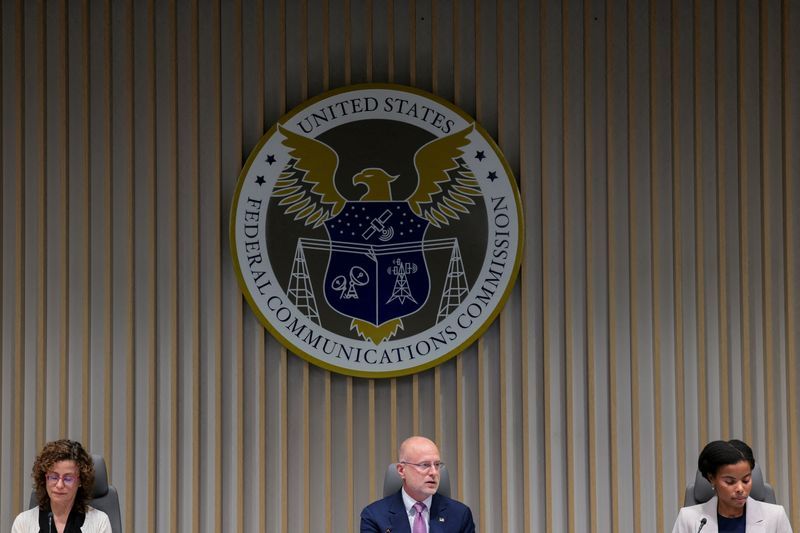
The US Federal Communications Commission has taken a major step to restrict Chinese technology from entering American markets, voting this week to bar the sale of any devices containing key hardware components from companies on its national security blacklist. The decision represents a significant tightening of existing rules and signals an escalation in the Trump administration's comprehensive effort to sever American reliance on Chinese tech manufacturers, a policy direction that carries substantial implications for global supply chains and technology companies operating across Asia.
The FCC maintains a roster of Chinese firms—most notably Huawei and ZTE, both major telecommunications equipment producers—whose full products have faced import bans for years. However, a critical gap in the regulatory framework had allowed manufacturers to circumvent these restrictions by importing devices that incorporated component parts from blacklisted companies, even when the finished products themselves came from other manufacturers. FCC Chair Brendan Carr described the new enforcement action as a measure to "fully close the component part loophole," acknowledging that the previous system contained exploitable weaknesses.
The regulatory change targets what regulators view as a fundamental vulnerability in device security. Under the prior rules dating back to 2022, companies on the blacklist like Huawei were prevented from securing new authorizations for finished products entering the US market. Yet devices that embedded logic-bearing hardware components—the essential computational parts that process and manage data—manufactured by Huawei could still receive approval for US market entry if they were incorporated into products assembled by other firms. The revised regulations eliminate this distinction entirely, now prohibiting any device containing hardware components made by blacklisted Chinese manufacturers from reaching US consumers.
The theoretical risks underlying this policy shift reflect genuine concerns about supply chain security that extend beyond mere protectionism. According to Chris McGuire, a former White House National Security Council official serving under the Biden administration, compromised semiconductors or communications components embedded within larger devices can potentially be weaponised to corrupt or compromise the entire system. This concern has driven policy circles in Washington to view component-level restrictions as necessary to protect critical infrastructure and consumer privacy, though independent security experts remain divided on the practical likelihood and severity of such supply chain attacks.
This enforcement action forms one element of a much broader technological decoupling strategy that the Trump administration has pursued since taking office. Beyond component-level restrictions on finished devices, the FCC has implemented multiple overlapping prohibitions targeting Chinese technology imports across different sectors. Just last month, the agency banned imports of additional equipment from a defined group of Chinese manufacturers, effective from mid-July, demonstrating the rapid pace of regulatory changes. Simultaneously, the FCC proposed restrictions on military-grade drone imports, reflecting national security concerns that extend beyond the telecommunications sector that has traditionally been the agency's focus.
The accumulating restrictions reveal a strategic approach to technology security that operates across multiple levels simultaneously. In recent months, the FCC has prohibited imports of new foreign drone models and wireless router designs, categories that sit outside traditional telecommunications but represent potential entry points for surveillance or data interception capabilities. The agency has also proposed regulations that would prevent US telecommunications carriers from establishing interconnections with Chinese telecom firms designated as security risks, effectively creating digital walls that would prevent data exchange between American and Chinese telecom networks.
Looking forward, the FCC is contemplating an even more aggressive posture toward Chinese telecom operations within US territory. The agency is considering prohibitions that would prevent Chinese telecommunications companies from operating data centers or "Points of Presence"—the technical infrastructure that sits at internet exchange points where data traffic is routed and monitored—within American jurisdiction. Such restrictions would effectively force Chinese telecoms to cease operating or significantly curtail their US-based infrastructure operations, a measure that goes beyond banning products to targeting the operational presence of Chinese companies themselves.
For technology companies and supply chain managers operating across Southeast Asia and the Asia-Pacific region, these cascading US restrictions create substantial disruption and planning challenges. Many regional manufacturers depend on Chinese components for their products or maintain business relationships with companies on American blacklists. The expanding scope of US restrictions means that manufacturers must increasingly verify not just their direct suppliers but also sub-component suppliers several layers down the production chain, a task that requires sophisticated supply chain mapping and compliance expertise. Companies exporting to the US market now face regulatory burdens that did not exist twelve months ago.
The absence of immediate comment from Huawei on the FCC's decision underscores the company's constrained position in the American market, where it has already faced near-total exclusion for years. However, the new restrictions extend beyond Huawei specifically, applying to any blacklisted Chinese firm and potentially creating a framework that could be expanded to additional companies at the FCC's discretion. This regulatory flexibility suggests that future administrations could apply the same component-level restrictions to additional Chinese technology companies, establishing a precedent that may reshape global technology trade patterns for years to come.

