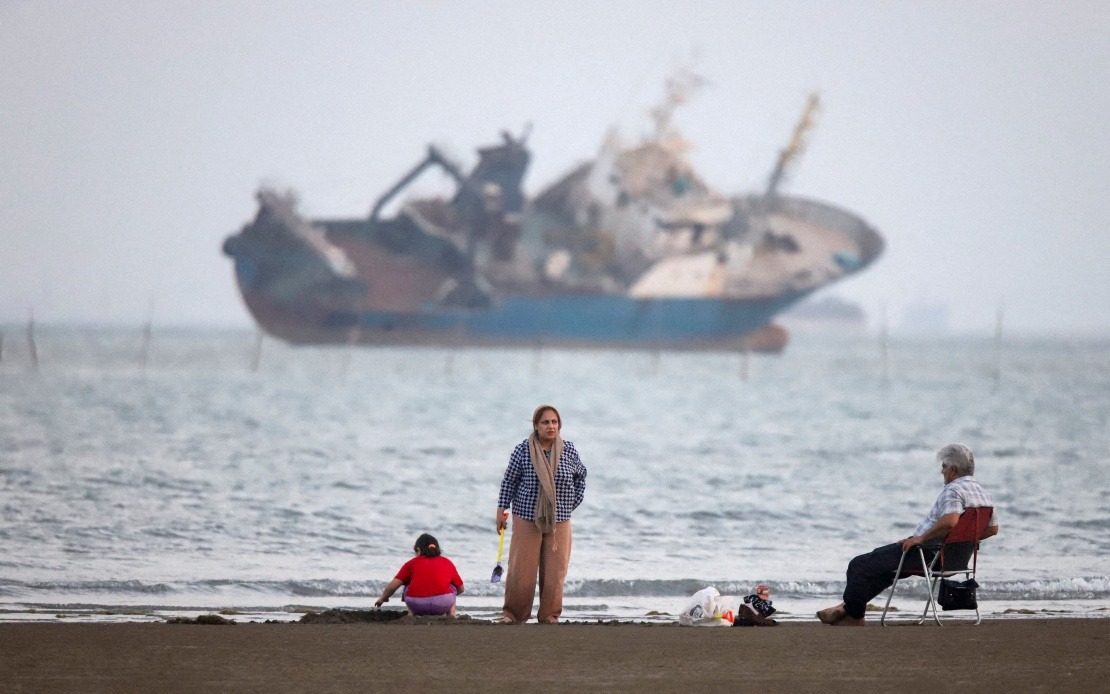
The United States has escalated economic pressure on Iran by imposing new sanctions targeting a network of financial operatives and unlicensed money exchange companies, responding to maritime incidents that have reignited tensions in one of the world's most critical shipping corridors. The Treasury Department's Office of Foreign Assets Control announced the designations on Friday, marking the latest round of financial restrictions as hostilities resurface in the Strait of Hormuz, a waterway through which roughly one-fifth of global oil trade passes annually.
At the centre of the American action is Ali Ansari, an individual the US government characterizes as closely affiliated with Iran's Supreme Leader Mojtaba Khamenei and the powerful Islamic Revolutionary Guard Corps. By targeting Ansari alongside his financial network, Washington aims to disrupt money flows that officials argue support activities contrary to American interests in the region. The designation effectively freezes any assets Ansari holds within US jurisdiction and prohibits American citizens and entities from conducting transactions with him.
The sanctions package extends beyond individual operatives to strike at the informal financial infrastructure facilitating capital movement within Iran. Three so-called shadow exchange houses—the Mohammad Darbani and Partners Exchange, the Mohsen Khandan and Partners Exchange, and the Lavasani and Partners Exchange—have been added to the Specially Designated Nationals List. These entities operate as general partnerships based in Tehran and Shiraz, serving as alternative channels for money transfer outside the formal banking system. Such informal networks have long enabled Iran to circumvent international financial restrictions and maintain economic activity despite comprehensive sanctions regimes.
The financial web extends internationally through Smart Global Limited, a holding company registered in Saint Kitts and Nevis in the Caribbean. American officials view this entity as part of Ansari's broader network, illustrating how Iran-linked financial operations maintain a global footprint through shell companies and overseas registrations. The use of Caribbean jurisdictions for financial vehicles has become a common pattern in sanctions evasion schemes, allowing operators to obscure ownership structures and complicate enforcement efforts.
For Malaysian observers, these developments carry particular significance given the region's maritime dependencies. The Strait of Hormuz incident that triggered these sanctions threatens not only immediate shipping safety but also global energy prices, with implications for Malaysia's oil and gas sector and broader economic stability. Any escalation affecting transit through this chokepoint could influence maritime insurance premiums and shipping routes affecting Southeast Asian trade.
Iran's Foreign Minister Seyed Abbas Araghchi has rejected American characterizations of Iranian actions, publicly responding through social media with accusations that Washington is violating terms of a previous agreement. Araghchi specifically referenced paragraph nine of what he described as a memorandum of understanding, claiming the United States has breached commitments while Iran has maintained compliance. His statement suggests ongoing diplomatic friction over the interpretation and implementation of previous accords.
The Iranian government's defence hinges on a broader argument about reciprocal obligations and American trustworthiness. Araghchi asserted that mutual compliance forms the foundation for any resolution, implying Tehran views current American sanctions as unilateral escalation rather than legitimate enforcement. This rhetorical positioning reflects Iran's consistent contention that US policy shifts have repeatedly undermined agreements, making future negotiations inherently uncertain from the Iranian perspective.
The clash between Washington's coercive financial measures and Tehran's diplomatic protests illustrates the entrenched nature of US-Iran tensions. Rather than resolving underlying disputes, successive rounds of sanctions have become ritualistic expressions of conflict, with each side framing its actions as responses to prior provocations. The maritime incidents in the Strait serve as immediate catalysts, yet they emerge from deeper strategic competition over regional influence and the nuclear question.
For Southeast Asia more broadly, these tit-for-tat measures underscores regional vulnerability to great power confrontations. Malaysia and its neighbours depend on stable international waters for trade and energy security. Friction in the Persian Gulf reverberates through shipping lanes linking the Middle East to Asia, affecting insurance costs, routing decisions, and overall maritime commerce. Malaysian policymakers must navigate a landscape where major power rivalries impose externalities on regional prosperity.
The targeting of financial intermediaries and shadow exchange networks reflects Washington's strategy of attacking Iran's economic sinews rather than military capabilities. By restricting access to international financial systems and designating individuals facilitating capital movement, the US aims to constrain Tehran's ability to fund regional activities without direct military confrontation. However, such measures have historically prompted targeted economies to develop alternative financial mechanisms and deepen relationships with non-compliant partners.
The submarine nature of these financial networks complicates enforcement. Exchange houses operating informally within Iran adjust their methods constantly to evade detection. International cooperation through financial intelligence sharing and sanctions coordination proves essential, yet varies significantly among different countries. Malaysia, as part of the international system yet positioned in a region with diverse geopolitical alignments, must balance its own strategic interests with international financial system participation.
Looking forward, the trajectory suggests continued regulatory escalation unless diplomatic channels achieve breakthroughs. The Strait of Hormuz incidents signal willingness by Iranian forces to test American resolve and regional vulnerability. Whether additional sanctions prove effective in changing Iranian behaviour or merely entrench existing positions remains uncertain. Meanwhile, the risks to maritime commerce and regional stability persist, with implications extending well beyond Tehran and Washington into the vital sea lanes upon which Southeast Asian prosperity depends.

