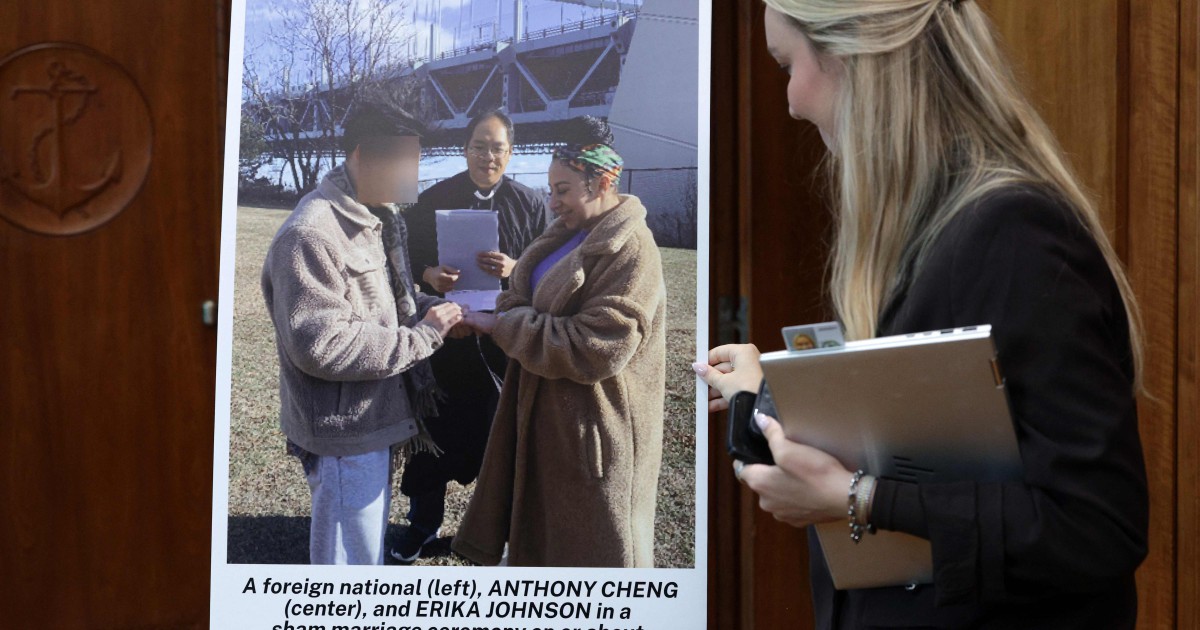
The United States Justice Department announced charges against 11 individuals on Wednesday for orchestrating what prosecutors describe as a decade-spanning marriage fraud enterprise. The scheme, detailed in court filings released this week, facilitated roughly 1,000 fraudulent marriage contracts designed primarily to enable Chinese nationals and other foreign citizens to obtain lawful immigration status in America. The operation, which operated largely undetected across multiple years, represents one of the more expansive marriage fraud rings uncovered by federal authorities in recent times.
Marriage fraud—where individuals enter matrimonial contracts purely for immigration benefits rather than genuine spousal relationships—constitutes a serious federal crime in the United States. Convicted offenders face substantial prison sentences and permanent criminal records. The scheme's scope, involving approximately one thousand separate fraudulent unions, suggests a highly organised operation with systematic recruitment, vetting, and processing procedures designed to evade immigration scrutiny and maintain the appearance of legitimate spousal arrangements.
Those charged in the case include both organisers who coordinated the marriage brokerage activities and individuals who posed as American citizens or permanent residents willing to marry foreign nationals. Court documents indicate the conspirators charged substantial fees from foreign nationals seeking to establish US legal residence, extracting payments that reportedly reached thousands of dollars per fraudulent marriage contract. The financial incentive structure underpinning the operation made it economically attractive for both the organisers managing the scheme and the intermediaries facilitating individual matches.
The indictment arrives within the broader political context of heightened enforcement scrutiny targeting immigration pathways perceived as vulnerable to abuse. The timing coincides with renewed federal focus on what immigration officials characterise as attempts to circumvent established legal channels, including recent enforcement actions against what the Trump administration termed "birth tourism"—the practice of foreigners entering the United States temporarily to give birth and secure citizenship for their children. Though distinct from marriage fraud, both represent categories of immigration law that federal authorities have identified as requiring intensified examination.
For Malaysian and Southeast Asian observers, the prosecution underscores increasing American determination to enforce stricter immigration controls and eliminate what officials view as systematic exploitation of available legal pathways. The marriage fraud scheme's heavy involvement of Chinese nationals reflects broader demographic patterns in US immigration, where citizens from Asia constitute a significant portion of those seeking permanent American residence. The operation's decade-long duration before dismantling reveals gaps in monitoring systems that enforcement agencies have now moved to address.
The mechanics of such schemes typically involve coordinating networks spanning multiple states, creating false documentation, and coaching participants to fabricate convincing evidence of genuine spousal relationships. Immigration officials must verify that couples possess authentic personal connections, have cohabitated, and share financial obligations—requirements that sophisticated fraud rings learned to circumvent through coordinated deception. The scale of this particular operation suggests the conspirators developed considerable expertise in manufacturing credible documentation and coaching foreign nationals to successfully navigate interviews with immigration officials.
Convictions in marriage fraud cases carry substantial consequences beyond imprisonment. Federal courts typically impose restitution requirements on defendants, order deportation of foreign nationals in cases involving visa fraud, and issue permanent bars from future immigration petitions. Immigration records indicate that marriage fraud convictions frequently result in deportation of the foreign spouse, negating the entire benefit sought through the fraudulent arrangement. Such consequences create powerful incentives for would-be participants to cooperate with authorities and testify against organisers.
The investigation and prosecution require extensive coordination between federal immigration authorities, the Department of Justice, and intelligence agencies tracking movement patterns and document fraud. Investigators examined marriage certificate records, bank transactions, communication records, and immigration interviews to establish that participants lacked genuine spousal intent. The complexity of unravelling such schemes explains why significant time typically elapses between scheme initiation and prosecution—in this case, authorities required ten years of operation before assembling sufficient evidence for comprehensive charges.
This prosecution carries implications for immigration policy throughout the region. Malaysia and other Southeast Asian nations should consider whether similar schemes operate within their jurisdictions, possibly targeting their citizens seeking residence in third countries. The case demonstrates how organised fraud networks exploit legitimate immigration categories, creating risks that authorities might respond by tightening regulations affecting genuine applicants. Couples with authentic international relationships may face heightened scrutiny from immigration officials increasingly trained to identify deceptive patterns.
The case also highlights persistent demand for immigration pathways among citizens of countries experiencing economic constraints or political concerns. That thousands of individuals agreed to participate in fraudulent marriages—despite substantial legal risks—underscores the powerful motivations driving migration to the United States. Addressing the root causes of such demand ultimately requires international cooperation on economic development, rule of law strengthening, and legitimate immigration channels, rather than enforcement alone.
Federal authorities indicated that investigations into marriage fraud networks continue, suggesting additional prosecutions may be forthcoming. Immigration officials have reportedly intensified training for personnel conducting marriage-based visa interviews, focusing on recognising fraudulent indicators and questioning techniques designed to detect fabricated relationships. The comprehensive nature of this enforcement action signals that American authorities intend marriage fraud suppression to remain a sustained priority area within broader immigration enforcement strategy.

