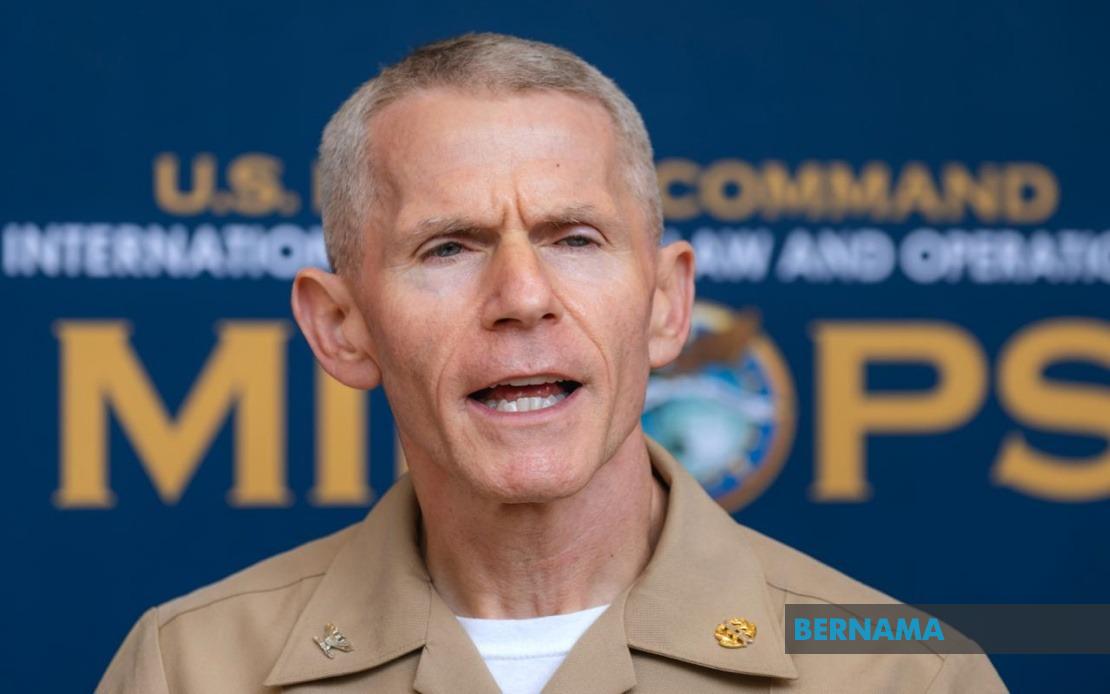
The United States Pacific Command has underscored its determination to sustain operational engagement across the South China Sea as a cornerstone of broader Indo-Pacific stability efforts, pledging continued support for allied nations and regional partners through integrated security cooperation. Navy Captain Dustin Wallace, serving as USPACOM's Staff Judge Advocate, made the pronouncement during a high-level conference in Kuala Lumpur, signalling Washington's strategic resolve to maintain its military posture in waters that remain among the world's most contested and economically vital.
Wallace emphasized that preserving security and stability within the South China Sea domain constitutes an essential operational priority for the command's wider mission across the Indo-Pacific region. He articulated a clear enforcement mandate centred on deterring aggressive actions and countering activities that could undermine established regional equilibrium, framing USPACOM's role as fundamentally defensive rather than provocative. This positioning reflects longstanding American doctrine that emphasizes reassurance of allies while presenting credible resistance to coercive behaviour.
Central to the American strategic framework are commitments to upholding international law, safeguarding freedom of navigation, and protecting freedom of commerce—principles that Washington argues form the bedrock of regional prosperity. Wallace stressed that these cornerstones receive enthusiastic endorsement from multiple regional governments, creating a shared foundation upon which cooperative security architectures rest. For Malaysian observers particularly, this emphasis on established legal frameworks carries significance given Malaysia's own economic dependence on unimpeded maritime commerce and its sovereignty interests in territorial waters.
Regarding the Association of Southeast Asian Nations, Wallace articulated a view of ASEAN as fundamentally indispensable to regional peace architecture and security governance. The command's stated support for ASEAN centrality—the principle that the ten-member bloc should remain the driving force in regional affairs—reflects American recognition that unilateral approaches hold limited legitimacy in the contemporary Southeast Asian context. Wallace acknowledged the intricate geopolitical reality that ASEAN members harbour divergent priorities and strategic orientations, necessitating differentiated engagement approaches rather than one-size-fits-all diplomatic formulae.
This nuanced position carries implications for Southeast Asian nations pursuing independent foreign policies. By pledging to work with individual countries according to their respective sovereign interests, USPACOM signals flexibility and respect for strategic autonomy—a messaging strategy designed to counter perceptions that American engagement represents hegemonic pressure. For countries like Malaysia, Vietnam, and the Philippines, which maintain complex relationships with both Washington and Beijing, this declaratory stance may provide diplomatic space for pursuing balanced regional positioning.
Wallace indicated USPACOM's broader strategic agenda encompasses strengthening existing military and security partnerships whilst cultivating nascent relationships across the region. This expansion of the security architecture reflects Washington's commitment to broadening its coalition of partners committed to rules-based regional order. The command seeks to position itself as a stabilizing force advancing prosperity across the Indo-Pacific through security cooperation, a framing that appeals to nations seeking predictability in an increasingly multipolar environment.
The pronouncements came during the 37th International Military Law and Operations Conference, held jointly by USPACOM, Malaysia's Defence Ministry, and the Malaysian Armed Forces. This particular gathering, designated MILOPS 26, convened over three hundred military officials, legal specialists, defence policymakers, and academic experts drawn from more than thirty countries alongside international organization representatives. The conference's inclusive composition underscores the multilateral dimension of contemporary security cooperation in the Indo-Pacific.
Thematically, the conference addressed the expansive scope of modern security challenges, encapsulated in its subtitle: "From the Seabed to Space: Advancing Security, Freedom, and Prosperity for All Across the Indo-Pacific." This formulation acknowledges that contemporary security extends across multiple domains—maritime, terrestrial, aerial, space-based, and cyber—requiring integrated policy responses and legal frameworks. For Malaysia and other regional states grappling with diverse security threats ranging from maritime piracy to space-based surveillance capabilities, this holistic security approach carries immediate practical relevance.
The annual forum functions as a critical venue for advancing dialogue among military and civilian security specialists regarding complex legal, operational, and policy dimensions of regional security. Participants deliberated on mechanisms for reinforcing the rule of law and ensuring respect for sovereign equality across diverse national contexts. These discussions prove particularly salient given ongoing territorial disputes in the South China Sea and the persistent challenge of establishing shared legal interpretations governing maritime conduct and boundary demarcation.
For Malaysia specifically, USPACOM's emphasis on ASEAN centrality and respect for individual member states' sovereignty interests offers some reassurance regarding American intentions. As a nation with its own maritime claims in the South China Sea and a declared policy of maintaining equidistant relations with major powers, Malaysia benefits from a security architecture that respects its autonomous decision-making capacity. The stated American commitment to working with each nation according to its interests, rather than imposing uniform strategic frameworks, aligns with Malaysian preferences for non-aligned positioning and pragmatic great power management.
The broader implication of USPACOM's commitment centres on the durability of American security engagement in the region despite shifting global priorities. Washington's sustained military presence, coupled with regular high-level declarations of commitment, signals that Southeast Asian nations can rely on continued American presence as a counterbalance to alternative regional power distributions. This reassurance function becomes increasingly important as nations navigate complex decisions regarding military modernization, alliance relationships, and participation in regional security initiatives.
Looking forward, the effectiveness of USPACOM's approach depends substantially on its capacity to translate rhetorical commitment into tangible operational engagement that accommodates diverse regional preferences. The command's stated flexibility regarding partnerships and its emphasis on ASEAN centrality suggest an American security strategy predicated on coalition-building rather than unilateral dominance. For regional players, this positioning offers opportunities to leverage American security interests for their own strategic objectives whilst maintaining policy autonomy in an increasingly multipolar security environment.

