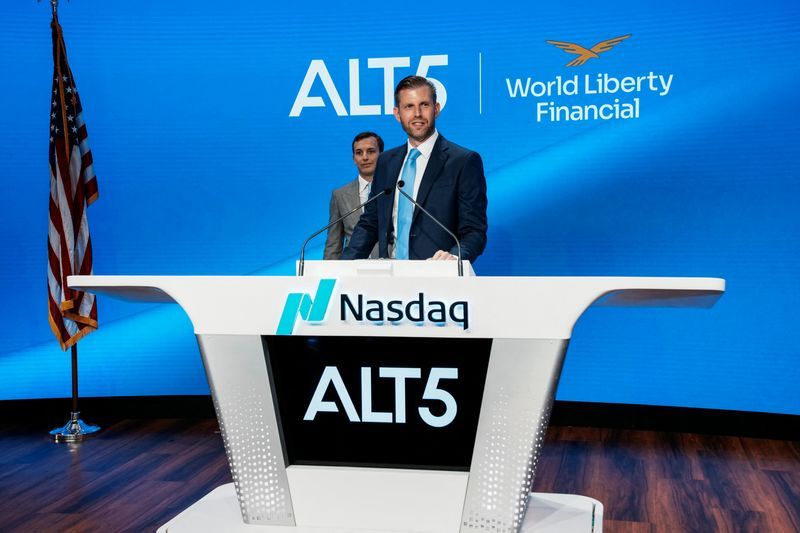
The Office of the Comptroller of the Currency has conditionally approved a national trust bank charter application linked to President Donald Trump and his family's cryptocurrency enterprise, World Liberty Financial, marking a significant milestone in the company's bid to expand its digital finance operations. The regulator announced its decision through a letter published on its website, granting preliminary approval to World Liberty Trust Company, which had submitted its application in January. This development underscores how the current US administration's favourable regulatory stance toward the crypto industry is translating into tangible approvals for Trump-affiliated ventures.
Once fully approved, the charter would equip World Liberty with capabilities that extend beyond typical cryptocurrency operations. The trust bank structure would enable the company to manage and hold customer assets, facilitate faster payment settlements, and provide custodial services across the United States under a single federal charter. Importantly, the charter does not grant traditional banking powers such as deposit-taking or lending, but it substantially enhances the company's operational framework. This distinction matters because it allows crypto firms to function with greater legitimacy and institutional credibility while avoiding the stricter regulatory requirements imposed on conventional banks.
World Liberty's primary objective in securing this charter is to directly control the issuance and custody of its USD1 stablecoin, which is currently managed through a partnership with BitGo. A stablecoin is a cryptocurrency designed to maintain a stable value by being backed by reserves of actual US dollars. By bringing these functions in-house under federal supervision, World Liberty positions itself to offer institutional-grade asset management services. The company's leadership framed the approval as validation of its approach, with Zach Witkoff, the trust company's president and chairman, emphasizing that federal oversight would apply standards comparable to those governing traditional banking institutions.
The regulatory approval reflects broader industry momentum within the Trump administration's crypto-friendly environment. Comptroller Jonathan Gould, appointed to his position by the president last year, has been relatively receptive to charter applications from cryptocurrency firms. Competitors including Ripple and Circle have similarly received preliminary approval for comparable trust bank charters, suggesting a pattern rather than an isolated decision. This shift represents a departure from previous regulatory caution toward crypto enterprises and signals a recalibration of federal policy under the current administration.
The conditional approval carries specific requirements that World Liberty must satisfy to achieve full charter status. The company must maintain a minimum capital reserve of at least $20 million, notify regulators of significant changes to its business strategy, and employ a qualified internal audit manager. Additionally, the Office of the Comptroller of the Currency specifically addressed concerns regarding foreign investors by obtaining "passivity agreements" from non-US shareholders, including members of the Trump family. These commitments ensure that foreign stakeholders would not seek to influence or control the bank's operations, addressing national security considerations that had been raised by Democratic lawmakers.
The security concerns surrounding World Liberty's financing arrangements warrant closer examination. In February, two Democratic members of the US Senate Banking Committee requested that the Treasury secretary investigate potential national security implications stemming from a reported $500 million investment stake purchase linked to the United Arab Emirates' national security adviser. This request reflects broader anxieties about the convergence of cryptocurrency ventures, international capital flows, and presidential family interests. The OCC's approach of requiring passivity agreements appears designed to address such concerns while permitting the charter to proceed.
World Liberty Financial's organizational structure reveals deep interconnections between the Trump family and the Witkoff family, one of the president's longstanding allies. Zach Witkoff, who serves as both the trust company's president and World Liberty's chief executive, is the son of Steve Witkoff, the president's special diplomatic envoy. The Witkoffs and Trumps jointly founded World Liberty Financial in late 2024, creating a business entity that blends political proximity with cryptocurrency operations. Robert Witkoff, Steve's brother and a former insurance executive, will serve as a director of the trust bank, while Scott Alper, who heads the Witkoff family's real estate operations, is proposed as another director, further solidifying the family-oriented governance structure.
The political controversy surrounding this approval extends to questions about regulatory impartiality and conflict of interest. Democrats have characterised the charter process as problematic given the direct family connections to the sitting president. During a February congressional hearing, they pressed Comptroller Gould to disclose the company's unredacted application materials, noting that the public version lacked comprehensive details about capital structures and business strategy. The OCC responded by asserting that its staff and leadership had adhered to their statutory duties and ethical obligations, and that career examiners rather than political appointees would conduct ongoing supervision. However, critics note that the Office of the Comptroller of the Currency, unlike many other financial regulators, lacks a bipartisan board structure, potentially concentrating decision-making authority.
World Liberty Financial has emerged as the most high-profile element of the Trump family's cryptocurrency business portfolio, which has proven financially lucrative beyond traditional political income sources. The company's flagship USD1 stablecoin has achieved remarkable growth since its March 2025 launch, becoming the fourth-largest stablecoin by market capitalisation with approximately $4 billion in circulation. Reuters investigations have calculated that the Trump family accumulated roughly $50 million in earnings from the USD1 stablecoin through June 2026. More comprehensively, World Liberty Financial has channelled over $1.6 billion to the president and his family as of April, representing substantial wealth generation through cryptocurrency ventures.
The company's broader vision positions itself as a financial democratisation platform, framing traditional banking institutions as restrictive and inequitable barriers that blockchain technology can circumvent. This narrative resonates within cryptocurrency circles but also presents governance challenges that Malaysian and Southeast Asian regulators may observe carefully. As digital finance innovation accelerates across the region, the question of how regulatory frameworks balance innovation incentives against prudential oversight and conflict-of-interest safeguards becomes increasingly relevant. The World Liberty Financial case demonstrates how closely cryptocurrency regulation can become entangled with political relationships and how different regulatory philosophies produce markedly different approval outcomes.
For Malaysian financial observers, this development signals important considerations about cryptocurrency regulation in a globalised context. While Malaysia has been developing its own digital asset regulatory framework through Bank Negara Malaysia and the Securities Commission, the American experience demonstrates how closely tied crypto sector growth becomes to regulatory philosophy and political context. The rapid institutional adoption of stablecoins—particularly one backed by US dollars—creates cross-border implications for currency systems and payment flows. As World Liberty Financial expands its operations, understanding its governance structure, regulatory constraints, and the precedent it sets for future cryptocurrency charter applications provides valuable perspective on how major economies are reshaping their approach to digital finance.

