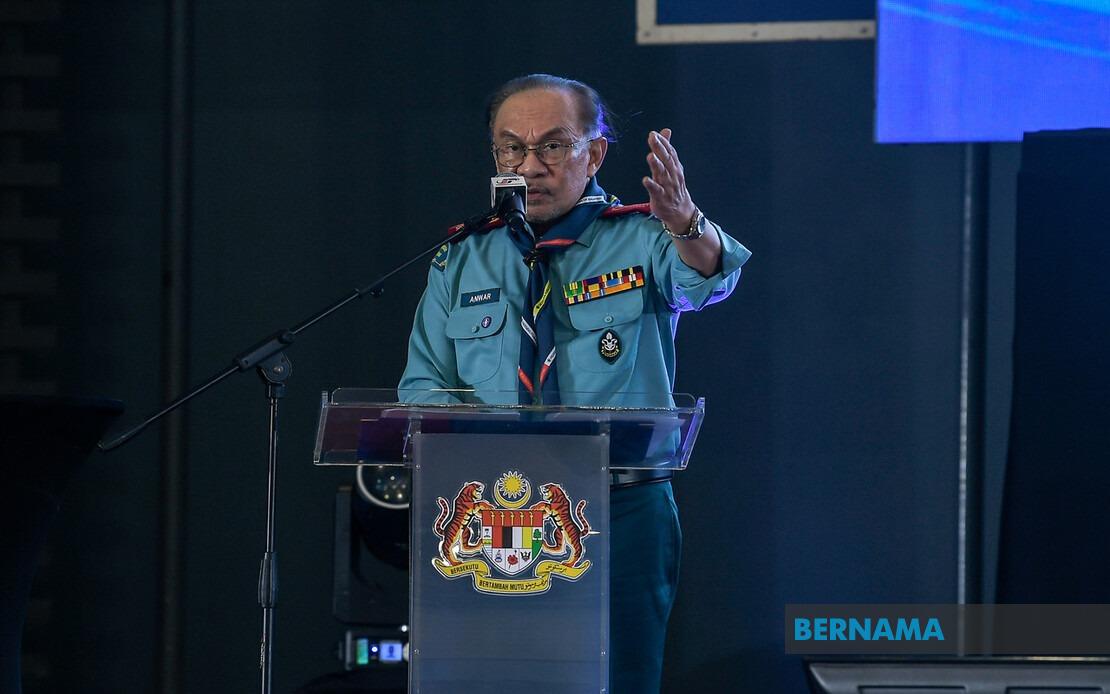
Prime Minister Datuk Seri Anwar Ibrahim has sought to allay concerns about language policy by drawing a distinction between elevating Malay's role as the national language and diminishing Malaysia's commitment to multilingualism. Speaking at the Ambang Merdeka Sahabat MADANI 2026 programme at Universiti Teknologi MARA (UiTM) Permatang Pauh on August 29, Anwar articulated a vision in which citizens develop strong command of the national tongue whilst simultaneously building capabilities across multiple languages that serve economic and educational advancement.
The Prime Minister's remarks come as Malaysia navigates persistent tensions over language education policy. Recent years have witnessed debate about the balance between reinforcing Malay language competency among schoolchildren and maintaining English proficiency levels that enable global economic participation. Anwar's framing suggests the government intends to position these objectives as complementary rather than competing, a nuance that carries significance for policymakers, educators, and parents assessing curriculum priorities.
Central to Anwar's argument is the contention that strengthening any single language need not occur at the expense of others. He emphasised that English, having established itself as a dominant medium of international commerce and communication, deserves continued prominence in Malaysia's educational framework. Rather than viewing English competency as a replacement for Malay, Anwar characterised the relationship as one of mutual reinforcement—English enhancing rather than substituting the national language's foundational role.
The Prime Minister additionally highlighted the rising economic significance of Mandarin Chinese across Southeast Asia and the wider region. As trade patterns increasingly centre on China-related commerce and as Chinese firms expand their regional footprint, proficiency in Mandarin has become a practical asset for Malaysian professionals and entrepreneurs. Anwar framed language acquisition in economic terms, suggesting that children mastering Mandarin—provided their Malay foundation remains robust—gain competitive advantage rather than experience cultural dilution.
Tamil, the language of Malaysia's Indian community, featured in Anwar's remarks as another example of linguistic diversity deserving cultivation. His acknowledgement that Malaysians wish to strengthen Tamil proficiency reflects sensitivity to minority language concerns and suggests governmental openness toward heritage language preservation within the broader multilingual framework. This positioning may resonate particularly among Indian Malaysian constituencies concerned about the diminishing intergenerational transmission of Tamil.
The Prime Minister employed explicit language to reject the notion of linguistic competition, describing the matter as "not a zero-sum game." This formulation directly counters framing that treats language development as a finite resource where gains in one language necessitate losses in another. By rejecting zero-sum logic, Anwar implies that Malaysia possesses sufficient educational capacity and societal commitment to nurture multiple linguistic competencies simultaneously, a proposition with considerable policy implications for curriculum design and resource allocation.
Beyond technical language considerations, Anwar's remarks carried a broader social message regarding national cohesion. He explicitly cautioned against efforts to foment racial tensions through language grievances, linking linguistic policy to Malaysia's fragile intercommunal equilibrium. His warning that national harmony cannot be assumed permanent without sustained maintenance effort reflects acknowledgment that language disputes carry potential to destabilise the broader social contract. This connection suggests the government views coherent language policy as integral to managing ethnic and religious sensitivities.
The Prime Minister further appealed for cultivation of shared values encompassing mutual support, generosity, and collective benefit-sharing across racial and religious lines. By anchoring language discussions within a wider framework of communal obligation, Anwar attempted to reframe the language debate from a competitive assertion of communal interests toward a narrative emphasising inclusive national development. This approach seeks to position multilingualism as contributing to rather than threatening national unity.
Anwar's statements warrant interpretation within Malaysia's specific historical and political context. Recurring tensions between vernacular education advocates and Malay-medium education proponents have occasionally erupted into public controversy. The Prime Minister's careful calibration—simultaneously affirming Malay's constitutional and symbolic primacy whilst defending multilingual aspiration—represents an attempt to navigate competing constituencies without substantial policy concession. Whether such rhetorical balance translates into concrete educational initiatives remains uncertain.
For Malaysian stakeholders—particularly parents, educators, and minority language advocates—the Prime Minister's remarks offer reassurance that language policy need not become a zero-sum struggle. However, implementation details regarding curriculum hours, teacher training, assessment priorities, and resource distribution will ultimately determine whether the government's multilingual rhetoric reflects substantive commitment. The distinction between affirming multiple languages as desirable and allocating institutional resources to support them meaningfully represents the critical gap between vision and execution.
The implications extend beyond Malaysia's borders. Southeast Asian nations similarly grapple with balancing national language requirements against linguistic globalisation pressures and minority language preservation. Anwar's framing—treating multilingualism as economically rational and culturally compatible—may influence regional approaches to language policy, suggesting that national identity and cosmopolitan capability need not conflict but rather reinforce one another when properly conceived.

