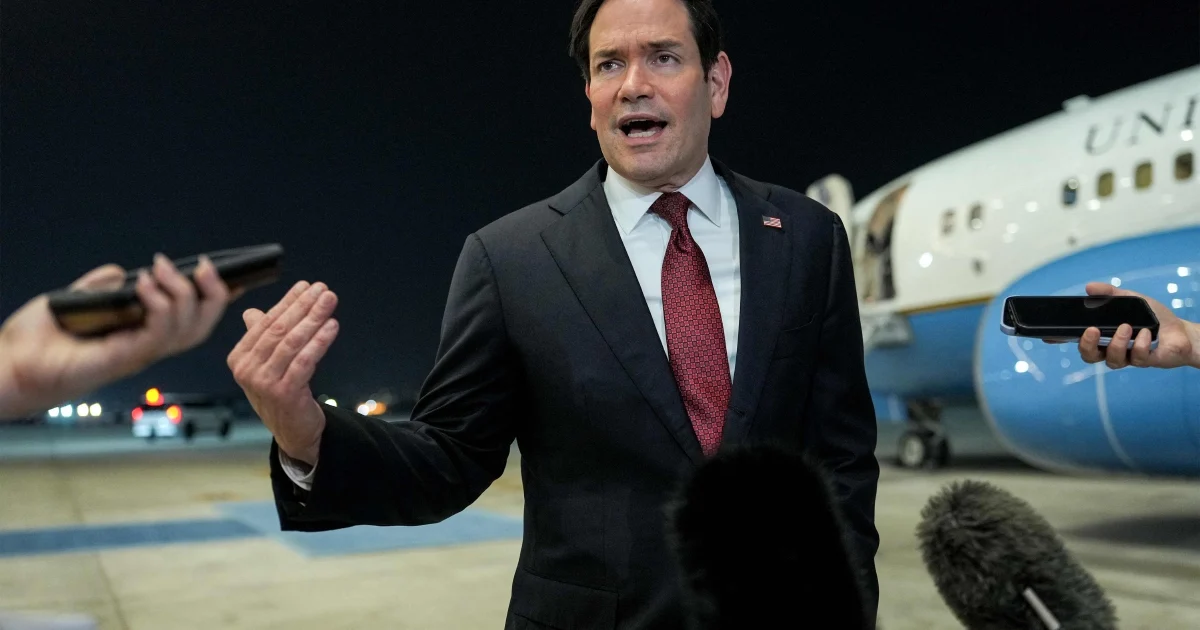
The United States has drawn a firm line in escalating Middle East peace negotiations, with Secretary of State Marco Rubio explicitly refusing to entertain Iranian demands for toll revenues or fees on the Strait of Hormuz. His statement on Tuesday underscores the widening gulf between Washington and Tehran as diplomatic efforts to resolve the region's conflicts face mounting pressure from competing strategic interests and long-standing mistrust.
The Strait of Hormuz remains one of the world's most strategically vital shipping corridors, with roughly one-fifth of global oil passing through its narrow passage annually. Any Iranian attempt to impose tolls would represent a significant assertion of control over international commerce and would directly threaten energy security for nations across Asia, Europe, and beyond. For Malaysia and other energy-dependent Southeast Asian economies, such actions would carry profound implications for fuel prices and supply stability, making the dispute particularly relevant to the region's economic interests.
Rubio's rejection signals that fundamental disagreements extend far beyond the symbolic issue of maritime fees. The disputes encompassing nuclear inspections represent perhaps the most technically complex element of negotiations. International concerns about Iran's nuclear programme have persisted for years, with the International Atomic Energy Agency requiring unfettered access to facilities and comprehensive transparency regarding past military dimensions of the programme. Washington's insistence on robust verification mechanisms reflects broader Western anxieties about Iran's nuclear ambitions, while Tehran has historically resisted what it characterises as intrusive inspections that compromise national sovereignty.
Missile capabilities constitute another major sticking point threatening to derail progress. Iran's ballistic and cruise missile programmes have expanded dramatically over recent years, prompting concern from multiple regional and international actors. The United States seeks binding restrictions on Iran's missile development, particularly regarding range and payload capacity, while Iranian negotiators have framed such limitations as unacceptable constraints on their defensive capabilities. This disagreement encapsulates the broader security dilemma: each side views the other's military development through fundamentally incompatible lenses.
The broader context of Middle East instability compounds these technical disputes. Ongoing conflicts in Yemen, Syria, and Iraq have created humanitarian catastrophes and fractured regional alignments. Any comprehensive settlement would necessarily address Iran's role in these conflicts, its support for non-state actors, and the future trajectory of proxy warfare. Washington and its regional allies demand meaningful commitments to cease support for militant organisations, while Tehran argues that such demands violate its sovereignty and strategic prerogatives.
For Southeast Asian observers, these negotiations warrant close attention given the region's dependence on global stability and open shipping lanes. Malaysian businesses rely on uninterrupted maritime commerce through the Strait of Hormuz for energy imports and export trade. Disruption of this critical waterway—whether through tolls, blockades, or military confrontation—would ripple across ASEAN economies already navigating global supply chain volatility and inflationary pressures. The region has consistently advocated for peaceful resolution of Middle Eastern disputes precisely because regional prosperity hinges on international order and commerce.
Rubio's hardline stance reflects a broader American reassessment of engagement with Iran. Previous diplomatic efforts, including the Joint Comprehensive Plan of Action negotiated in 2015, collapsed amid mutual accusations of bad faith. The current administration appears determined to adopt more demanding initial positions, calculated to prevent future compromises it might later regret. However, this strategy risks creating an atmosphere of maximum pressure that leaves little room for Iranian flexibility and may harden positions on both sides.
Iran's leadership faces domestic political constraints that complicate negotiations equally. Hardline factions within Iran's government and security establishment view any accommodation with the West as capitulation to imperialism. Supreme Leader decisions on nuclear and military policy ultimately reflect complex factional dynamics within Iran's theocratic system, where multiple centres of power compete for influence. Negotiators must balance international pressure against internal political survival, creating genuine constraints on what concessions they can credibly offer.
The parallel pursuit of military deterrence and diplomatic engagement complicates prospects for breakthrough. Both sides have signalled willingness to resume negotiations while simultaneously reinforcing military capabilities and signalling readiness for conflict. This dual-track approach, though sometimes necessary for credibility, inherently generates mistrust and incentivizes worst-case planning rather than confidence-building measures.
Regional actors including Saudi Arabia, the United Arab Emirates, and Israel have keen interests in any settlement's outcome. These nations worry that inadequate restrictions on Iranian military capabilities or nuclear development could shift regional balance of power disadvantageously. Their influence on American negotiating positions adds another layer of complexity, as Washington must balance competing alliance obligations with diplomatic flexibility.
For meaningful progress to materialise, negotiators would need to compartmentalise issues and identify areas where mutual gains exist. Questions about maritime transit rights and toll policies, while symbolically charged, might be separated from nuclear and missile discussions. However, the interconnected nature of Middle Eastern security means that progress on one front often requires movement on others, making such compartmentalisation difficult in practice.
The coming weeks will reveal whether current positions represent opening gambits in extended negotiations or signals of fundamental incompatibility. Historical precedent suggests that negotiations often require extended periods of posturing before genuine movement becomes possible. Yet the human cost of continued regional conflict, combined with global economic implications of instability, creates urgency that neither side can entirely ignore.