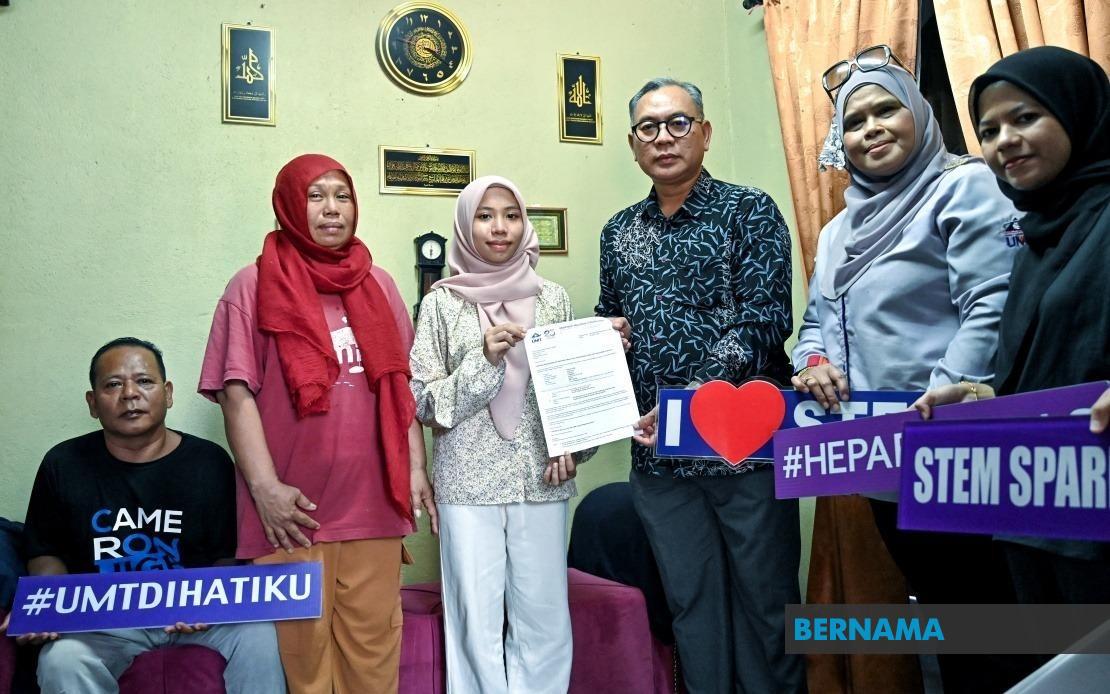
Universiti Malaysia Terengganu has demonstrated its commitment to social responsibility by intervening to secure the educational future of Nurul Amira Abdul Hamid, an 18-year-old student whose promising university offer was nearly derailed by her family's inability to meet registration and tuition costs. The intervention came at a critical juncture when the young scholar from Parit Jawa in Perak was preparing to decline her acceptance into the institution's prestigious STEM Foundation programme and subsequent Bachelor of Science degree in Nautical Science and Maritime Transportation, having lost hope of affording the necessary fees.
Nurul Amira's predicament reflects a broader challenge facing Malaysian families with limited means whose children achieve academic excellence but face barriers to realising their potential at tertiary level. After completing her Sijil Pelajaran Malaysia examinations with three A grades at Sekolah Menengah Kebangsaan Sri Kurau, the youngest of three siblings took on employment at a retail establishment earning RM1,300 monthly to contribute to household expenses. This income supplementation became necessary because her father, Abdul Hamid Othman, contends with ongoing health complications that have limited his earning capacity, whilst her mother, Asmah Che Ros, manages the household as a full-time homemaker. The financial constraints facing the family illustrated how even academically gifted students from working-class backgrounds may abandon their aspirations unless proactive institutional support emerges.
Upon receiving her university acceptance, Nurul Amira directly approached UMT to candidly discuss her circumstances and the genuine financial obstacles preventing her enrolment. Rather than treating her situation as exceptional or problematic, the university's administrative and leadership structures responded with practical solutions. The institution secured the Al-Ikhlas Scholarship worth RM500 alongside supplementary financial packages designed to diminish the burden of tuition obligations. Beyond the scholarship component, UMT has already subsidised RM400 of her directly related programme fees, substantially reducing the initial financial shock of commencing tertiary education.
The scope of institutional support extended well beyond conventional financial aid mechanisms. University officials recognised that merely providing tuition assistance would prove insufficient if students lacked resources for transport, accommodation, and day-to-day living expenses during their studies. Consequently, UMT implemented a comprehensive living assistance programme throughout Nurul Amira's entire academic trajectory, eliminating the need for her to maintain external employment that would fragment her focus and compromise academic performance. This holistic approach acknowledges that financial stress undermines educational outcomes regardless of scholarship availability.
UMT's vice-chancellor, Prof Dr Mohd Zamri Ibrahim, framed the institution's approach as an embedded institutional responsibility rather than discretionary charity. He articulated a proactive engagement model wherein university officials conduct direct outreach to students and families experiencing financial hardship, establishing relationships before crises threaten educational continuity. This stance represents a departure from reactive systems where disadvantaged students must navigate bureaucratic processes to access support. The vice-chancellor emphasised that students encountering affordability barriers should approach the university immediately, with confidence that institutional mechanisms exist to facilitate pathways forward.
The scale of UMT's commitment to disadvantaged students has expanded measurably, with the institution assisting more than ten undergraduates from underprivileged family backgrounds during the current academic year. This expanding cohort suggests that UMT has institutionalised processes for identifying and supporting students facing economic obstacles, moving beyond isolated instances of administrative goodwill toward systematic intervention. The vice-chancellor's assertion that the university bears responsibility for supporting academically capable students regardless of socioeconomic circumstance reflects a philosophical orientation that educational access should depend on merit and capability rather than family wealth.
Nurul Amira's case illuminates broader inequalities within Malaysia's tertiary education landscape. Despite the existence of public universities with relatively lower fees compared to private institutions, upfront costs for registration, accommodation, and living expenses create formidable barriers for families operating at subsistence income levels. Many talented students from similar backgrounds never articulate their difficulties to university administrators, instead silently withdrawing and entering the workforce. The gap between academic merit and educational attainment remains disproportionately influenced by parental income levels, perpetuating intergenerational economic disparities.
The maritime science and nautical science fields represent strategically significant areas of specialisation for Malaysia's economy and regional positioning. As the country maintains substantial shipping, maritime trade, and ocean resource management sectors, developing human capital within these domains carries both immediate labour market relevance and long-term national competitiveness implications. Students from disadvantaged backgrounds may hold particular motivation to succeed within maritime careers offering clear pathways to stable, well-remunerated employment, yet they face the highest barriers to obtaining necessary qualifications. UMT's investment in students like Nurul Amira therefore carries economic dimensions extending beyond individual social mobility.
The accessibility question raised by Nurul Amira's near-withdrawal from tertiary study reflects systemic gaps in how Malaysia funds public higher education. Whilst tuition fees at public universities remain comparatively modest, the transformation of universities from heavily subsidised institutions into cost-recovery models has shifted financial burdens toward students and families. Government scholarship and loan schemes address only portions of the affected student population, leaving gaps where individuals like Nurul Amira must seek institutional discretion. The sustainability and equity of this approach depends on whether universities can consistently commit resources to support students beyond their immediate operational requirements.
Professionals entering maritime science fields after overcoming genuine adversity frequently demonstrate exceptional commitment to their careers and communities. Nurul Amira's determination to pursue tertiary education despite financial obstacles suggests she possesses the resilience, motivation, and perspective that inform career satisfaction and professional contribution. Universities that deliberately invest in supporting students from disadvantaged backgrounds therefore may experience both immediate social impact and longer-term returns through the achievements and loyalty of graduates whose opportunities they protected. The educational relationship becomes reciprocal, with institutions gaining as much as individual students from deliberate inclusion efforts.
UMT's intervention with Nurul Amira demonstrates that systematic barriers to higher education access need not persist inevitably. Institutions possessing sufficient autonomy and resources can implement proactive identification systems, establish clear protocols for students experiencing financial difficulty, and dedicate financial resources toward support programmes. The vice-chancellor's public statement that students should approach the university rather than abandon aspirations signals important cultural messaging that transforms institutional image from gatekeeping entity toward inclusive facilitator. However, wider adoption of such approaches requires both financial resources and philosophical commitments that not all Malaysian universities may currently possess, suggesting that expanding equitable access remains an ongoing challenge requiring broader policy attention and resource allocation.

