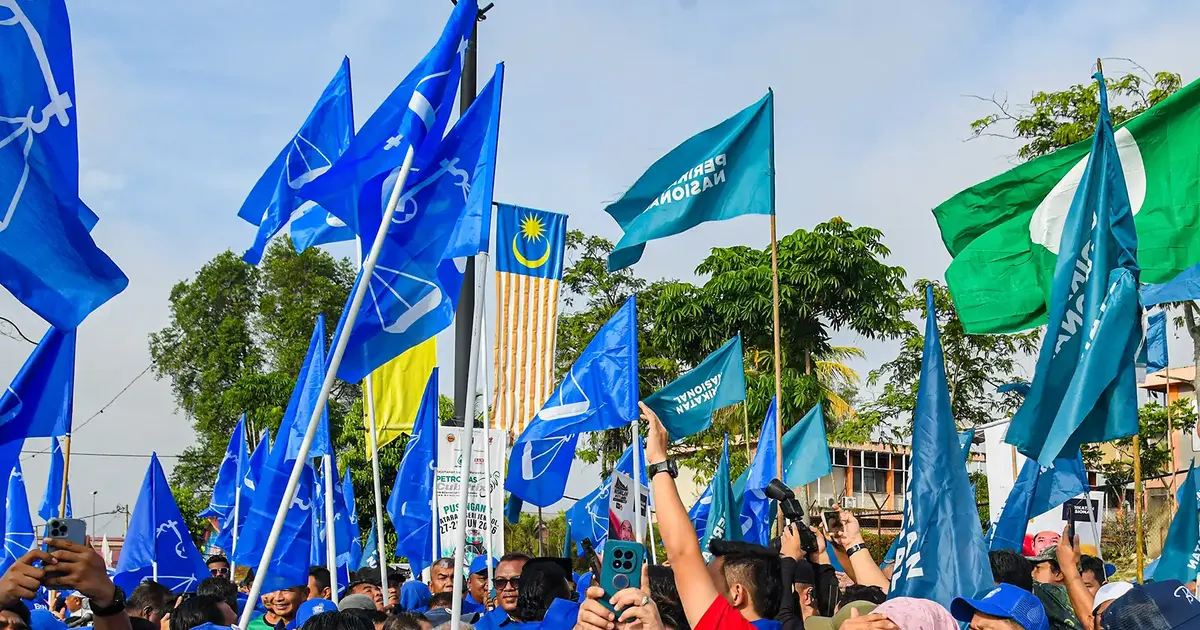
The delicate balance holding Malaysia's ruling coalition together faces mounting pressure as Umno moves to reassert its historical political supremacy across multiple states, raising fundamental questions about whether the Barisan Nasional-Perikatan Nasional alliance can weather intensifying internal rivalries heading toward the next general election.
Analysts monitoring coalition dynamics warn that Umno's territorial ambitions pose a genuine threat to the stability of the partnership that has governed the country since the 2023 elections. The tensions centre on Umno's desire to expand its presence in states where the coalition currently lacks meaningful representation, particularly in the northern strongholds where Perikatan Nasional has built substantial support over recent years. These regional disparities reflect deeper questions about power distribution and electoral competitiveness within the broader alliance structure.
Terengganu represents perhaps the most contentious flashpoint. Perikatan Nasional currently commands this state unopposed by Umno, which holds no parliamentary seats in the territory. Political observers note that Umno's historical weakness here—a dramatic reversal from past dominance—creates both resentment and strategic appetite for recovery. The party views Terengganu as essential to any serious bid to restore its once-commanding presence across the peninsula. However, Perikatan Nasional has no incentive to surrender this consolidated position, having invested considerable political capital in building local organizational structures and voter loyalty over successive election cycles.
Similar dynamics play out in Kedah and Perlis, where Umno similarly holds no parliamentary representation despite these states' historical significance to the party's identity. Kedah especially carries symbolic weight, having once been an Umno stronghold. The party's current absence from these legislatures grates on leadership circles accustomed to automatic influence across northern Malaysia. Yet Perikatan Nasional views these states as proof of successful electoral repositioning, making any Umno incursion appear as threat rather than opportunity for coalition-wide strengthening.
Kelantan presents a marginally different but equally fraught scenario. Umno retains two parliamentary seats in this PAS-dominated state, but this pittance underscores the party's dramatic decline from historical dominance. The state's persistent orientation toward Islamic-based governance has eroded Umno's traditional influence. Any Umno push to field more candidates or claim larger territorial concessions will almost certainly provoke resistance from Perikatan Nasional, which views Kelantan as part of its consolidated northeast regional base alongside Terengganu and increasingly influential positions in Perlis.
The underlying tension reflects a fundamental incompatibility in how Umno and Perikatan Nasional conceptualize their partnership. Umno still operates from assumptions of preeminence—the notion that it should naturally dominate coalition architecture and claim first choice of winnable seats. Perikatan Nasional, by contrast, has built political momentum by positioning itself as Umno's equal or superior in crucial regions, explicitly challenging the older party's supremacy narrative. This philosophical clash makes routine seat negotiations into existential struggles over which bloc will define the coalition's future trajectory.
The mathematics of electoral politics aggravate these tensions. Both Umno and Perikatan Nasional need to demonstrate strength to their respective grassroots constituencies. Umno must show it can recover lost ground; Perikatan Nasional must prove it can defend recently conquered territory. These imperatives move in directly opposite directions. Compromise seat-sharing arrangements that might satisfy both blocs' strategic objectives become politically untenable when each faces pressure to look strong before party members and voters.
For Malaysian and Southeast Asian observers, the coalition's internal strains carry broader implications. Malaysia's political system requires governing coalitions capable of accommodating multiple parties and regional interests. The BN-PN partnership represents an attempt to construct such an arrangement, yet success depends on managed competition rather than hegemonic domination. If Umno pursues supremacy aggressively—or if Perikatan Nasional treats Umno's legitimate concerns about representation as mere territorial encroachment—the coalition could fracture at crucial moments when unified action matters most.
Regional stability in Southeast Asia benefits from predictable Malaysian governance. Coalition instability creates uncertainty that ripples outward, complicating Malaysia's diplomatic positioning and economic decision-making. Investors and neighboring governments watch closely for signals about whether the ruling bloc can maintain coherence through the next election cycle. Visible tensions between Umno and Perikatan Nasional risk projecting weakness at moments when Malaysia needs to project confident, consistent leadership across domains ranging from trade negotiations to security cooperation.
The clock is ticking toward electoral tests that will either validate the partnership or expose its fundamental incompatibilities. State elections in various constituencies will occur before the next general election, providing proving grounds where coalition tensions become public spectacles. How Umno and Perikatan Nasional manage seat allocations in these preliminary contests will signal whether negotiated compromise is genuinely possible or whether each bloc ultimately prioritizes self-preservation over collective success.
Political observers emphasize that the coalition need not collapse, but managing Umno's ambitions requires genuine restraint from the party's leadership—restraint that becomes harder to maintain as the party confronts questions about whether the current partnership serves its long-term interests. Perikatan Nasional, meanwhile, must distinguish between defensive protectionism and willingness to accommodate Umno's reasonable requests for expanded representation. The distinction between these positions remains frustratingly unclear, leaving coalition stability perpetually vulnerable to miscalculation or hardening attitudes on either side.

