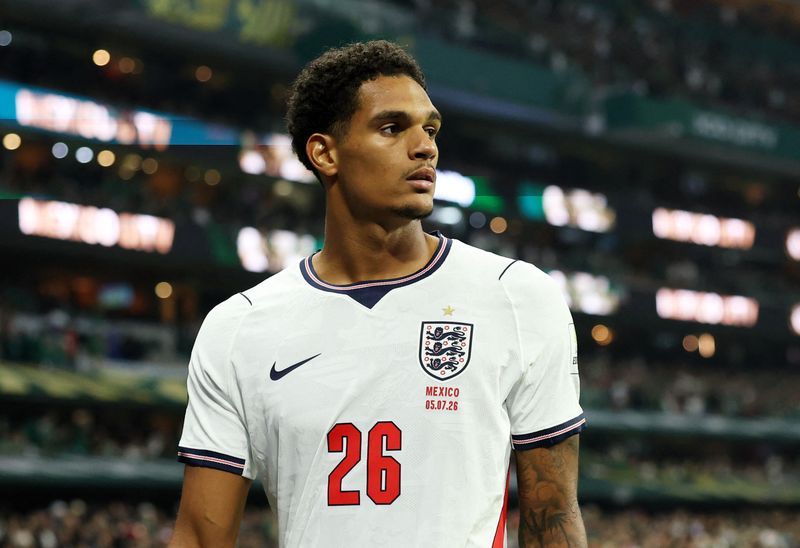
The controversy surrounding FIFA's handling of disciplinary cases at the World Cup has taken a sharper political turn, with British lawmakers directly intervening to demand the sporting body apply its own precedents consistently. The dispute centres on whether defender Jarell Quansah should receive the same suspension deferral granted to American striker Folarin Balogun, a decision that has triggered widespread allegations of political influence after U.S. President Donald Trump publicly confirmed contacting FIFA head Gianni Infantino on Balogun's behalf.
Quansah received a red card during England's dramatic 3-2 victory against Mexico at the Azteca Stadium on Sunday, triggering an automatic one-match ban that would sideline him for the quarter-final against Norway in Miami this Saturday. However, the precedent set by Balogun's case—where FIFA deferred his suspension under Article 27 provisions—has prompted a coordinated response from British parliamentarians arguing that fairness demands identical treatment for players facing materially similar circumstances. Labour MPs Noah Law and Melanie Onn have jointly appealed to Infantino to extend the same reprieve to the England defender, suggesting that selective application of disciplinary rules undermines the legitimacy of FIFA's judicial process.
The intervention by Law and Onn represents an unprecedented attempt to leverage one player's case as a precedent for another, effectively challenging FIFA's original framing that the Balogun decision reflected independent judicial reasoning rather than political calculation. In their separate correspondence posted on social media, the MPs acknowledged the legitimacy of Quansah's red card itself but questioned whether FIFA's approach to suspension deferral should be uniformly applied across the tournament. Law stated his belief that while the dismissal was warranted, delaying the suspension until after the World Cup's conclusion would be the appropriate course of action, paralleling the reasoning used for Balogun.
Melanie Onn went further in articulating the consistency argument, asserting that FIFA would struggle to justify one player benefiting from a deferred ban while another in substantially equivalent circumstances faced immediate punishment. Both MPs warned that FIFA risked catastrophic damage to public confidence in its disciplinary framework unless it demonstrated equal treatment across the tournament. This raises a fundamental question about whether FIFA's rules can retain credibility if applied selectively, particularly when such selectivity appears connected to external political pressure rather than objective judicial criteria.
The controversy has been further elevated by intervention from Caroline Dinenage, Chair of the House of Commons Culture, Media and Sport Committee, who has demanded urgent clarification from FIFA regarding its Balogun decision. Dinenage framed the question not merely as a matter of sporting fairness but as essential to preserving faith in the tournament itself. She suggested that FIFA's handling of the case threatened to overshadow England's impressive victory with questions about institutional integrity, warning that the legitimacy of sport depends fundamentally on consistent application of its rules across all participants regardless of nationality or geopolitical significance.
Dinenage's statement highlights how FIFA's disciplinary decisions are increasingly viewed through a lens of institutional credibility rather than technical football law. By failing to proactively explain its reasoning and address speculation about political interference, FIFA has allowed the narrative to harden around allegations that Infantino yielded to presidential pressure. The parliamentary committee chair's call for urgent explanation suggests growing impatience among British political figures with FIFA's opacity, and signals that further selective rulings could trigger more formal parliamentary scrutiny of the governing body's decision-making processes.
The English Football Association has reportedly begun exploring appeal options regarding Quansah's suspension, though no formal challenge has yet been lodged. This measured approach reflects the complexity of the situation: openly appealing Quansah's case risks appearing opportunistic or validating claims that political pressure has infiltrated FIFA's judicial system, yet failing to pursue remedies for one's own players could be viewed as insufficient advocacy. The FA's cautious stance contrasts with the more assertive parliamentary intervention, suggesting internal disagreement about how aggressively to push back against what many see as an inconsistent application of disciplinary rules.
FIFA's silence on the matter has become its own form of communication, broadcasting institutional unwillingness to engage substantively with legitimate questions about the coherence of its decision-making. By declining to clarify whether Article 27 provisions that applied to Balogun might similarly apply to Quansah, FIFA has effectively invited further political pressure and speculation. This reticence may reflect legal caution about prejudging another case, but it also allows the narrative of political interference to consolidate among observers and political figures already predisposed toward scepticism about FIFA's impartiality.
The deepening controversy illustrates how major sporting decisions inevitably acquire political significance when they affect national teams competing for prestigious tournaments. Quansah's suspension, if upheld without explanation or consistency with the Balogun precedent, could reasonably be interpreted by British audiences as evidence of unequal treatment based on geopolitical considerations rather than sporting merit. Conversely, granting the reprieve might reinforce perceptions that FIFA's disciplinary process is susceptible to external pressure and parliamentary intervention, fundamentally compromising the autonomy that international sports bodies require to function credibly.
For Malaysian and Southeast Asian observers, this dispute carries broader implications regarding FIFA's institutional governance and its capacity to operate according to transparent, consistently applied principles. If a major governing body can be seen to treat similar cases differently based on political influence or external pressure, it raises questions about the integrity of international sports administration more generally. The parliamentary intervention also demonstrates how national governments increasingly view their involvement in sporting disputes as legitimate, a trend that could reshape relationships between political institutions and international sports bodies across the region and globally.
The situation facing England ahead of Saturday's quarter-final remains unresolved, with uncertainty about Quansah's availability adding an unpredictable element to the team's preparation. FIFA's eventual decision—whether to grant, deny, or defer addressing the deferral request—will be scrutinised intensely as either validation or repudiation of the British politicians' arguments. The manner in which this case concludes may establish precedents for how future disciplinary questions are adjudicated and whether political advocacy from national governments becomes a routine feature of World Cup administration.

