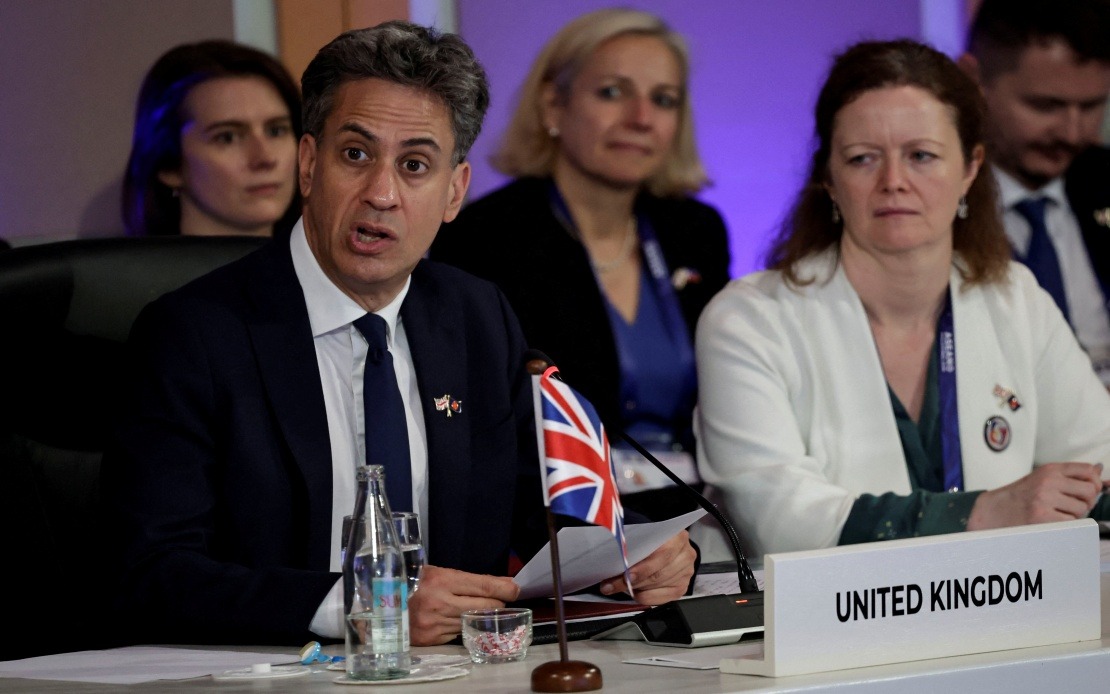
Ed Miliband's debut trip as Britain's foreign secretary represents a symbolic recommitment to European engagement, as the newly appointed official travels to France and Spain this week to establish working relationships with key continental counterparts. The visit underscores the Labour government's broader strategy of rebuilding diplomatic bridges across the Channel following years of post-Brexit tension, signalling that London intends to position itself as an active partner within European security architecture rather than a peripheral observer.
The itinerary reflects carefully calibrated diplomatic messaging, with Miliband scheduled to meet Jean-Noel Barrot in Paris before proceeding to Madrid for talks with Spanish Foreign Minister José Manuel Albares. These face-to-face encounters with two influential EU member states allow the new foreign secretary to address substantive bilateral concerns whilst simultaneously projecting Britain's willingness to cooperate on matters of mutual strategic interest, ranging from defence cooperation to the management of regional instability.
Ukraine remains a central pillar of the discussions, with both France and Spain expected to coordinate with London on sustained military and humanitarian support for Kyiv. The timing of Miliband's visit coincides with ongoing European reassessment of long-term commitment levels to Ukraine, making his presence in Paris and Madrid particularly significant for reinforcing allied cohesion around this geopolitical flashpoint. For Southeast Asian observers, the emphasis on Ukraine coordination illustrates how European security frameworks continue to shape global alignments, with implications for regional partners navigating great-power competition.
The West Asian peace agenda constitutes another substantive negotiating theme, particularly in Paris where complex diplomatic initiatives require careful European orchestration. Britain's involvement in mediation efforts across the Middle East signals continuity with previous administrations whilst potentially offering EU partners a transatlantic channel for policy coordination. Spain's geographic proximity to North Africa and its established role in Mediterranean security affairs make it an equally valuable counterpart for discussing regional stabilisation efforts.
Immigration and migration policy feature prominently in the diplomatic schedule, reflecting shared European preoccupations with irregular movement across borders and the management of asylum pressures. These discussions will likely explore burden-sharing mechanisms and intelligence cooperation, areas where British and European interests increasingly converge despite post-Brexit institutional separation. For Malaysian policymakers and regional observers, European approaches to migration governance offer instructive models regarding securitisation, integration frameworks, and bilateral burden-sharing arrangements.
The Gibraltar question adds particular significance to the Madrid leg of Miliband's journey, as the recently concluded UK-EU treaty governing the contested territory represents a rare diplomatic success story in post-Brexit relations. By elevating this agreement during high-level talks with Albares, Miliband signals British commitment to operationalising the accord and demonstrating that pragmatic solutions remain achievable even within the fraught post-referendum context. Spain's willingness to engage constructively on Gibraltar suggests broader flexibility in European capitals regarding normalised UK engagement.
Wildfires devastating both France and Spain provide an immediate humanitarian context for Miliband's visit, offering opportunities to express British solidarity whilst anchoring security partnerships within broader climate imperative frameworks. The evacuation of approximately 330,000 people across both nations underscores the escalating physical consequences of climate change, permitting Miliband to frame environmental cooperation as integral to European resilience rather than a peripheral concern. This thematic integration allows the foreign secretary to connect immediate humanitarian response with longer-term strategic positioning on green transitions.
Climate change discussions transcend token gestures, as both nations grapple with intensifying environmental pressures that demand coordinated policy responses. Britain's participation in European climate governance, even outside formal EU structures, demonstrates recognition that certain policy domains necessitate supranational coordination. For Southeast Asian nations increasingly vulnerable to climate impacts, the European experience with coordinated response mechanisms offers relevant insights regarding institutional design and burden-sharing arrangements within regional frameworks.
Miliband's inaugural European tour reflects the Labour government's deliberate choice to rebuild institutional relationships and diplomatic credibility following years of Brexit-induced friction. The sequencing of Paris before Madrid suggests priority ordering, with France maintaining disproportionate weight in British strategic calculations. However, Spain's inclusion signals awareness that European partnerships extend beyond the traditional Franco-British axis, acknowledging Spanish influence across Mediterranean and Atlantic dimensions of European strategy.
The visit occurs within a broader context of European reassessment regarding geopolitical positioning amidst ongoing Russian-Ukrainian conflict, intensifying great-power competition, and evolving transatlantic relationships. Britain's efforts to establish itself as a reliable security partner despite institutional separation from EU decision-making structures requires sustained diplomatic engagement and demonstrated commitment to collective projects. Miliband's meetings with Barrot and Albares represent necessary preliminary steps toward embedding Britain within informal European security networks.
For Malaysian and broader Southeast Asian readers, these European developments carry indirect but consequential implications. A Britain successfully integrating itself within European security architecture demonstrates that post-institutional separation need not precipitate strategic isolation, offering relevant lessons for regional partners navigating complex great-power alignments. Furthermore, European approaches to migration management, climate governance, and security cooperation provide comparative perspectives applicable within Southeast Asian contexts where similar pressures demand regional coordination mechanisms.
Miliband's journey ultimately represents more than ceremonial diplomacy, constituting instead a substantive effort to reconstruct British influence within European councils following extended period of diminished engagement. The choice of France and Spain as inaugural destinations emphasises simultaneously both continuity with traditional great-power relationships and broader commitment toward inclusive European partnership. Whether this diplomatic initiative translates into institutional mechanisms for sustained cooperation will determine whether British foreign policy successfully repositions itself within European strategic frameworks.

