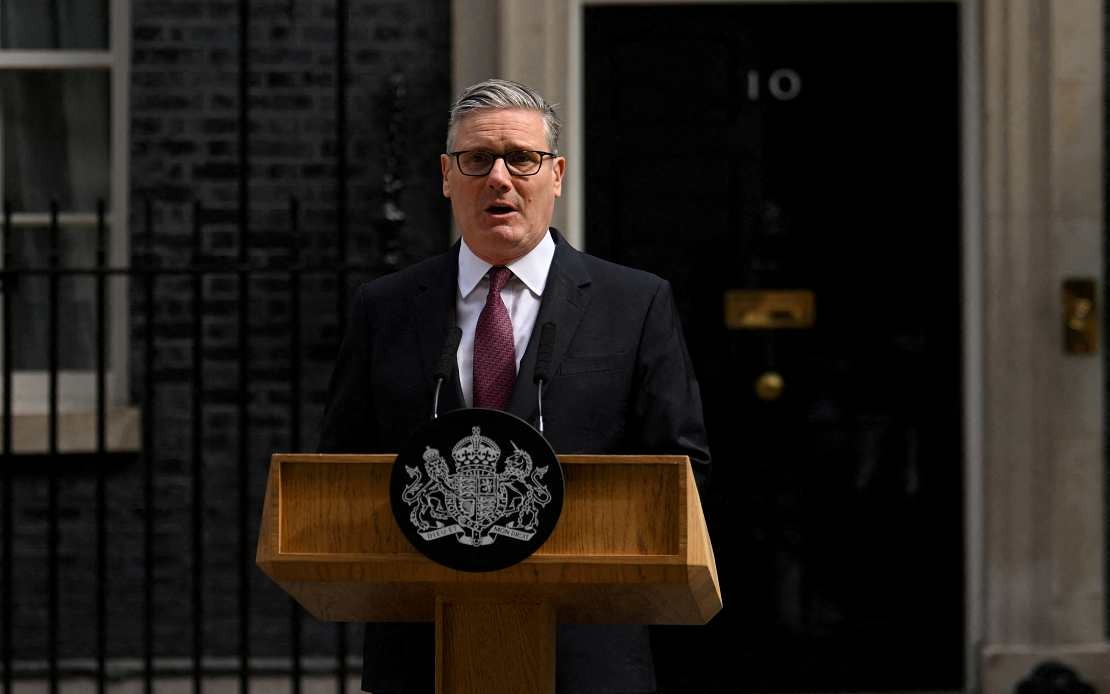
British Prime Minister Keir Starmer has demanded an immediate resumption of ceasefire talks between the United States and Iran, citing the deteriorating situation around the Strait of Hormuz as a pressing international concern requiring coordinated action from major Western powers. Speaking during a joint press conference in Paris alongside French, German and Ukrainian leaders following a "coalition of the willing" meeting on Monday, Starmer articulated growing alarm over the escalating maritime crisis that threatens global commerce and regional stability.
The British leader's intervention comes as tensions have ratcheted up significantly between Washington and Tehran following a fresh exchange of military strikes over the weekend. Starmer's statement represented a direct rebuke of Iran's recent attacks on commercial vessels transiting the waterway, with the Prime Minister stating unequivocally that he "utterly condemns Iran's strikes on commercial shipping and on our Gulf partners." He emphasised that such actions represent a clear violation of international maritime norms and must cease immediately to prevent further destabilisation.
The immediate backdrop to Starmer's appeal involves US President Donald Trump's announcement that Washington was "reinstating" a blockade on Iran and would charge vessels for safe passage through the strategically vital Strait of Hormuz. This pronouncement marked a significant hardening of American policy toward Tehran and raised questions about whether the US intended to enforce a unilateral toll system on international shipping lanes. Trump's characterisation of the arrangement as a security measure designed to maintain freedom of navigation stood in stark contrast to international maritime law principles that govern passage through international straits.
Despite the heated rhetoric and military posturing, Starmer signalled that diplomatic channels remained open and that Western nations retained hope for negotiated resolution. The British Premier expressed support for continued dialogue between the hostile parties, indicating that London and its European allies viewed military escalation as counterproductive to regional interests. His statement that "we are ready" to deploy assets to facilitate maritime commerce suggested Britain was prepared to take concrete steps to stabilise shipping routes, though specific details regarding the nature and scope of such deployments remained vague.
The Strait of Hormuz itself occupies a critical position in global energy infrastructure, serving as the chokepoint through which roughly one-fifth of the world's petroleum traffic passes. Any disruption to shipping in this waterway carries immediate implications for energy markets worldwide and for Southeast Asian economies heavily dependent on reliable oil supplies. Malaysia, as a regional trading hub and energy consumer, stands directly affected by the instability gripping this vital maritime corridor.
The current crisis has roots in the broader US-Israeli military operations that commenced in late February and significantly escalated regional tensions. Iran responded at that time by effectively restricting access through the Strait of Hormuz, leveraging its geographic position as a tool of coercion. However, a memorandum of understanding signed in June had offered hope that normal shipping operations might resume following a comprehensive settlement, with many analysts expecting a gradual normalisation of traffic flows.
Starmer's call for "unrestricted freedom of navigation in the straits" reflected widespread concern among trading nations that the waterway might become weaponised through deliberate disruptions. Such freedom of navigation represents a cornerstone principle of international maritime law, enshrined in the United Nations Convention on the Law of the Sea. Any systematic interference with shipping constitutes a violation of global norms that the international community cannot tolerate without establishing a dangerous precedent.
The involvement of French and German leaders in the coalition discussions underscores the truly international dimensions of the crisis. European nations maintain substantial economic interests in the Middle East and rely heavily on stable maritime routes for energy security and commerce. The inclusion of Ukrainian representation in these talks suggests that Western powers view their response to the Iran-US standoff as interconnected with broader challenges to international law and multilateral order.
For Southeast Asian observers, the unfolding situation carries multiple layers of significance. Beyond the immediate impact on energy prices and shipping costs, the crisis illustrates how Middle Eastern instability can reverberate across global trade networks on which regional economies depend. The approach taken by Britain and its European partners—emphasising negotiation over military confrontation while signalling readiness to support maritime security—offers lessons for how regional powers might balance deterrence with diplomatic engagement when managing high-stakes international disputes.
Starmer's framing of the crisis as requiring urgent international attention reflects concern that without swift diplomatic intervention, escalatory dynamics might prove difficult to reverse. Both Iran and the United States have demonstrated willingness to conduct military operations in response to perceived provocations, creating a cycle of action and counter-action that risks spiralling beyond the control of political leadership. Breaking this pattern requires sustained diplomatic effort and credible commitments from both parties to return to negotiating tables.
The broader challenge facing Western diplomacy involves convincing both Washington and Tehran that their long-term interests favour negotiated settlement over continued confrontation. For the United States, sustained military deployments in the region impose significant costs and risks. For Iran, continued isolation and economic restrictions create internal pressures that ultimately limit the regime's policy flexibility. Finding common ground that allows both sides to claim diplomatic victories while addressing core security concerns represents the essential task facing negotiators in coming weeks.

