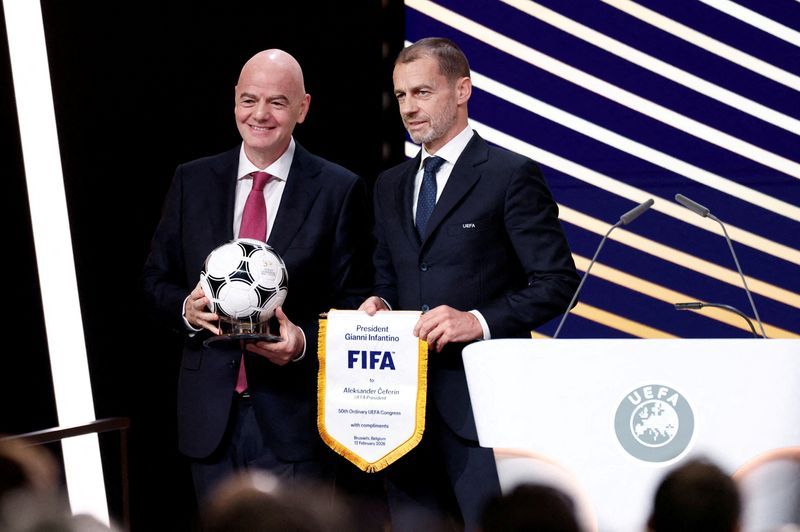
UEFA has escalated its conflict with FIFA President Gianni Infantino by filing a court petition in the United States seeking access to documents and testimony that would support a criminal complaint in Switzerland. The European confederation alleges that Infantino orchestrated a scheme to transfer lucrative commercial rights linked to men's and women's World Cups and the Club World Cup to a newly created entity called FIFA Forward Enterprise, circumventing established decision-making procedures within world football's governing body.
The legal maneuver targets two Florida-based FIFA subsidiaries—FIFA (AMERICAS), Inc. and FWC2026 US, Inc.—from which UEFA hopes to extract evidence revealing how the controversial proposal was conceived, structured, and valued. According to the court filing reviewed by Reuters, UEFA and allied parties are preparing to lodge criminal charges under Article 158 of the Swiss Criminal Code, which addresses mismanagement by public officials. This represents a significant escalation from UEFA's earlier threat to withdraw European teams from FIFA competitions, a position the confederation has now suspended pending FIFA's compliance with certain demands.
At the heart of UEFA's complaint lies an accusation of governance violation and financial impropriety. The confederation contends that Infantino developed the FIFA Forward Enterprise proposal in secret alongside a select group of advisers and investors, deliberately excluding FIFA's Council, the 55 regional confederations, and the 211 member associations from the consultation process. This procedural circumvention contradicts FIFA's established statutes, which vest the Council with sole authority over decisions regarding the promotion and management of the organization's commercial rights—a point UEFA has emphasized repeatedly in its legal filings.
The commercial arrangement itself triggered significant controversy within world football. According to UEFA's documentation, investors led by Thrive Eternal, an investment vehicle controlled by Joshua Kushner and affiliated with Thrive Capital, were poised to inject $4.2 billion for a stake in the enterprise, which would have valued the entire business at approximately $20 billion. UEFA argues this valuation substantially underestimated the true worth of FIFA's commercial rights and that the deal was never subjected to open bidding or independent professional appraisal. For Southeast Asian readers accustomed to transparent procurement processes, the opacity of this arrangement represents a cautionary tale about how international sports governance can operate without accountability mechanisms.
The proposal met swift and decisive resistance across global football when details emerged in late July. UEFA's 55 member associations unanimously resolved on July 30 that European teams would boycott all FIFA competitions, including the forthcoming World Cup, unless Infantino withdrew the plan. This united European stance proved decisive; FIFA formally abandoned the proposal on July 31. Infantino framed the withdrawal as necessary to restore unity and serve football's broader development objectives, yet UEFA remains unconvinced that fundamental questions about decision-making authority and institutional accountability have been adequately addressed.
Even as UEFA suspended its competitive boycott following written assurances that the FFE project had been "irrevocably and permanently withdrawn," the confederation has made clear that legal accountability remains a priority. UEFA's member associations have unanimously mandated the confederation to pursue "every available institutional, political and legal avenue" to secure structural reforms and establish meaningful limits on presidential authority. The confederation has specifically called for an independent external review of the failed proposal, pointedly noting that "FIFA cannot investigate itself and expect the football community simply to accept its conclusions." This criticism reflects broader concerns about FIFA's ability to police its own misconduct without external oversight.
UEFA has also questioned the underlying rationale for the entire scheme. With FIFA holding billions of dollars in reserves that legally belong to member associations, the confederation asked why the FIFA President believed external investor capital was necessary to fund development programmes. This line of questioning strikes at the credibility of Infantino's original justification for the proposal and suggests that motives beyond genuine development funding may have animated the initiative. For Malaysian observers, this dynamic echoes concerns about nepotism and self-interest that periodically plague governance structures across the Asia-Pacific region.
Internal FIFA communications have further complicated Infantino's position. UEFA's filing references complaints from FIFA staff who claimed they had been "deceived" regarding the proposal's scope and timeline. Notably, FIFA Secretary General Mattias Grafstrom was reportedly excluded from the drafting process, suggesting that even senior FIFA officials were deliberately kept in the dark about a decision of immense strategic and financial consequence. Such exclusion of the organization's chief administrative officer points to a troubling pattern of centralized decision-making divorced from normal institutional channels.
Infantino continues to enjoy substantial support from African and South American confederations, and Saudi Arabia's football federation has publicly endorsed his leadership. The Saudi federation stated that it supports Infantino's "continued efforts" to restore unity and grow the global game. However, this geopolitical fracture within world football's governance structure has potentially lasting implications. Infantino has signaled his intention to seek a fourth term as president in March 2027, but UEFA has warned that if he proceeds with that candidacy, the European confederation will work with allied confederations to present member associations with a "credible alternative" committed to institutional reform and democratic governance.
The legal action in US courts represents UEFA's attempt to construct a factual record that transcends FIFA's internal investigation processes. By securing documents and testimony from American entities subject to US discovery rules, UEFA hopes to establish a documentary foundation independent of FIFA's control. This strategy acknowledges that FIFA's capacity for self-investigation remains fundamentally compromised by conflicts of interest and institutional loyalty. For Southeast Asian football nations, particularly those within AFC that might feel less aligned with European concerns, the unfolding dispute underscores broader questions about how international sports bodies balance presidential prerogative with institutional accountability and democratic representation.
The outcome of UEFA's legal initiative will likely shape FIFA's governance architecture for years to come. If the Swiss authorities pursue criminal charges and evidence emerges of deliberate circumvention of FIFA's constitutional processes, the political and reputational consequences for Infantino could be severe. Conversely, if the case falters or produces inconclusive findings, it may embolden similar efforts to concentrate power within FIFA's presidency. For Malaysian stakeholders in Asian football, the dispute exemplifies how governance disputes at the international level can create lasting divisions within the global game and influence which confederations wield influence over world football's future direction.

