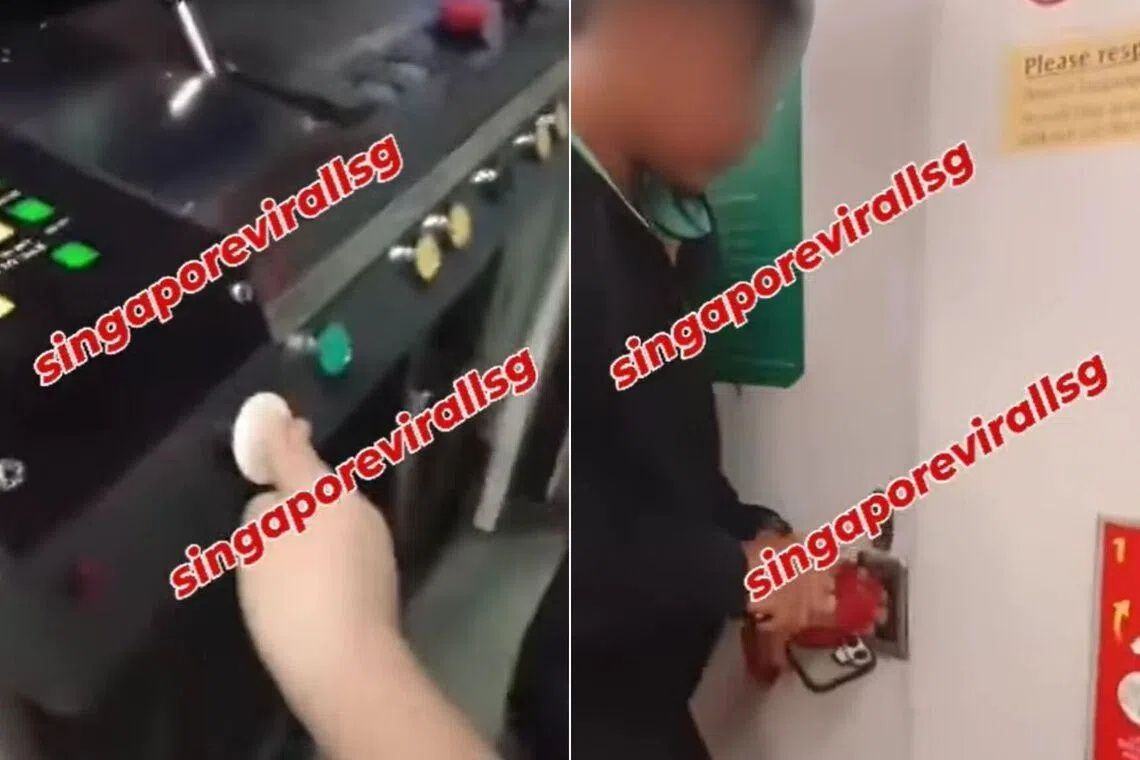
Two boys aged 11 and 12 have escaped formal prosecution after breaking into the restricted back cabin of a Singapore MRT train, instead receiving conditional warnings from police. The February 21 incident aboard a North-South Line train went largely unnoticed at the time but gained significant public attention recently when video footage circulated widely across social media platforms. The conditional warning represents a lenient outcome for the pair, decided following consultations between police and the Attorney-General's Chambers after investigations concluded.
The incident unfolded when the two boys forcibly opened the cabin partition door using a tool, gaining unauthorised access to an area strictly off-limits to passengers. Once inside the restricted space, they repeatedly pressed what appears to be a white button, triggering an audible horn and activating an on-board alarm system. SMRT Trains president Lam Sheau Kai confirmed that the train captain in the front cabin immediately alerted SMRT's Operations Control Centre, the nerve centre coordinating all daily operations across the rail network. Staff stationed at the next stop were deployed to investigate the incident, and the boys alighted there, where their actions were recorded by CCTV cameras.
The viral reach of the incident underscores growing public concern about train safety in Singapore's heavily-used transit system. The video posted on the singaporevirallsg Instagram page accumulated over 281,000 views, attracting nearly 140 comments and more than 200 reposts. This social media amplification reflects broader anxieties among commuters about security protocols and the vulnerability of critical infrastructure to unauthorised access. The scale of online sharing also highlights the speed and reach with which safety incidents can circulate, potentially influencing public perception of transport reliability and security beyond the actual incident itself.
Lam's response to the incident emphasised SMRT's commitment to maintaining strict operational boundaries. He stated that the company takes such breaches seriously, stressing that unauthorised access to restricted train areas creates substantial safety and security vulnerabilities. The operator's concern extends beyond the immediate risk to the two boys themselves; their actions had the potential to disrupt train services and inconvenience the broader commuting public. By activating the alarm system, the incident demonstrated how even juvenile intrusions can trigger operational consequences that ripple across the network.
The police investigation process, while thorough, ultimately recommended a measured approach rather than prosecution. Investigators completed their inquiry and provided findings to the Attorney-General's Chambers, which holds decisive authority in determining whether prosecution should proceed. The decision-making process reflected careful evaluation of the circumstances, including the ages of the individuals involved, the nature of the breach, and other contextual factors. Police confirmed that conditional warnings were issued under the Rapid Transit System Regulations, a framework designed to address infractions on Singapore's mass transit infrastructure without necessarily resorting to criminal proceedings.
The use of conditional warnings represents a middle ground between no action and full prosecution, signalling official disapproval while providing an alternative to court involvement for young offenders. This approach aligns with juvenile justice principles that favour rehabilitation and deterrence over punitive measures where appropriate. However, it also sends a message that such behaviour will not go unrecorded, potentially affecting the boys' futures should they accumulate further infractions. The outcome reflects ongoing debates within Singapore's law enforcement and judicial systems about proportionate responses to rule-breaking by minors.
From a regional perspective, the incident highlights challenges faced by Southeast Asian public transport systems in managing passenger safety and security. As urban transit networks expand across the region to serve growing metropolitan populations, protecting critical infrastructure from unauthorised interference remains a persistent concern. Singapore's MRT system, regarded as one of Asia's most advanced and well-maintained networks, nonetheless remains vulnerable to breaches of this nature. The incident raises questions about how transit authorities across the region balance operational transparency with security measures needed to prevent disruption.
The February timing of the incident, followed by the public emergence of footage months later, suggests that social media discovery and circulation of transit security incidents may occur unpredictably and sometimes significantly after the fact. This temporal gap between occurrence and viral spread creates challenges for transit operators seeking to manage public messaging and confidence. For Malaysian commuters familiar with the rapid growth and continuing development of systems like the LRT and MRT in Kuala Lumpur, the Singapore case offers a reminder that even sophisticated transit networks must contend with determined individuals seeking to access restricted areas.
SMRT's formal response emphasises the operational risks inherent in such breaches. Train cabins represent controlled environments where inadvertent activation of safety systems or operational controls can have cascading effects on service delivery. The potential to disrupt schedules, delay thousands of commuters, and create ripple effects across an interconnected network underscores why transit operators maintain strict access protocols. Each breach that goes undetected represents a gap in security procedures; each one that triggers alarms demonstrates both the robustness of safety systems and the vulnerability points they are designed to protect.
The regulatory framework under which the boys were warned, the Rapid Transit System Regulations, provides operators with tools to address infractions without necessarily invoking criminal law. This framework reflects recognition that transit systems require specialised legal instruments tailored to their unique operational and safety contexts. For Malaysian authorities overseeing KL's expanding transit network, such regulatory approaches offer models for balancing enforcement with flexibility, particularly when dealing with young offenders who may not fully appreciate the consequences of their actions.
Moving forward, the incident serves as a case study in how digital media amplification can transform a contained security matter into a public talking point. SMRT's proactive confirmation of details and explanation of response protocols demonstrates how transit operators can shape narratives around security incidents. The restraint shown by police in pursuing conditional warnings rather than prosecution, while the social media conversation swirled around the incident, indicates mature decision-making within Singapore's enforcement structures. For broader implications across Southeast Asia, the case reinforces that transit security requires multi-layered approaches combining physical barriers, surveillance, monitoring systems, and measured enforcement responses calibrated to circumstances.

