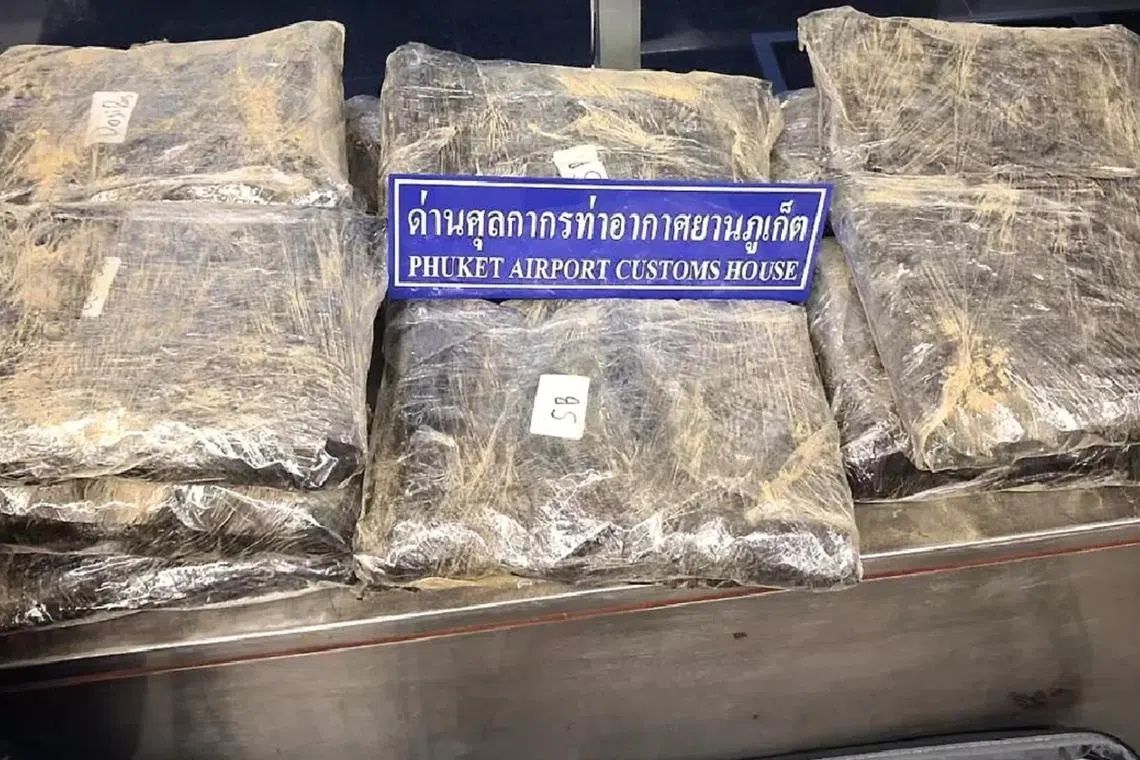
Customs and police officers working jointly at Phuket International Airport have detained two women on suspicion of attempting to smuggle more than 32 kilograms of cannabis out of Thailand without proper authorisation. The coordinated operation, carried out on Thursday (July 9) by personnel from Phuket Airport Customs House and Sakhu Police Station, uncovered what authorities describe as a significant attempt to circumvent Thailand's strict narcotics regulations at one of the region's busiest departure points.
The first incident occurred during routine luggage screening at approximately 11am in the international departures terminal. Officers examining a black Pierre Cardin suitcase belonging to 18-year-old Filipino national Levannah Chelsea Guzman discovered 14 separately vacuum-sealed packages concealed within. The cannabis flowers, complete with their protective wrapping, totalled 14.5 kilograms. Guzman subsequently confirmed during interrogation that both the suitcase and its contents were hers, providing authorities with a clear admission that facilitated the formal charges that would follow.
The second apprehension took place approximately two hours later when inspectors became suspicious of a green Swish Navy wheeled suitcase at the same departure terminal. The bag belonged to Thai national Penpitcha Phutsiang and contained 16 vacuum-sealed packages of cannabis flowers totalling 17.6 kilograms. Like Guzman, Phutsiang admitted ownership of the luggage and all seized materials during questioning, streamlining the investigative process and establishing the factual basis for subsequent legal action.
Both individuals face multiple charges spanning several legislative frameworks reflecting Thailand's comprehensive approach to narcotics enforcement. The primary charge relates to attempting to transport goods across an international border without completing mandatory customs procedures, a violation of the Customs Act BE 2560 (2017). This offence, which applies regardless of the nature of the goods being exported, carries distinct penalties under Thai law and serves as the foundational allegation in both cases.
Beyond the customs violation, the authorities have invoked the Narcotics Code, which represents Thailand's primary legislation governing controlled substances. Additionally, charges fall under the Protection and Promotion of Traditional Thai Medicine Wisdom Act BE 2542 (1999), a framework that complicates cannabis prosecutions in Thailand where certain traditional medicinal applications had previously enjoyed limited legal recognition. The Public Health Ministry's 2025 notification specifically addressing controlled herbs and cannabis regulations has also been cited, indicating Thailand's recent intensification of cannabis oversight despite the country's evolving stance on hemp cultivation for industrial purposes.
The timing of these arrests reflects broader patterns in regional drug enforcement. Thailand has become increasingly vigilant regarding outbound cannabis smuggling, particularly through major international airports serving millions of passengers annually. The Kingdom's geography as a crossroads between Southeast Asia and global markets has made its airports attractive to trafficking networks seeking to move drugs northward toward China or westward toward Europe and the Middle East. Phuket, as a major tourist and transit hub, faces particular pressure from such activities.
The seizure of over 32 kilograms represents a substantial quantity by airport interdiction standards. While cannabis cultivation in Thailand has become more prevalent following regulatory changes that permitted hemp growing for industrial and research purposes, the strict controls on export remain in force. The fact that both suspects were attempting to leave simultaneously suggests possible coordination, though authorities have not publicly indicated whether they knew each other or were operating independently.
For Malaysian authorities and Southeast Asian law enforcement agencies, incidents of this nature serve as crucial reminders of the interconnected nature of drug trafficking across the region. The routes used to smuggle cannabis from Thailand mirror those employed for methamphetamine, heroin, and synthetic drugs that regularly transit through Malaysia en route to international markets. Enhanced cooperation between Thai and Malaysian customs and police services at border checkpoints and airports remains essential to disrupting these supply chains before they reach local communities.
The incident also highlights the operational effectiveness of joint customs-police operations at critical infrastructure points. The coordination between Phuket Airport Customs House and Sakhu Police Station demonstrates how integrated approaches can yield results in high-volume screening environments where resources are necessarily limited. This model has gained traction across Southeast Asian airports facing similar trafficking pressures, with Bangkok's Suvarnabhumi Airport and Kuala Lumpur International Airport implementing comparable collaborative frameworks.
Both suspects have been transferred to Sakhu Police Station where further investigation and legal proceedings continue. The formal prosecution process will likely extend over several months, with outcomes potentially setting precedent for similar cases. Thai courts have generally imposed custodial sentences for cannabis trafficking offences of this magnitude, though sentences vary based on individual circumstances and aggravating factors discovered during investigation.
The broader context involves Thailand's transitional stance on cannabis policy. While the country has permitted licensed cultivation for medical research and hemp fibre production, recreational use and trafficking remain strictly prohibited. This creates legal ambiguity that criminal networks occasionally attempt to exploit, though airport security protocols have adapted to address such grey-area trafficking attempts. The authorities' comprehensive charging approach, invoking multiple legislative acts, reflects awareness that single-statute prosecution might face technical challenges should defence counsel argue definitional or jurisdictional issues.
The arrest also underscores Thailand's determination to maintain its international standing regarding narcotics enforcement. Despite domestic policy evolution around cannabis, the Kingdom remains vigilant regarding export controls and participates actively in regional and global counter-narcotics initiatives. These airport operations generate data and intelligence that contribute to broader understanding of trafficking patterns, source regions, and destination markets.
For travellers and visitors, the incident reinforces that Phuket and other Thai airports maintain rigorous screening standards. The visible enforcement, while beneficial for deterrence, reflects genuine commitment to preventing Thailand from becoming a jurisdiction associated with drug trafficking. As tourism and trade continue to recover post-pandemic, maintaining secure, drug-free airports remains crucial for both public health and economic stability across the region.

