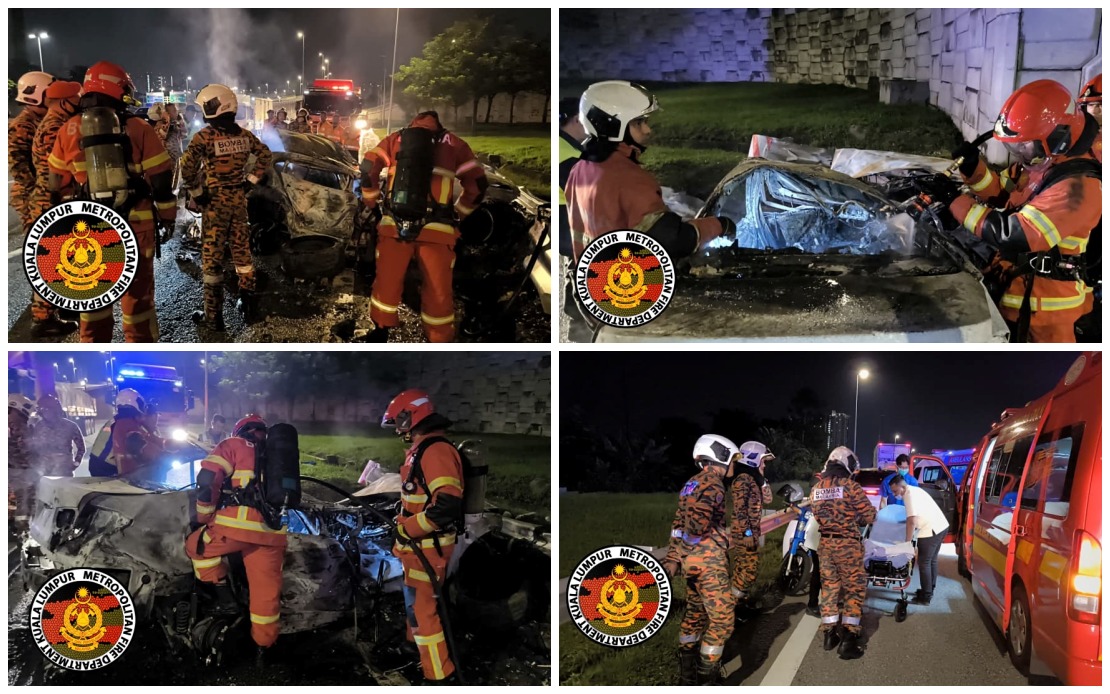
A tragic road accident on the Duta-Ulu Kelang Expressway (DUKE) in the early hours of Thursday claimed the lives of two university students when their vehicle caught fire following a high-speed crash. The incident, which occurred at the Jalan Kuching exit ramp, has renewed concerns about speeding and driver safety on one of Kuala Lumpur's major arterial routes. A third passenger survived the collision with minor injuries, making him the sole witness to the catastrophic sequence of events that unfolded during the early morning hours.
According to investigations led by Kuala Lumpur Traffic Investigation and Enforcement Department chief ACP Mohd Zamzuri Mohd Isa, a BMW 328i Sport travelling from Jalan Duta toward Selayang was moving at excessive speed when the driver lost control of the vehicle. The car subsequently skidded across the roadway and collided forcefully with the left road divider. The impact of the crash triggered an immediate fire that engulfed the vehicle, trapping two occupants inside as flames consumed the cabin. Emergency response teams were unable to extract the two victims before they succumbed to the inferno.
The two deceased have been identified as a 22-year-old Malaysian male who was enrolled as a student at Queensland University of Technology in Australia, and a 21-year-old Malaysian male who attended Sunway University. Both were confirmed dead at the crash scene, with authorities believing they were unable to escape the burning wreckage. The third occupant, a 20-year-old male student from Singapore, managed to exit the vehicle and was treated for minor injuries at Kuala Lumpur Hospital. His survival and relative good health contrast sharply with the fatal outcomes experienced by his two companions, adding a layer of tragedy to the incident that will likely haunt him for years to come.
The investigation into the crash has been initiated under Section 41(1) of the Road Transport Act 1987, which governs serious traffic violations and fatalities. Police investigators are examining multiple aspects of the incident to establish a comprehensive timeline and determine all contributing factors. Preliminary findings strongly suggest that excessive speed was the primary cause, though the exact circumstances that led the driver to lose control require further scrutiny and analysis of available evidence at the scene.
Identification of the two charred victims presents a significant challenge for authorities due to the extent of fire damage sustained by the bodies. The Kuala Lumpur Traffic Investigation and Enforcement Department has announced that DNA analysis will be employed to formally identify the deceased, a process that typically requires several days to complete. This forensic approach ensures accuracy while families await confirmation of their loved ones' identities, though in this case the confirmation is unfortunately inevitable.
Police have launched a comprehensive evidence-gathering operation that extends beyond initial observations at the scene. Investigators are reviewing closed-circuit television (CCTV) footage from cameras positioned along the DUKE expressway, which should provide crucial visual documentation of the vehicle's behaviour in the moments preceding the crash. Additionally, officers have recorded formal statements from the surviving passenger, whose account of events may clarify the circumstances that preceded the loss of control and collision with the road divider.
The incident highlights persistent challenges with speeding and reckless driving on Kuala Lumpur's expressway network, where high speeds and heavy traffic volumes create an inherently hazardous environment. Young drivers, particularly those operating high-performance vehicles like the BMW involved in this crash, remain disproportionately represented in fatal traffic accidents. The concentration of university students among both victims and survivor underscores how road safety affects the younger demographic, who often underestimate risks and overestimate their driving capabilities.
Authorities have made a public appeal for assistance from witnesses and motorists who may possess relevant dashcam footage of the accident or the moments leading up to it. Members of the public are encouraged to contact the Traffic Police Station at Jalan Tun H.S. Lee or any nearby police station with information that could assist ongoing investigations. Such dashcam evidence has become increasingly valuable in traffic investigations, often providing objective documentation that supplements official evidence collection efforts.
For Malaysian and Southeast Asian readers, this tragedy serves as a sobering reminder of the dangers inherent in high-speed driving on urban expressways. The DUKE expressway, connecting Kuala Lumpur's northern areas to the city centre, experiences significant daily traffic and demands heightened driver awareness. The loss of two young lives with promising academic futures—one pursuing tertiary education internationally—represents not only a personal tragedy for their families but also a broader societal cost in terms of human potential lost to preventable accidents. Regional road safety initiatives continue to emphasize the critical importance of speed management, proper vehicle maintenance, and enhanced driver education programs aimed at younger motorists who collectively represent a disproportionate share of serious and fatal accidents across Malaysia and the broader Southeast Asian region.

