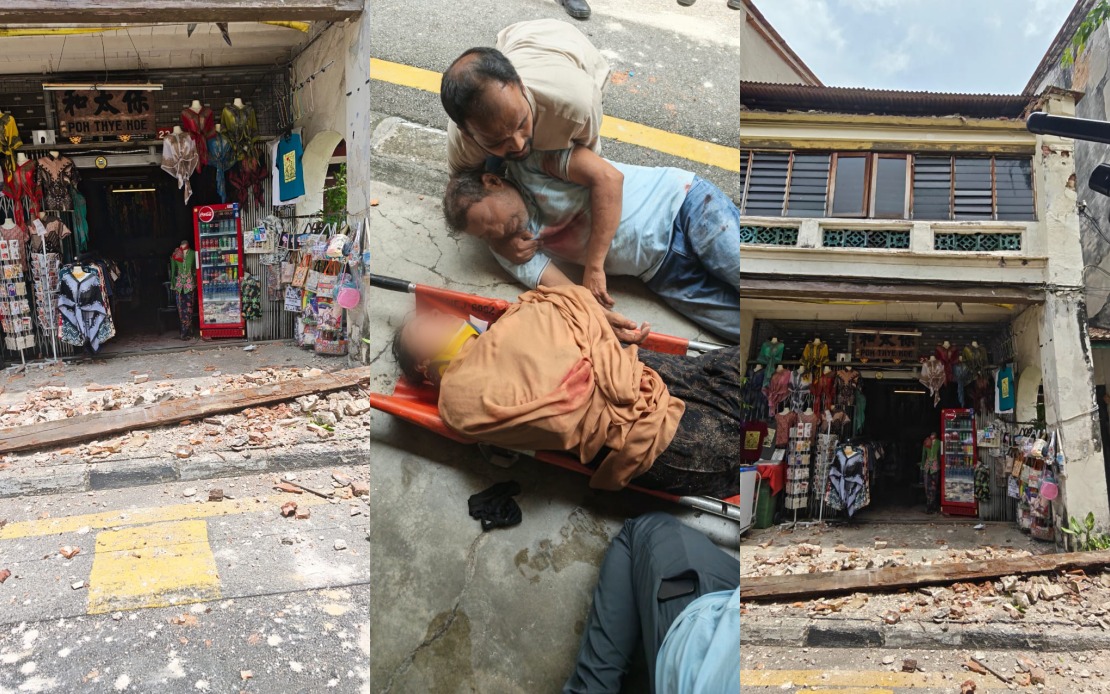
A crumbling piece of Penang's architectural heritage turned dangerous this week when debris from a centuries-old building struck two visiting tourists on one of the state's most bustling heritage thoroughfares. The incident on Armenian Street in George Town, which occurred on August 4, has reignited concerns about the structural integrity of the island's prized older buildings and their potential hazards to the thousands of visitors who navigate the narrow lanes of the UNESCO World Heritage zone each month.
The two injured parties, identified as Mohamad Ammtar, 66, and Fatimah, 55, both from Sri Lanka, were struck by falling stone and timber debris that gave way from the first-floor level of the building. Emergency responders from the Penang Fire and Rescue Department's Lebuh Pantai station arrived at the scene following a distress call logged at 1.11 pm. Penang Fire and Rescue Department assistant director of operations John Sagun Francis confirmed that Health Ministry personnel administered initial first aid before the pair were transported to Penang Hospital for more comprehensive medical evaluation. The timing proved particularly difficult for the tourists, who had booked return flights to Sri Lanka for the following day.
The affected building, which functioned as mixed-use commercial property with a grocery shop occupying the ground floor, appeared to have no active occupants on its upper storeys at the moment of collapse. This fortunate circumstance may well have prevented more serious casualties, though investigators have yet to pinpoint the exact cause of the structural failure. The incident has prompted questions about how thoroughly George Town's heritage precinct is monitored for maintenance standards, particularly given the age and fragility of many buildings in the area.
State authorities have treated the episode as a serious wake-up call for the broader heritage conservation sector. Wong Hon Wai, chairman of Penang's Tourism and Creative Economy Committee, visited the scene and subsequently issued directives to both George Town World Heritage Incorporated and the Penang City Council to circulate safety advisories to owners throughout the heritage district. His comments underscored the paradox facing heritage preservation efforts: maintaining authentic character often means working with structures whose age and original construction methods may not meet contemporary safety standards.
The committee chairman emphasised that the problem extends well beyond the single building on Armenian Street. George Town's entire stock of heritage and older buildings requires systematic structural assessment to identify potential hazards before they endanger the public. Wong's intervention reflects a recognition within government that the World Heritage status that brings international prestige and tourism revenue also carries obligations to ensure visitor safety. A heritage destination that injures tourists faces not only immediate legal and diplomatic consequences but also longer-term damage to reputation and visitor confidence.
The diplomatic dimensions of the accident quickly became apparent, prompting the state government to contact the Sri Lankan High Commission in Kuala Lumpur to coordinate support for the injured tourists. Such incidents between visitors and host destinations can generate awkward diplomatic moments, and authorities have moved to forestall any perception of inadequate care. The willingness to extend assistance at the government level signals both proper diplomatic protocol and recognition that preventable injuries to international visitors undermine Penang's standing as a welcoming destination.
For Malaysian heritage specialists and urban planners, the incident exemplifies a chronic challenge facing conservation efforts across Southeast Asia. Many properties designated for preservation were constructed decades or even centuries ago, using materials and techniques ill-suited to modern traffic patterns and visitor volumes. The narrow lanes of George Town now experience foot traffic loads that would have been unimaginable when these buildings were erected. Retrofitting safety measures without compromising heritage value requires substantial investment and technical expertise that not all building owners possess.
The authorities acknowledged they are awaiting full forensic investigation results to determine what specific factors led to the structural failure. Whether the collapse resulted from natural deterioration, inadequate maintenance, previous damage, or some combination remains unclear. Understanding the root cause will be essential for developing appropriate intervention strategies and determining whether remediation requires funding assistance for property owners or stronger enforcement mechanisms to compel maintenance.
This episode arrives at a moment when Southeast Asian heritage zones are increasingly grappling with balancing preservation with safety and accessibility. Chiang Mai, Luang Prabang, and other regional heritage districts face similar pressures. The intersection of economic interest—heritage tourism generates significant revenue—and safety obligation creates genuine management challenges that simple solutions cannot address. Penang's response will likely set precedent for how Malaysian heritage authorities manage comparable issues in other protected zones.
For George Town specifically, the path forward requires coordinated action across multiple stakeholders. Building owners need clear guidance and possibly financial incentives for necessary safety upgrades. Inspection regimes must become more rigorous and transparent. Visitors should ideally receive information about heritage areas that acknowledges both their charm and the realities of navigating older structures. The incident, while unfortunate, may ultimately strengthen the systems that protect both Penang's irreplaceable heritage and the safety of everyone who experiences it.

