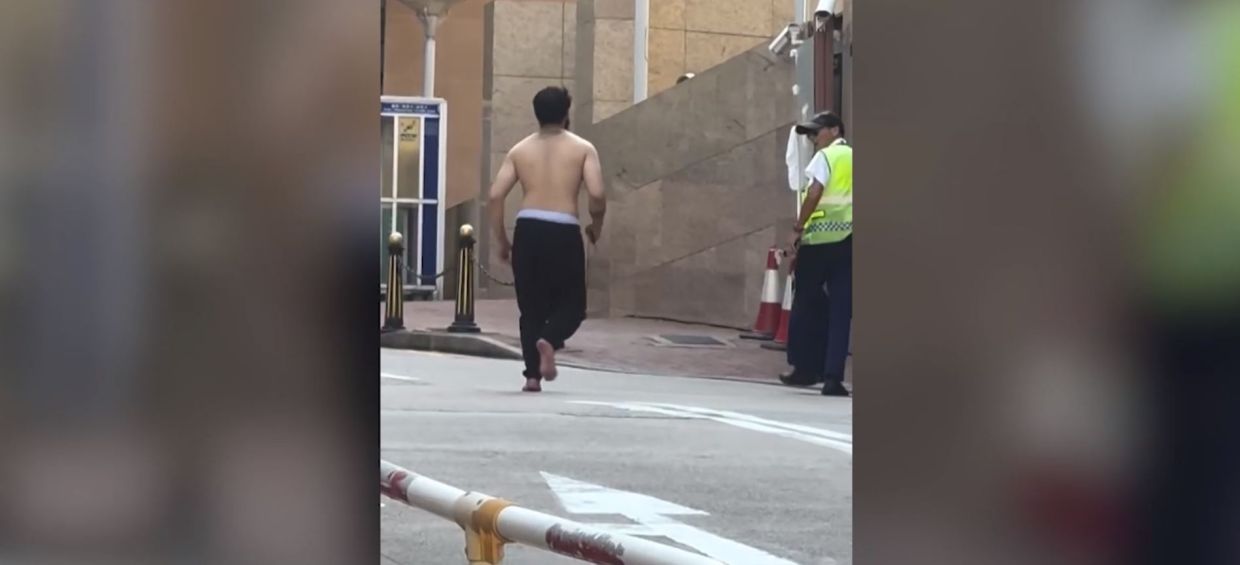
A 22-year-old resident of Baguio Villa in Hong Kong's Southern District was arrested on Monday after a violent rampage that left two people requiring hospital treatment. The incident, which unfolded in the early morning hours around 9am on August 10, began when the man emerged from his unit at block 47 wearing only sweatpants, authorities said. The seemingly unprovoked assault highlights growing concerns about random violence in what are ordinarily regarded as secure, affluent residential communities across Hong Kong.
Emerging from his flat in a state of partial undress, the suspect made his way to the common areas of the estate. Witnesses described him as bare-chested and barefoot when he encountered his first target outside block 43. A male passerby narrowly avoided injury when the attacker lunged at him with a blade, missing his intended target by mere moments. The quick reflexes of the victim prevented what could have been a serious injury in what appeared to be an entirely random selection of prey.
The assailant's aggression quickly escalated as security personnel attempted to intervene. When a security guard moved to stop him, the knife-wielding man engaged the officer in a physical struggle at the scene. As the confrontation intensified, additional security staff members rushed to assist their colleague, creating a chaotic situation within the estate's grounds. The focus on containing the suspect gave the man an opportunity to flee the immediate area around block 43.
During his escape, the attacker targeted a foreign domestic worker who happened to be passing through the estate. The worker sustained a stab wound to the back in what appeared to be another random selection. However, the presence of mind shown by estate residents and security personnel proved crucial in preventing further bloodshed. Multiple people intervened to physically restrain the suspect, pinning him down until police officers arrived at the scene and took him into custody without further incident.
The two victims—the injured domestic helper and the security guard who had initially engaged the attacker—were both transported to hospital for treatment. Neither sustained injuries described as life-threatening, though both required medical attention for their wounds. The domestic worker, being a foreign national employed in a residential capacity, represents a vulnerable segment of Hong Kong's workforce often targeted in isolated incidents within private properties.
The arrest and subsequent police investigation took an unexpected turn when officers searched the suspect's residential unit. There they discovered a pet cat bearing signs of abuse, with injuries to its right ear suggesting the animal had been harmed before the man's assault on humans. The discovery raised troubling questions about whether the violence inflicted on the animal represented a precursor to the broader attack, or whether the individual was simply acting out violently toward all living beings in his vicinity. The injured cat was handed over to the Society for the Prevention of Cruelty to Animals, which provided treatment for its wounds.
The incident casts a spotlight on security vulnerabilities within Hong Kong's residential estates, even those marketed as premium and exclusive communities. Baguio Villa, situated in the upscale Southern District, represents precisely the type of address that residents expect to offer protection and safety as part of the premium pricing structure. Yet the ease with which the suspect moved through communal areas and attacked multiple people suggests that security measures may be insufficient to prevent determined individuals from causing harm. The role of security guards in attempting to contain the situation underscores both their importance and their limitations when facing a determined attacker.
For the broader population of domestic helpers working in Hong Kong, the incident represents another reminder of the occupational hazards they face while employed in private households and residential estates. Foreign domestic workers, predominantly from the Philippines, Indonesia, and other Southeast Asian nations, occupy a precarious position within Hong Kong society, often isolated in their workplaces and vulnerable to various forms of harm. Incidents of violence against this population, whether random or targeted, tend to receive less public attention than attacks on other groups, yet they reveal systemic vulnerabilities in how Hong Kong protects its most economically dependent residents.
The mental health component of the incident remains unclear from available information, though random violent attacks of this nature often involve individuals experiencing psychological crises. The suspect's decision to emerge partially clothed and immediately commence an unprovoked assault on strangers could suggest a break from rational decision-making or a psychiatric episode. How Hong Kong's mental health services and law enforcement coordinate in identifying and assisting individuals in crisis before they resort to violence remains an ongoing challenge for the city's authorities.
This incident represents the third major public violence case in Hong Kong in recent months, contributing to a perception among residents that random attacks have become increasingly common in spaces previously considered safe. While statistical data may not support a dramatic increase in such incidents, each high-profile case reinforces public anxiety about personal security even in affluent, gated communities. The response from Baguio Villa's security team and neighbouring residents in restraining the suspect before police arrival demonstrated the importance of community vigilance, yet also illustrated how quickly normalcy can be shattered in residential spaces.

