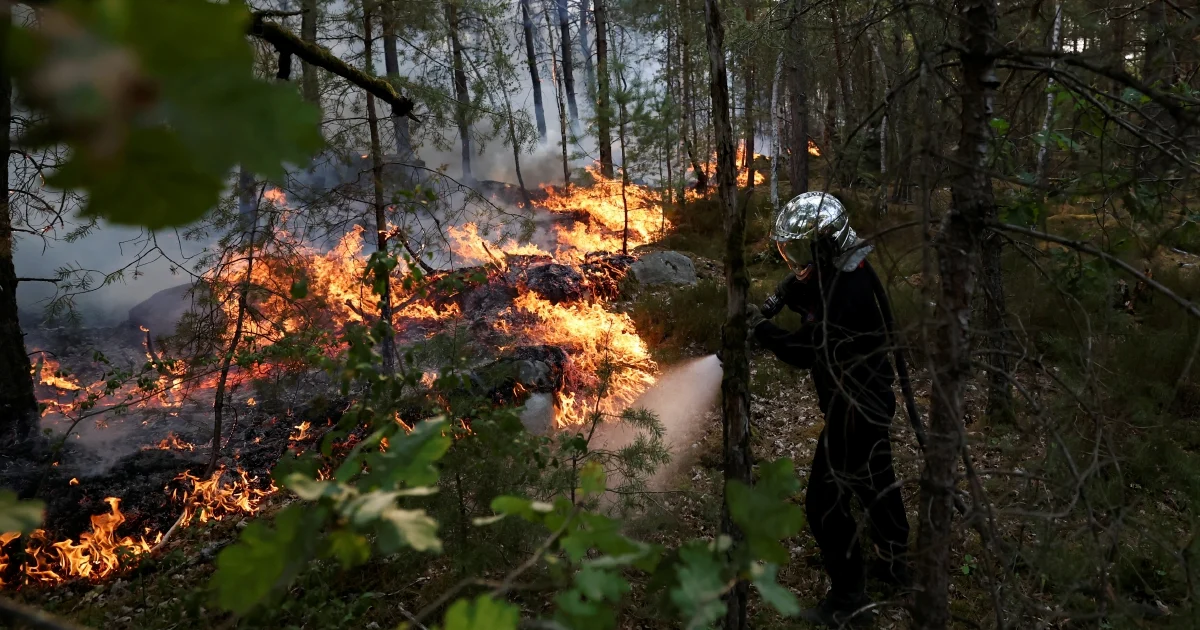
A devastating wildfire spread across a historic forest in the Arbonne-la-Foret region south of Paris on Monday, consuming an area exceeding 1,300 hectares as French authorities mobilised resources to contain the expanding blaze. The scale of destruction prompted law enforcement to accelerate investigations, with police making two arrests on suspicion of arson as firefighting teams worked to prevent further damage to the region's natural heritage.
The outbreak of fire simultaneously affected multiple zones within the forest complex, forcing emergency services to divide their response efforts across distinct fronts. This multi-site nature of the outbreak complicated containment strategies, as resources and personnel became stretched across the affected territory. The sheer acreage involved—comparable to roughly 1,800 standard football fields—underscores the severity of the incident and the extraordinary scale of response required from France's firefighting contingent.
Forests near major population centres such as Paris hold particular ecological and cultural significance for the surrounding communities. These woodlands provide crucial ecosystem services including carbon sequestration, wildlife habitat, and recreational space for residents of the bustling capital region. The destruction of such extensive forestland represents not merely an environmental loss but also a blow to the region's natural infrastructure that supports both biodiversity and human wellbeing. Restoration efforts, should they be undertaken, typically require years of careful management and investment.
The involvement of alleged arson in triggering the disaster distinguishes this incident from naturally occurring wildfires sparked by lightning or uncontrolled agricultural burning. The deliberate nature of the suspected cause raises questions about public safety in forest zones and the adequacy of surveillance and deterrent measures in vulnerable areas. France's forests have experienced multiple significant fire events in recent years, prompting policymakers to reassess security protocols in sensitive natural areas.
Police operations proceeded rapidly following initial assessments of the fire's scale and trajectory. The decision to arrest two individuals within the immediate timeframe suggests that investigators identified potential suspects through either witness reports or physical evidence discovered at or near the ignition sites. Such swift law enforcement action reflects the seriousness with which French authorities treat intentional fire-setting, particularly when the consequences threaten substantial tracts of protected or ecologically valuable land.
For Malaysian observers monitoring international environmental incidents, the Arbonne-la-Foret fire serves as a cautionary reminder that wildfire threats extend beyond tropical and subtropical regions. European nations with temperate forests face their own challenges during periods of dry weather and elevated fire risk. Climate patterns across the Northern Hemisphere have increasingly produced conditions favourable to large-scale forest fires, a trend that scientists attribute partly to broader climatic shifts and changing precipitation patterns.
The firefighting response mobilised by French authorities reflects the institutional capacity and resource availability of a developed European nation. Coordinated deployment of aerial and ground-based suppression equipment, combined with pre-positioned personnel and mutual aid arrangements across regional fire services, represents the operational framework within which such emergencies are addressed. Smaller nations or regions with more limited firefighting infrastructure might face substantially greater challenges in managing equivalently sized incidents.
Ecological recovery from fires of this magnitude typically extends across multiple growing seasons, with varying timelines depending on forest composition and management strategy. Deciduous and mixed forests such as those typical of the region south of Paris may regenerate more rapidly than coniferous stands, but the process involves complex interactions between soil recovery, seed dispersal, and wildlife recolonisation. Stakeholders including environmental agencies and landowners must balance priorities such as fire suppression, habitat restoration, and prevention of erosion or hydrological disruption in the aftermath.
The investigation into alleged arson will likely produce findings relevant to broader discussions about forest security and public access management across European protected areas. Authorities may examine whether existing restrictions on movement within sensitive zones require strengthening, whether surveillance technology deployment is warranted, or whether community education campaigns might reduce the incidence of deliberately ignited fires. The outcomes of prosecutions, should they proceed, may establish legal precedents affecting how European courts address environmental destruction through arson.
For regional audiences in Southeast Asia, where wildfire incidents regularly affect multiple nations, the European experience underscores the transnational dimension of fire management and the persistent challenge of deliberate fire-setting across diverse regulatory environments. Collaboration mechanisms, information sharing about detection technologies, and harmonised approaches to public awareness campaigns represent areas where nations might pursue greater cooperation regardless of geographic proximity.

