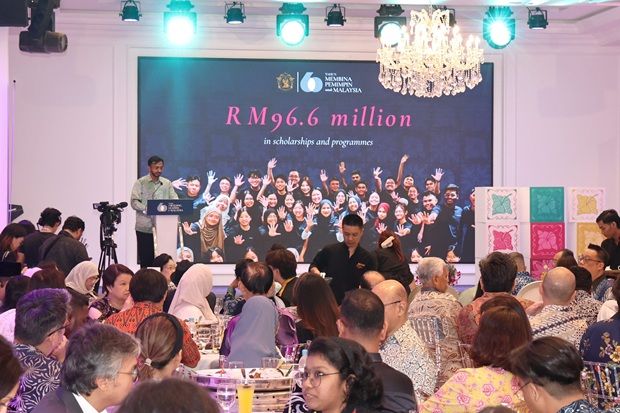
The Tunku Abdul Rahman Foundation (YTAR) reached a significant milestone this month, marking six decades of championing educational access and youth development across Malaysia. The institution observed its 60th anniversary on August 13 at Bangunan Sultan Abdul Samad, reflecting on a legacy rooted in the belief that investing in young people represents the nation's most valuable undertaking. What began as a community-driven initiative to honour Malaysia's first Prime Minister has evolved into a cornerstone institution shaping the trajectories of thousands of Malaysians who would go on to occupy leadership positions across every sector.
The foundation's origins trace back to a groundswell of public support that emerged when Utusan Melayu launched a nationwide fundraising campaign on Tunku Abdul Rahman Putra al-Haj's birthday. This grassroots effort accumulated more than M$60,170.20—equivalent to approximately RM380,000 in contemporary monetary terms—demonstrating the depth of popular affection for the nation's founding premier. The government subsequently formalised this spontaneous expression of gratitude through the Tunku Abdul Rahman Foundation Fund Act 1966 (Act 43), transforming what might have remained a temporary memorial gesture into a permanent, systematised mechanism for identifying and nurturing Malaysian talent.
Education Minister Tan Sri Mohamed Khir Johari recognised the opportunity to align this public initiative with urgent national requirements. The newly independent nation faced critical imperatives to develop its human capital and equip young Malaysians with the skills necessary for nation-building. By channelling the collected funds into a structured scholarship programme, the government created an institution that could dispatch deserving students to premier universities worldwide, with the expectation that beneficiaries would return to contribute their acquired expertise to Malaysia's development. This forward-thinking approach positioned education not merely as personal advancement but as a patriotic obligation and investment in collective progress.
Over the past six decades, YTAR has distributed RM96.6 million across various initiatives, benefiting over 12,000 Malaysian youths irrespective of ethnicity, religion, or socioeconomic background. This comprehensive support framework extends beyond simple loan provisions to encompass scholarships, financial assistance packages, and employability development programmes designed to equip recipients with competitive skills. National Unity Minister Datuk Aaron Ago Dagang highlighted at the anniversary ceremony how the foundation's mandate has progressively broadened. Rather than functioning solely as a disbursement mechanism, YTAR now actively identifies emerging talent, creates pathways for educational access, and cultivates the latent potential within Malaysia's younger generation. This evolution reflects a deepening understanding that scholarship provision represents merely the foundation for comprehensive talent development.
The foundation's sustained relevance derives substantially from its unwavering commitment to a singular conviction: that the quality of Malaysia's youth determines the nation's trajectory. This principle, articulated by Tunku Abdul Rahman himself in 1964, remains as cogent today as during the founding era. The late premier recognised that contemporary choices and future prosperity hinge fundamentally upon how effectively society invests in and nurtures its younger citizens. This philosophical anchor has enabled YTAR to maintain institutional coherence across generational transitions, preventing the organisation from drifting toward disconnected initiatives or fragmentary programming. Instead, every programme and decision radiates from this central commitment to youth development as the ultimate expression of national self-interest.
Datin Sri Sharifah Menyalara Syed Hussein, serving as YTAR chairperson and granddaughter of Tunku Abdul Rahman, offered perspective on her grandfather's conception of education's transformative potential. For the founding premier, education extended beyond academic credentialing or technical skill acquisition. Rather, it encompassed the formation of character, the clarification of purpose, and the development of individuals capable of identifying their authentic roles within society while contributing meaningfully to collective welfare. Over six decades, YTAR has operationalised this expansive vision through its evolution from a straightforward financial aid provider into a comprehensive empowerment mechanism. Current beneficiaries receive not merely capital and academic opportunities but also skills training and value formation designed to position them as architects of improved futures for themselves, their communities, and the nation.
The anniversary ceremony accorded special recognition to Dr Zakaria Ali and Ch'ng Kim See, among the foundation's earliest recipients, whose subsequent careers embody YTAR's intended outcomes. Ch'ng Kim See, upon receiving her scholarship in 1967 during acute financial hardship, experienced a transformative moment. Having exhausted conventional scholarship applications without success and subsequently forced to work while studying, the unexpected YTAR award literally rescued her educational trajectory. She subsequently emerged as one of Malaysia's most distinguished librarians, cultivating regional eminence in Southeast Asian historical scholarship and library science. Her professional gratification manifests not in complacency but in active commitment to advancing others, demonstrating how properly supported talent creates cascading cycles of mutual advancement throughout society.
Dr Zakaria Ali's pathway to YTAR support illuminates the serendipitous yet consequential nature of opportunity provision. While working as a processing assistant, he encountered an American instructor from Texas who recognised his potential and independently initiated an application to Southwestern University in Austin without Zakaria's foreknowledge. Confronted with the obstacle of inadequate financial resources, his instructor circulated correspondence to the King, education minister, and prime minister, articulating Zakaria's promise and requesting consideration. This advocacy succeeded, granting him an interview that ultimately resulted in scholarship provision. Zakaria subsequently became a formative figure in Malaysian fine arts, establishing himself as painter, writer, educator, and academic luminary. His trajectory illustrates how institutional support mechanisms, coupled with individual advocacy and fortunate circumstance, can unlock exceptional potential that might otherwise remain dormant.
The Tunku Scholars who have benefited from the foundation's support have dispersed throughout Malaysian society, occupying positions from classroom educators to government administrators, legal practitioners to medical professionals, and activists positioned at the forefront of social progress. Their geographic and professional dispersion demonstrates that YTAR's impact transcends any single sector or domain, instead permeating the entire institutional landscape that constitutes modern Malaysia. This diffusion reflects both the foundation's deliberate commitment to supporting diverse fields of study and the broader principle that talent development benefits society most effectively when nurtured across all domains rather than concentrated within privileged sectors. The common denominator uniting these diverse professionals remains their shared conviction that Malaysia's advancement depends upon sustained commitment to collective progress and mutual elevation.
Minister Datuk Aaron Ago additionally called upon Malaysia's corporate sector to recognise education and talent development as integral components of organisational corporate social responsibility frameworks. His appeal acknowledges that governmental institutions alone cannot adequately address the full scope of educational needs and skill development requirements across Malaysia's expanding population. Strategic corporate partnerships with established foundations like YTAR can multiply the impact of scholarship provision and skills training, creating synergistic arrangements where business interests align with social benefit. This invitation to corporate engagement reflects understanding that sustainable solutions to talent development challenges require mobilisation of resources across governmental, non-governmental, and commercial sectors.
The foundation also announced the commencement of nominations for the 2026 Pingat Tunku Award, with nomination windows opening from August 31 through September 30. This year introduces a significant procedural innovation by permitting self-nomination from graduates of both public and private higher education institutions throughout Malaysia. This democratisation of the nomination process potentially widens the pool of recipients by reducing barriers to nomination and eliminating dependence upon institutional gatekeepers. The change reflects broader institutional evolution toward accessibility and inclusivity, ensuring that meritorious individuals need not depend upon external advocates to secure recognition.
As YTAR embarks upon its seventh decade, its institutional challenge involves maintaining historical continuity while advancing into contemporary contexts characterised by rapidly shifting technological, economic, and social conditions. The foundation's reflection upon its legacy carries explicit recognition that institutional longevity depends not upon nostalgia or backward-looking commemoration but upon forward movement that carries foundational principles into future circumstances. Living institutions, as Sharifah Menyalara suggested, necessarily transform and adapt while remaining anchored to enduring purposes. For YTAR, this means that while Tunku Abdul Rahman's vision provided the philosophical bedrock, each generation of custodians must interpret and apply that vision within their own era's constraints and possibilities. The foundation's continued relevance hinges upon this balance between honouring past achievement and embracing the necessary innovations that permit educational access and youth development to flourish amid contemporary conditions.

