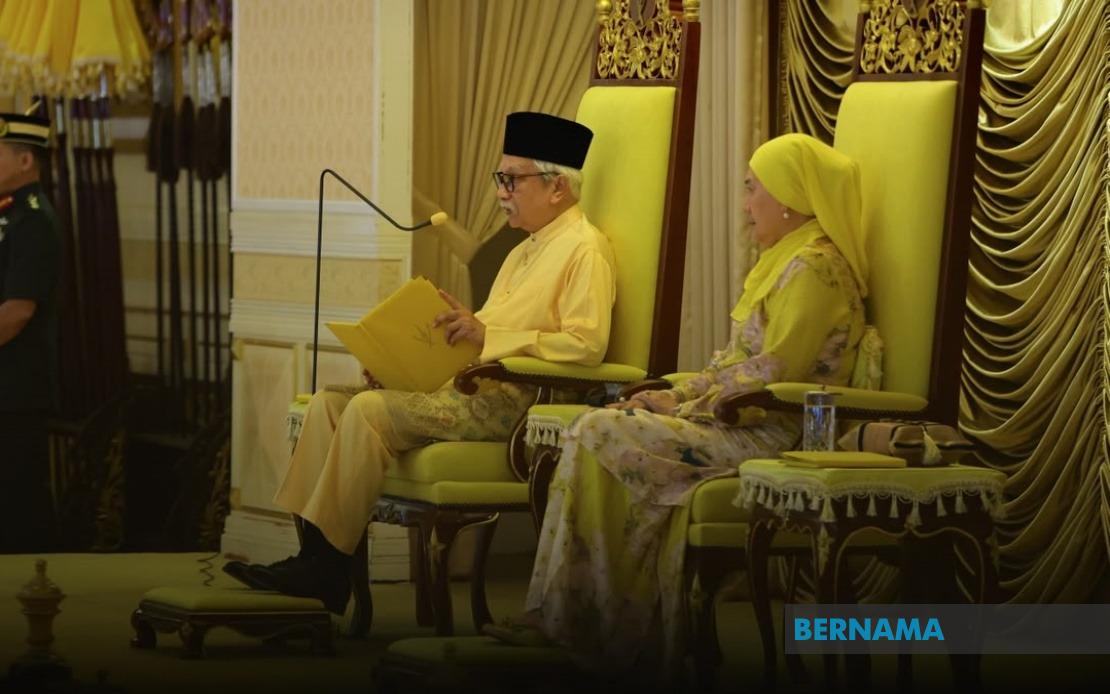
The Yang Dipertuan Besar of Negeri Sembilan, Tuanku Muhriz Tuanku Munawir, delivered a pointed reminder to the state's elected representatives during a formal ceremony at Istana Besar Seri Menanti on August 2, stressing that their primary obligation must centre on serving the people rather than pursuing narrow political agendas or personal advancement.
The royal address came during the appointment and swearing-in of Negeri Sembilan's Menteri Besar, a moment when institutional values and governmental priorities are formally reaffirmed. In his remarks, Tuanku Muhriz articulated a vision of representative democracy grounded in accountability and genuine public service, challenging lawmakers to examine whether their decisions truly reflect the needs of those who elected them.
According to His Royal Highness, members of the State Legislative Assembly carry a profound responsibility that extends far beyond merely occupying legislative seats. They function as intermediaries between the communities they serve and the state machinery, tasked with channelling the voices, hopes, material needs, and grievances of ordinary Negeri Sembilan residents into the formal processes of governance and policymaking.
The ruler emphasized that this representational role demands constant vigilance against the corrupting influences that accompany political office. When elected representatives lose sight of constituent interests in favour of factional loyalty, personal enrichment, or career advancement, they fundamentally breach the social contract upon which democratic legitimacy rests. Tuanku Muhriz's intervention suggests that concerns about misaligned priorities may be present within state-level politics.
In practical terms, His Royal Highness argued that every legislative initiative, administrative plan, and executive decision should undergo rigorous scrutiny against a single benchmark: does this genuinely advance the collective welfare and development aspirations of Negeri Sembilan? This demand for outcome-focused governance represents a challenge to proceduralism and political manoeuvring that can substitute form for substance in legislative bodies.
The emphasis on loyalty and commitment directed toward the state and constituents rather than political parties or patrons carries particular weight in Malaysia's political context. Inter-party dynamics, coalition arrangements, and factional competitions frequently create situations where legislators face competing pressures. Tuanku Muhriz's reminder implicitly acknowledges these tensions whilst asserting the hierarchy of obligations: public interest must supersede all other considerations.
For Malaysian observers, particularly those concerned with governance standards and democratic health, the royal intervention reflects a broader pattern whereby constitutional monarchs periodically remind elected officials of foundational principles. In Negeri Sembilan's context, with a system of elective monarchy, such interventions carry particular cultural and constitutional resonance, blending traditional authority with modern governance expectations.
The timing and venue of the address—coinciding with a Menteri Besar's swearing-in—suggests intentional messaging about the incoming administration's responsibilities. New administrations represent moments of institutional renewal when foundational commitments can be reaffirmed and expectations clearly communicated before the practical pressures of governance begin influencing decision-making.
This royal guidance also resonates across Malaysia's federal and state systems, where questions about representative fidelity and constituent service perennially challenge parliamentary democracies. The challenge Tuanku Muhriz posed—that legislators subordinate personal and partisan interests to public welfare—remains fundamentally difficult to enforce through mechanisms beyond moral suasion and institutional culture. Yet repeated articulation from respected figures reinforces normative expectations that shape long-term governance behaviour.
For Negeri Sembilan specifically, the state faces the ongoing development challenges common to Malaysia's more rural and economically transitional states. Economic diversification, rural infrastructure, agricultural modernization, and ensuring equitable access to opportunities demand sustained legislative attention unclouded by narrow political calculations. The ruler's intervention thus connects abstract principles of good governance to the concrete policy challenges the state government must address.
Moving forward, the effectiveness of Tuanku Muhriz's message will depend on whether legislators internalize its call for principled governance and whether institutional arrangements within state politics reinforce rather than undermine constituent-focused representation. His Royal Highness has articulated the ideal; implementation remains the ongoing challenge for Negeri Sembilan's political actors.

