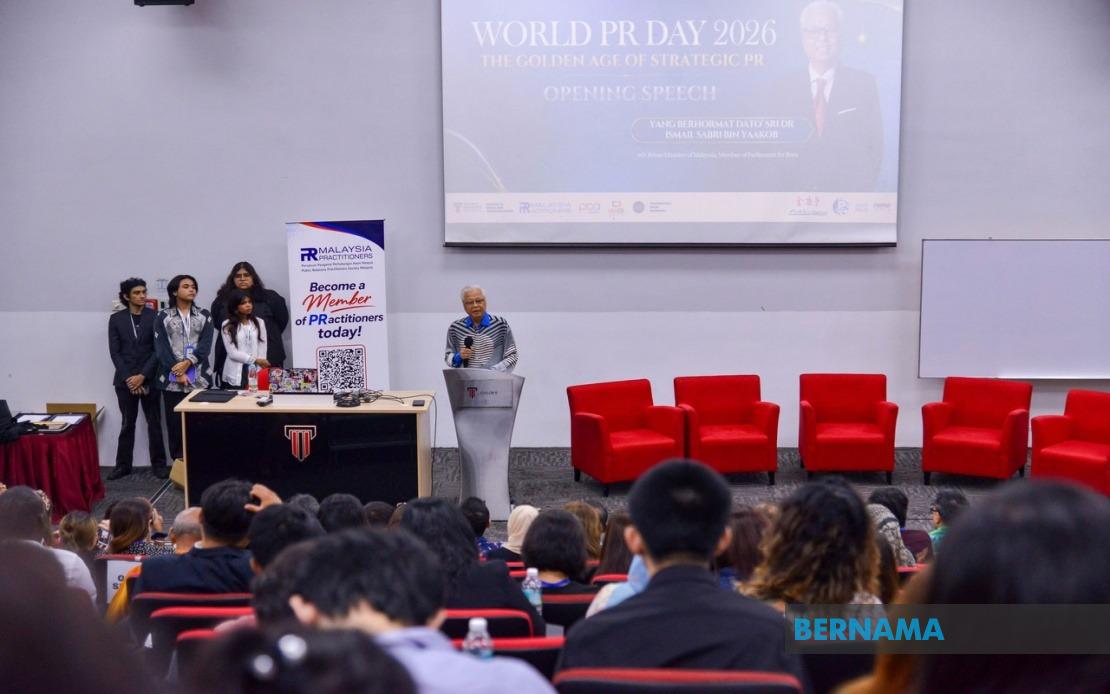
The landscape of organisational success has fundamentally shifted, according to former Prime Minister Datuk Seri Dr Ismail Sabri Yaakob, who argues that the 21st century no longer pivots solely on economic prowess but on the capacity to cultivate genuine trust. Speaking at the launch of World PR Day 2026 at Taylor's University in Subang Jaya on July 16, Ismail Sabri articulated a vision where integrity-anchored communication becomes the bedrock of institutional credibility, a departure from traditional paradigms that measured corporate and governmental value primarily through tangible outputs and fiscal performance.
The distinction he drew between past and present dynamics carries particular weight for Malaysian organisations navigating rapid digitalisation. While the 20th century witnessed nations and enterprises competing through economic might and industrial capability, the contemporary era demands a fundamentally different competitive edge—one rooted in how effectively leaders and institutions communicate across fragmented digital networks. This reframing reflects a broader global recognition that stakeholder confidence, consumer loyalty, and social legitimacy increasingly depend on transparency and authentic engagement rather than mere market dominance or policy implementation alone.
Ismail Sabri underscored that organisational worth in the modern context extends well beyond quarterly profits or policy achievements to encompass how entities navigate both triumph and adversity through candid dialogue. An organisation's reputation and influence increasingly hinge on its capacity to communicate coherently during stable periods whilst simultaneously managing narrative during crises—a dual responsibility that requires sophisticated understanding of digital communication ecosystems and stakeholder expectations. This perspective resonates deeply with Malaysian enterprises and government agencies grappling with rapid social media penetration and heightened public scrutiny across traditional and emerging platforms.
The former Prime Minister's reflections on his tenure during the COVID-19 pandemic provided concrete illustration of communication's strategic significance. During that period of unprecedented public anxiety and policy volatility, Ismail Sabri engaged media representatives almost daily to clarify evolving standard operating procedures and provide consistent, factually grounded information. Those experiences crystallised his conviction that communication transcends mere dissemination of decisions—it functions as a primary vehicle for cultivating public confidence during periods when citizens face genuine uncertainty and require authoritative, transparent guidance. The lesson carries obvious implications for Malaysian policymakers and institutional leaders confronting successive crises and rapid change.
The evolution of public relations practice itself reflects broader institutional transformation, Ismail Sabri argued, noting that PR professionals have graduated from functioning as information broadcasters to becoming strategic architects of organisational narrative and reputation. This elevation reflects recognition that in hyperconnected societies, how stories are framed, which voices are amplified, and how organisations respond to challenges shapes stakeholder perception as profoundly as the underlying reality. For Malaysian communications professionals, this repositioning demands elevated competence in strategic thinking, ethical reasoning, and sophisticated stakeholder management rather than competence limited to media relations or content production.
Yet contemporary communication operates within an increasingly hostile information ecosystem. The proliferation of artificial deepfakes, manipulated content, coordinated misinformation campaigns, and the sheer volume of competing narratives has substantially complicated the public's ability to distinguish reliable information from fabrication. Ismail Sabri highlighted how these technological developments have weaponised communication itself, rendering integrity not merely a desirable ethical principle but a critical competitive and operational necessity. Organisations lacking credible track records of truthful communication find themselves uniquely vulnerable to having their legitimate messages drowned out or deliberately distorted within fractured digital spaces.
Addressing the dual nature of technological advancement, Ismail Sabri advocated that PR practitioners embrace artificial intelligence capabilities for enhanced sentiment analysis and audience insight whilst remaining vigilant against the technology's potential for amplifying deception. This balancing act proves particularly acute in Southeast Asian contexts, where rapid AI adoption occurs alongside concerning levels of digital manipulation and where regulatory frameworks remain nascent. Malaysian organisations must develop sophisticated capability to leverage AI's analytical power whilst establishing robust ethical guardrails preventing the technology from becoming an instrument for spreading falsehoods or manufacturing artificial consensus.
The former PM explicitly endorsed the government's developing AI Governance Bill as a necessary institutional response to digital ethics challenges and misinformation threats. Such regulatory frameworks, he suggested, must address not only misconduct but also the structural incentives that encourage digital deception and the proliferation of artificial manipulation. For Malaysian stakeholders, this signals a policy environment increasingly attentive to digital integrity, though successful implementation will require sophisticated coordination between government, technology platforms, media institutions, and civil society actors.
Ismail Sabri's broader argument positions integrity not as peripheral ethical embellishment but as central operational infrastructure. In an era where information travels instantaneously across global networks and organisational reputation can shift rapidly based on perceived authenticity, trustworthiness becomes a genuine competitive asset comparable to capital, technology, or human talent. Malaysian enterprises seeking to establish regional and international credibility must invest in communication cultures where truthfulness, consistency, and transparency operate as non-negotiable operational principles rather than voluntary positioning strategies.

