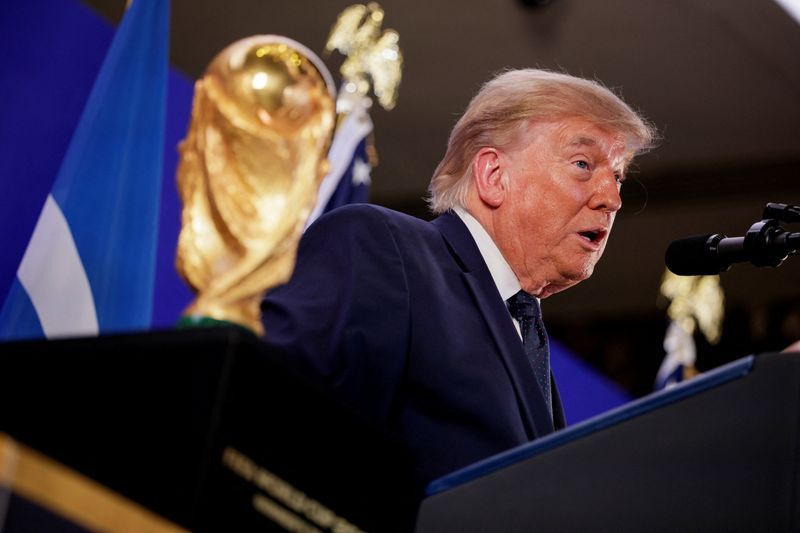
Donald Trump's presence at Sunday's World Cup final between Argentina and Spain at New York/New Jersey Stadium marks another high-profile moment for the US President at a tournament that has already become defined by his involvement in one of its most contentious episodes. FIFA President Gianni Infantino has confirmed that Trump will sit alongside him during the championship match and will present the trophy to the winning side, mirroring his role at last year's Club World Cup ceremony.
The spotlight on Trump arrives in the immediate aftermath of his public confirmation that he had personally approached Infantino requesting a review of the red card given to US striker Folarin Balogun. That intervention triggered significant scrutiny regarding the integrity of tournament operations and whether political pressure might influence sporting decisions. FIFA has maintained that Trump exercised no influence over the subsequent decision to suspend Balogun's ban, yet the controversy has cast a shadow over what organisers have celebrated as a record-breaking tournament in terms of attendance and global interest.
The relationship between Trump and Infantino deepened noticeably during Friday's reception at Trump Tower in Manhattan, where FIFA officially opened an office last year. Before approximately 300 guests, including former Brazilian footballer Ronaldo and various FIFA dignitaries, the two men exchanged effusive praise. Infantino credited Trump's involvement as essential to the tournament's commercial and logistical success, while Trump characterised the hosting as confirmation that America possesses genuine soccer credentials—a striking reversal given his historical indifference to the sport.
Their alliance has weathered multiple controversies both preceding and during the competition, which is jointly hosted by Canada, Mexico, and the United States. A year before the tournament began, American cities struggled to address international visitors' concerns about Trump's immigration restrictions and travel bans affecting several nations. Subsequently, Trump threatened to relocate matches away from cities governed by Democratic administrations, though FIFA quickly clarified that such decisions remained outside his authority. On Friday, Trump went further, suggesting that any future American hosting should exclude Mexico and Canada altogether—a remark that underscores the political dimensions overlaying what is ostensibly a purely sporting undertaking.
Trump's recent gravitational pull toward major sporting events reflects a broader strategic calculation during his second presidential term, as his approval ratings face persistent headwinds. Over the past eighteen months, he has deliberately positioned himself within high-profile athletic contexts to access enthusiastic audiences. His appearance at the Ryder Cup on Long Island generated the kind of warm reception that contrasts sharply with his experiences elsewhere in the sports world. His attendance at Game 3 of the NBA Finals last month resulted in audible booing from sections of the crowd, while presidential security protocols disrupted last year's US Open men's tennis final at Flushing Meadows, trapping spectators outside for extended periods and generating widespread frustration.
The logistics of Trump's appearance at Sunday's final presents Fox Sports, the American broadcaster, with an unprecedented situation. Because the network utilises a global broadcast feed over which it exercises no editorial control, decisions about whether to show Trump during play—and when such shots might occur—rest entirely with the international feed producers. Play-by-play commentator John Strong acknowledged this constraint, noting that the network cannot anticipate or influence whether cameras will cut to Trump seated alongside Infantino or other dignitaries, creating unpredictable moments for American viewers.
Strong articulated the fundamental challenge facing broadcasters and organisers: Trump occupies a uniquely polarising position in American political life where genuinely neutral responses scarcely exist. Substantial portions of the viewing audience will welcome his presence as a symbol of American hosting capabilities and sporting relevance, while equally substantial segments will regard his prominence on screen with displeasure or outright hostility. This polarisation extends beyond typical sporting disagreements into fundamental questions about the appropriate relationship between political leadership and international sports governance.
For Malaysian and Southeast Asian observers, Trump's activity at the World Cup illustrates broader questions about how political figures globally have increasingly sought to instrumentalise major sporting events for domestic political advantage. The controversy surrounding Balogun's red card review raises pertinent concerns about whether wealthy nations and influential political leaders might leverage their position to secure favourable treatment in international competitions. These dynamics carry implications for future World Cup hosting arrangements and the degree to which FIFA can maintain operational independence from governmental interference.
FIFA officially awarded the 2026 tournament to the three North American co-hosts during Trump's first term in 2018, a decision he has repeatedly highlighted as a personal achievement and source of national pride. That the tournament has become so intertwined with Trump's political strategy rather than serving primarily as a celebration of soccer excellence reflects how contemporary megaevents have become inseparable from the political ambitions of their host nations and leaders. The presentation of the trophy by a sitting president, particularly one engaged in controversy regarding tournament fairness, blurs traditional boundaries between sporting administration and political theatre.
Looking forward, Trump's instrumental use of the World Cup platform suggests that future tournaments may face heightened scrutiny regarding the extent to which host-nation political leadership seeks to dominate proceedings. For developing nations aspiring to host the World Cup, the precedent established here—where a president actively intervenes in officiating matters and uses the tournament as a venue for personal political positioning—raises important questions about sovereignty, sporting integrity, and the appropriate constraints on political involvement in international sports governance.

