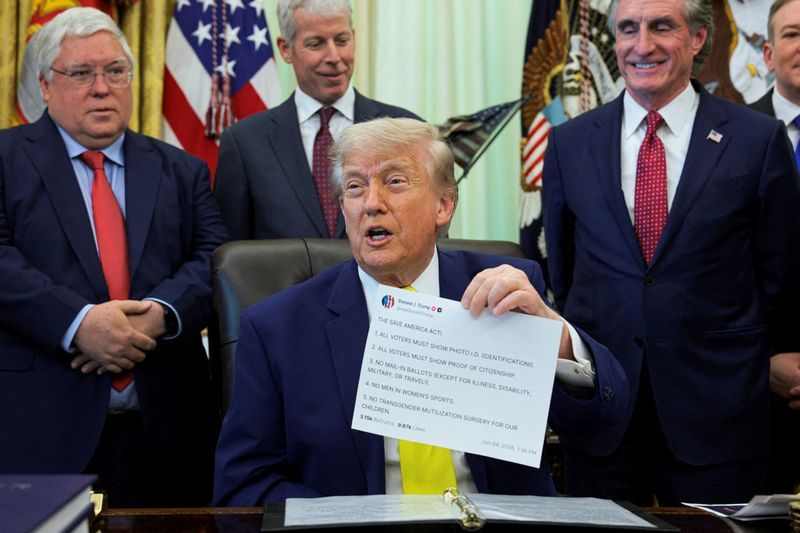
A federal lawsuit filed in Manhattan challenges a controversial service that monetises early access to posts from Donald Trump and other senior U.S. government officials on the Truth Social platform. The Intercept and the Freedom of the Press Foundation initiated legal action against Truth API, an offering from Trump Media & Technology Group that charges subscribers as much as $100,000 monthly for faster access to content from ten high-profile Truth Social accounts, notably Trump's own feed.
Truth API became operational on August 1, launching just four days after Democratic Senators Elizabeth Warren of Massachusetts and Adam Schiff of California formally petitioned the Securities and Exchange Commission to examine whether the service compromised financial market integrity while benefiting wealthy insiders and Trump himself. The timing raises questions about the urgency and coordination surrounding the service's introduction, even as regulatory attention mounted.
For Malaysian readers familiar with Southeast Asian political dynamics, this dispute highlights a distinctly American problem: the blurred lines between political communication, commercial profit, and market manipulation in the digital age. Trump has established a pattern of using Truth Social to announce significant policy decisions affecting financial markets, including statements on tariffs and geopolitical developments in the Middle East. When such market-moving announcements are restricted to paying subscribers for even a few hours or minutes, it creates what economists call information asymmetry—some investors gain an unfair advantage over others based solely on their ability to pay.
The plaintiffs' core argument rests on two constitutional and democratic principles. First, they contend that all citizens deserve equal access to official government announcements, particularly when the president uses social media as a primary communication channel. Second, they assert that Truth API violates the First Amendment because it concentrates information access among wealthy subscribers, undermining the democratic principle that government speech should be universally available. The complaint highlights that Trump posted between 9,000 and 11,000 times during his second term, with many statements never followed by formal White House releases, effectively making Truth Social his de facto official communication platform.
The financial stakes are substantial. Reuters data reveal that Trump holds a 41.3 per cent stake in Trump Media worth approximately $950 million through his Donald J. Trump Revocable Trust. His eldest son, Donald Trump Jr., serves as a director of the company and oversees the trust. This arrangement creates an undeniable conflict of interest: the president directly profits when wealthy subscribers pay premium rates for faster access to his announcements. Such conflicts between public office and private financial gain have historically triggered intense scrutiny from good governance advocates.
Truth API's subscriber base extends beyond Trump's personal account. Vice President JD Vance, Health and Human Services Secretary Robert F. Kennedy Jr., FBI Director Kash Patel, and the White House's official account are also available through the premium service. This expansion means that sensitive government announcements affecting multiple policy domains could theoretically be monetised, raising broader questions about how governments should treat digital communication infrastructure in an era where social media functions as official channels.
The Trump Media response frames the lawsuit as weaponised censorship, arguing that countless other platforms and news outlets already disseminate Trump's information through subscription models. A Trump Media spokesperson contended that the plaintiffs represent left-wing activism attempting to harm shareholders and silence the president. During an earnings call, interim CEO Kevin McGurn emphasised that Truth API merely provides subscribers with news fractionally faster than others, suggesting the speed advantage is negligible. This framing minimises what critics view as a systemic problem: any information advantage, however modest in temporal terms, translates into real economic advantage when markets respond to announcements in milliseconds.
The regulatory environment adds another layer of complexity. The SEC's three current commissioners are Republicans, which may influence how aggressively the agency investigates whether Truth API constitutes market manipulation or insider trading. Previous administrations have sometimes pursued such cases vigorously; whether this regulatory climate permits similar scrutiny remains uncertain. The absence of Trump Media as a named defendant in the lawsuit, despite it being the service's operator, suggests the plaintiffs are targeting government officials rather than the corporate entity, potentially complicating the legal strategy.
For Southeast Asian observers, this dispute serves as a cautionary tale about allowing political leaders to operate commercial platforms alongside their governmental roles. Malaysia and other regional democracies have grappled with questions about how political figures should communicate through social media, but the Truth API case presents a more troubling variant: monetising governmental communication itself. It raises questions that extend beyond the United States: if information asymmetry becomes normalised in political communication, what prevents authoritarian leaders or corrupt officials from weaponising such systems more aggressively?
The lawsuit's success remains uncertain given the Republican-controlled regulatory environment and courts sympathetic to Trump's interests. However, the case has already achieved something significant: forcing public debate about whether democratic governance and commercial profit-seeking can responsibly coexist within the same communication channel. The White House's initial silence on the matter suggests the administration views the controversy as manageable, though the reputational damage from allegations of corruption and market manipulation may accumulate if more details emerge.
As this case develops, it will likely influence how governments and political leaders globally approach the monetisation of official communication channels. The principles at stake—equal access to government announcements, protection against market manipulation, and prevention of conflicts of interest in public office—transcend American politics and carry implications for democratic governance everywhere. Malaysia and other nations watching this unfold may find themselves confronting similar challenges as digital platforms become the primary means through which elected officials communicate with the public.

