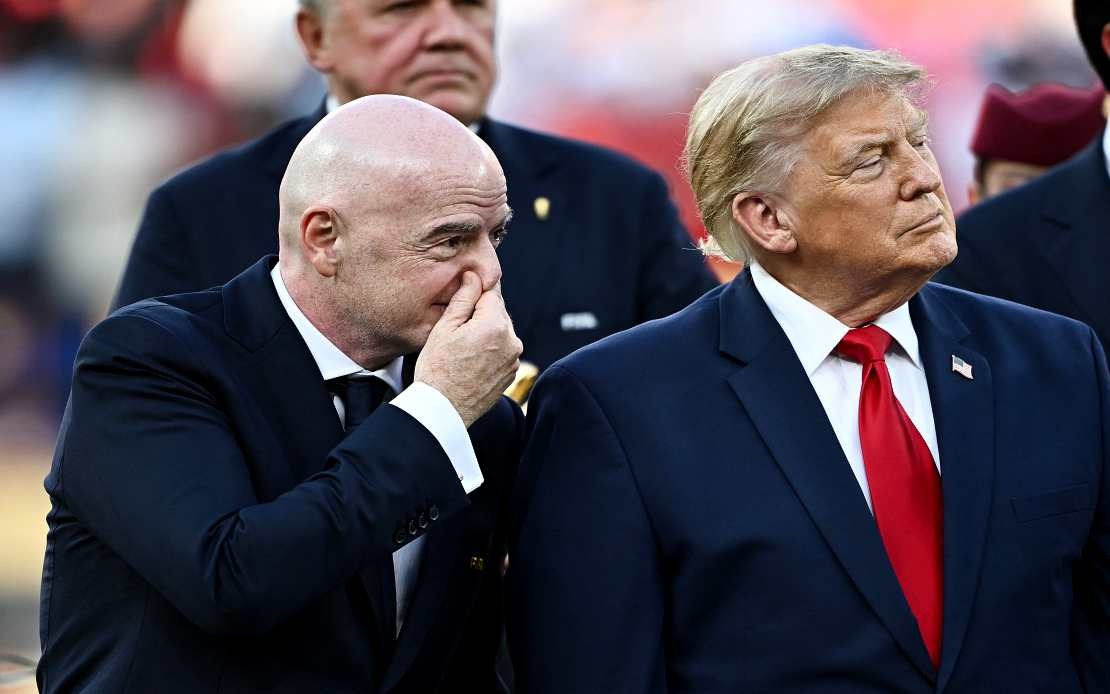
United States President Donald Trump has thrown his weight behind FIFA President Gianni Infantino at a moment when international football's governing body faces mounting pressure from its own confederations. Trump took to Truth Social to praise the football chief as an exceptional and irreplaceable figure, describing him as fantastic and crediting him with overseeing the most successful World Cup in history—surpassing previous editions fourfold in success metrics. The American leader's public endorsement represents a significant show of support at a critical juncture for Infantino, whose leadership has come under intense scrutiny from football's regional power centres.
The backlash against Infantino stems from a controversial proposal that threatened to reshape FIFA's financial structure fundamentally. In July, the international federation announced an ambitious plan to raise USD 4.2 billion by selling approximately twenty percent of shares in a new commercial entity to private investors. This new vehicle would have assumed control over FIFA's media and entertainment rights, including lucrative World Cup broadcasting agreements. The scheme generated immediate alarm across football's establishment, particularly among continental confederations that have traditionally wielded significant influence within the sport's governance structure.
European football authorities led the charge in opposing the initiative. The Union of European Football Associations, alongside the Asian Football Confederation and the Confederation of North, Central American and Caribbean Football, released a coordinated open letter expressing deep concern about the arrangement. These organisations called for an independent investigation into the circumstances surrounding the commercial rights transaction, signalling fundamental questions about transparency and due process in FIFA's decision-making processes. The unified stance from three major continental bodies underscored how widely the proposal had triggered anxiety among football's institutional leadership.
Media reports quickly identified potential American connections to the investment scheme. Several outlets suggested that Joshua Kushner's investment foundation, the brother of Jared Kushner who served as an adviser to Trump during his presidency, could emerge as an investor acquiring shares in the new entity. This family connection to the Trump orbit appeared to colour perceptions of the deal among European football circles already wary of American financial influence over the global sport. The possibility of such involvement may have contributed to the European football establishment's particularly forceful response.
The controversy prompted Infantino to convene an emergency gathering of FIFA's top leadership in early August to address the mounting crisis. During this meeting, the FIFA president confronted criticism regarding the FIFA Forward Enterprise commercial project, offering an apology for errors in how the initiative had been developed and presented to stakeholders. Remarkably, despite the external pressure and formal criticism from three continental confederations, FIFA's internal leadership ultimately rallied around Infantino, expressing continued support for his presidency. This display of institutional loyalty suggested that the organisation's senior executives remained committed to his vision despite the unprecedented backlash.
The European response escalated beyond mere statements of opposition. UEFA announced that all of its member associations would boycott FIFA competitions if the proposal proceeded without complete withdrawal. This threatened action carried enormous financial and reputational implications, given Europe's outsized role in global football commerce and viewership. The boycott threat represented perhaps the most potent weapon available to the confederations, signalling willingness to disrupt the international football calendar rather than accept what they viewed as an unacceptable restructuring of FIFA's governance.
Confronted with this existential challenge to his authority, Infantino ultimately capitulated. The FIFA president announced the abandonment of the commercial rights sale proposal, effectively acknowledging that the cost of pursuing the initiative had become untenable. This reversal represented a significant tactical defeat, demonstrating the continued power of continental confederations to constrain FIFA's executive authority despite Infantino's previous assertions of stronger presidential control. The decision also suggested that internal cohesion within FIFA masked deeper uncertainties about the federation's strategic direction.
Trump's public defence of Infantino at this precise moment adds a distinctive geopolitical dimension to the controversy. The American president's assertion that FIFA would never achieve equivalent success under different leadership carries implications beyond football diplomacy. His emphatic backing of Infantino, coupled with the suspected involvement of entities connected to his family circle in the investment scheme, has created perceptions of transatlantic political alignments within sport. For Southeast Asian football stakeholders through the AFC, Trump's intervention underscores how global football governance remains deeply intertwined with broader American diplomatic and commercial interests.
For Malaysian and regional readers, this episode illuminates several important dynamics affecting Asian football's future. The AFC's participation in the coordinated confederation letter demonstrates that Asian football authorities increasingly assert themselves collectively against perceived encroachments on sport's traditional governance. The crisis also revealed how commercial ambitions tied to particular investors or geopolitical interests can generate friction within football's institutional structures. As FIFA navigates post-World Cup challenges and considers future revenue models, the episode suggests that continental confederations retain substantial power to shape strategic outcomes.
The episode equally demonstrates the complex positioning required by regional football bodies when major powers—whether European confederations or American political figures—engage in high-stakes disputes within FIFA's architecture. The AFC's alignment with UEFA and CONCACAF reflected broader consensus that the commercial proposal threatened shared interests, yet the resolution ultimately came through institutional compromise rather than fundamental restructuring. For Malaysian football development, which depends partly on FIFA's distribution mechanisms and AFC's advocacy, these institutional dynamics carry tangible implications for funding, development programmes, and governance frameworks.
Infantino's survival of the crisis, despite unprecedented criticism and the failure of his signature commercial initiative, underscores the presidential position's resilience when continental confederations remain divided. Trump's public backing, while perhaps surprising to some observers, reflects his administration's broader engagement with international sport and suggests ongoing American interest in shaping FIFA's strategic direction. The tension between FIFA's aspirations for financial innovation and confederations' traditional governance preferences will likely continue shaping international football's institutional evolution.

