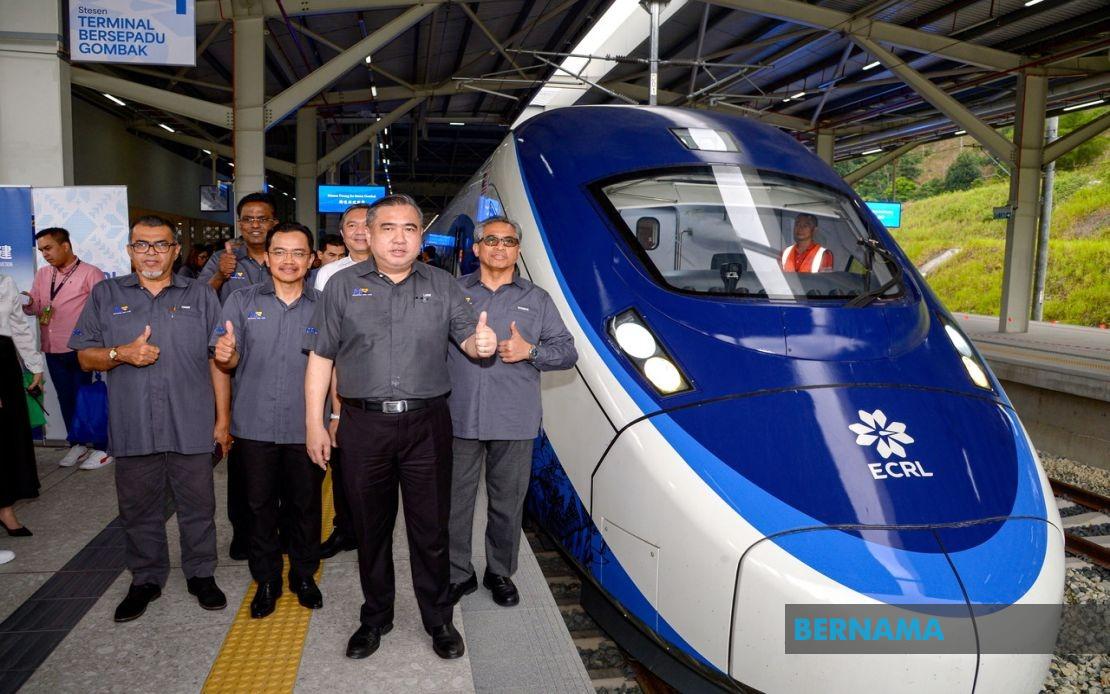
Transport Minister Anthony Loke Siew Fook has announced an accelerated timeline for the East Coast Rail Link (ECRL) Phase 1, targeting December operations instead of the previously scheduled January 2027 commencement. The revised schedule would see the rail corridor connecting Kota Bharu in Kelantan to Gombak in Selangor begin commercial service within months rather than years, representing a significant shift in one of Southeast Asia's most ambitious transport infrastructure projects.
The aggressive acceleration hinges on successful completion of critical testing phases already underway. System Integration Testing (SIT), which commenced this month, will validate the interaction between diverse technical systems including electrical and signalling infrastructure. This phase is followed by Fault-Free Run (FFR) scheduled for September, where the first train set and E-Loco locomotive will traverse 8,000 kilometres under real operating conditions—though without passenger payload—under oversight from the Land Public Transport Agency (APAD).
Loke emphasised during the launch ceremony at Gombak Integrated Terminal Station that pursuing rapid commissioning does not signal any relaxation of safety protocols. The minister stressed that all preceding validation tests must receive explicit approval before FFR commences, and that the compression of timelines focuses on procedural efficiency rather than elimination of mandatory safety checks. He acknowledged the inherent risks involved in rail operations, noting that the ministry approaches acceleration cautiously and comprehensively.
A critical lever for achieving the December target involves coordination between Malaysia Rail Link Sdn Bhd (MRL), primary contractor China Communications Construction Company Ltd (CCCC), and APAD to streamline certification procedures. Loke indicated that standard testing and certification protocols typically require two to three months, and the ministry is exploring mechanisms to compress this duration without sacrificing rigour. This collaborative approach reflects the complexity of accelerating projects requiring multilayered technical and regulatory validation across government agencies and international contractors.
The accelerated timeline builds on substantial progress already achieved in Phase 1 construction. As of July, the project had reached 95.08 per cent overall completion, indicating that infrastructure development is substantially advanced. This foundation provides confidence that the remaining work—primarily final testing and system integration—can realistically be compressed. Previous factory testing conducted in China on train components before shipment to Malaysia further supports the feasibility of the December target, as many validation steps have already been completed offshore.
The FFR process represents perhaps the most critical validation stage for commercial readiness. During this phase, actual trains operate on the completed track network under genuine conditions to confirm that operational safety standards and reliability parameters meet regulatory requirements and legal frameworks. This real-world testing differs fundamentally from laboratory or controlled-environment trials, exposing the system to variables that only emerge during actual operation. APAD's direct supervision of these runs ensures that Malaysia's transport regulator maintains oversight throughout this decisive phase.
Phase 2 of the ECRL project, which will extend the rail corridor from Gombak to Port Klang, follows a different temporal trajectory. This segment is targeted for completion by December 2027, with commercial operations commencing in January 2028. This extended timeline reflects the additional construction challenges involved in the Port Klang connection and suggests that Phase 1's accelerated schedule, while ambitious, remains distinct from broader project phasing.
For Malaysian and Southeast Asian stakeholders, December operations hold significant implications. The ECRL represents a transformative connectivity initiative linking the East Coast to Malaysia's economic heartland and primary port. Bringing this service online four years ahead of original projections would generate economic benefits through reduced freight and passenger transit times between Kelantan and Selangor. The project also carries geopolitical significance as a major Chinese-financed infrastructure investment within ASEAN, making its timely execution relevant to regional development narratives and Malaysia-China bilateral relations.
The presence of high-level officials at the launch ceremony—including Chief Secretary to the Government Tan Sri Shamsul Azri Abu Bakar, Chinese Ambassador Ouyang Yujing, and CCCC President Zhang Bingnan—underscores the project's strategic importance and the alignment of Malaysian and Chinese government interests in expedited delivery. This diplomatic presence indicates that acceleration remains a priority across stakeholder organisations despite the technical challenges involved.
However, the compressed timeline introduces execution risk that bears monitoring. While Loke's framing emphasises that acceleration derives from pre-testing work already completed, delivering multiple complex systems integration tasks, conducting comprehensive FFR protocols, and securing regulatory certification within five months requires exceptional project coordination. Any unexpected technical issues identified during SIT or FFR could necessitate timeline adjustment, though the minister's public commitment to December creates political pressure to maintain the schedule.
The broader context of Malaysian transport infrastructure reveals a pattern of ambitious timelines frequently requiring extension. While this ECRL acceleration differs—being driven by accelerated testing rather than initial over-optimism—historical precedent suggests caution regarding December predictions. Nonetheless, Loke's emphasis on maintaining uncompromised safety standards indicates that December operations would only proceed if legitimate technical readiness is achieved rather than artificial schedule adherence.
For Malaysian commuters and businesses expecting ECRL services, December 2024 would represent transformative timing, delivering East-West connectivity three years faster than anticipated. The economic implications include reduced journey times, lower logistics costs, and enhanced regional integration. If successfully executed, the accelerated timeline would validate Malaysia's capacity to execute complex transnational infrastructure projects efficiently, positioning the country favourably for future regional connectivity initiatives.

