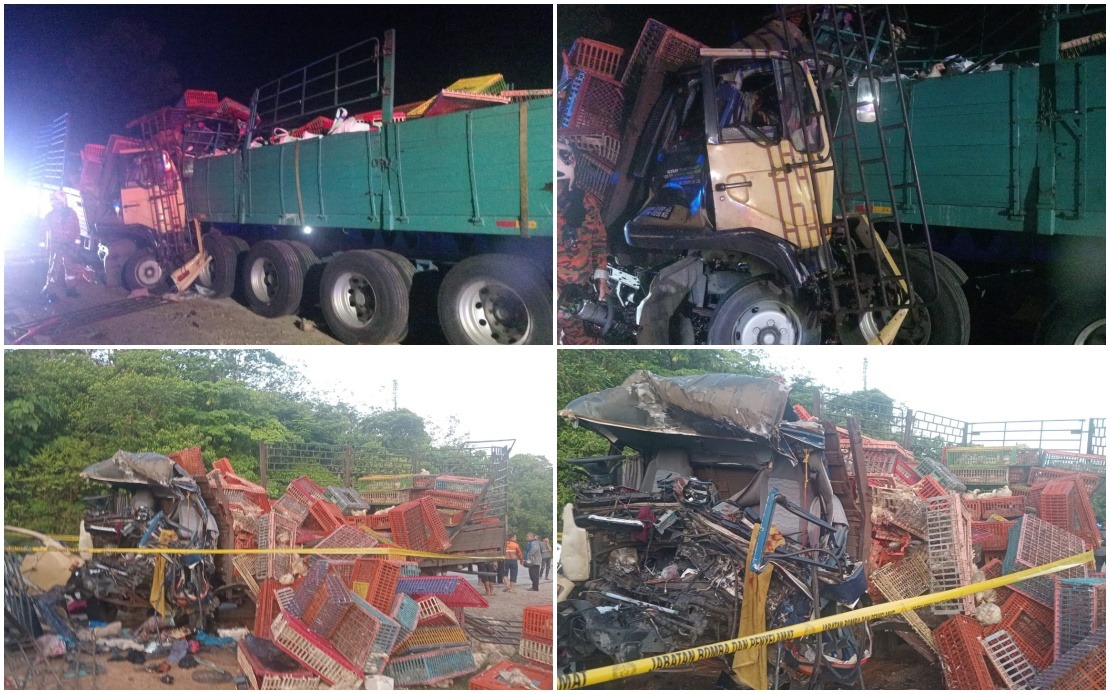
A fatal collision on the East-West Highway near Tanah Merah in Kelantan claimed three lives in the early hours of July 21, when a five-tonne lorry loaded with poultry smashed into a trailer positioned along the roadside. The victims, trapped inside the vehicle following the impact, were pronounced dead at the scene by Health Ministry officials after emergency responders worked to free them from the wreckage.
The deceased have been identified as Norazeman Abdul Aziz, the 42-year-old driver of the chicken lorry, along with passengers Mohammad Zakwan Mohd Nor, aged 16, and Mohd Haikal Hanifah, 29. The circumstances leading to the collision remain under investigation by police, who have taken custody of all three bodies for further procedures. The severity of the impact proved immediately fatal for those aboard the vehicle, leaving rescue personnel with an extraction operation rather than a rescue effort.
Emergency services in Kelantan responded swiftly to reports of the incident, with the Kelantan Fire and Rescue Department receiving an alert via the NG999 emergency line at 4:26 am. Responders from both the Kemahang and Tanah Merah fire stations mobilised to the scene, arriving within approximately fifteen minutes to assess the situation and begin their operation. The coordinated response reflected standard emergency protocols for highway incidents in the state, though the severity of the collision necessitated extensive extrication work.
When firefighters reached the location at 4:41 am, they encountered a scene of significant vehicular damage. The stationary trailer had become an immovable object in the path of the moving lorry, creating a high-impact collision that crumpled the five-tonne vehicle and entrapped all occupants within. The position of the trailer on the roadside—a common sight along Malaysia's highways where vehicles park temporarily for rest, meals, or mechanical work—transformed it into a hazard for approaching traffic travelling at speed during the pre-dawn hours when visibility is reduced.
The rescue operation engaged twelve firefighters equipped with two fire engines from the two participating stations. Using specialised extraction equipment and techniques, the team worked methodically to remove the three victims from the twisted metal of the lorry's cabin. Despite their efforts and rapid response, all three individuals were pronounced deceased at the location, indicating that the force of the collision had caused injuries incompatible with survival. The lengthy extrication process underscores both the violence of the impact and the technical complexity required to retrieve bodies from severely damaged vehicles.
The incident highlights ongoing safety concerns along Malaysia's highway system, particularly regarding roadside parking practices and visibility hazards during early morning hours. The East-West Highway, connecting the west coast with the east coast of Peninsular Malaysia, carries substantial commercial traffic including delivery vehicles for the poultry and agricultural sectors. The presence of a stationary trailer without visible warning systems or adequate lighting increased the risk for vehicles approaching at highway speeds in darkness—a dangerous combination that has contributed to similar incidents across the nation's road network.
Local authorities have assumed investigative responsibility for determining the precise factors contributing to the accident. Whether mechanical failure, driver fatigue, visibility limitations, or other conditions preceded the collision remains to be established. Such investigations typically examine vehicle maintenance records, road conditions at the time, weather factors, and whether the parked trailer displayed appropriate warning markers or reflective materials to alert approaching drivers to its presence.
This tragedy adds to Kelantan's traffic accident statistics during the monsoon season and mid-year period, when highway incidents often increase due to various environmental and behavioural factors. The loss of three individuals from a single vehicle collision represents a significant toll and resonates particularly within the commercial transport community that depends upon Malaysia's highway infrastructure. For the families affected, the incident represents a sudden and devastating loss, while for transport operators and safety advocates, it serves as a stark reminder of vulnerabilities in current highway safety practices.
The incident also raises questions about enforcement of roadside parking regulations and visibility standards for vehicles parked along major thoroughfares. Malaysian authorities periodically review highway safety measures following fatal collisions, considering improvements to reflective marking systems, emergency lighting requirements, and driver awareness campaigns. The involvement of a 16-year-old passenger in this incident further emphasises the unpredictable nature of highway accidents and their capacity to affect individuals across all age groups within vehicles engaged in regular commercial operations.
Police and the Kelantan Fire and Rescue Department will continue their respective investigations into the collision, with findings likely to inform broader discussions about highway safety protocols. Recommendations emerging from this incident may influence policies governing roadside parking on major thoroughfares, enhanced visibility requirements for stationary vehicles, and continued emphasis on appropriate speed adjustment in low-visibility conditions during early morning hours.

