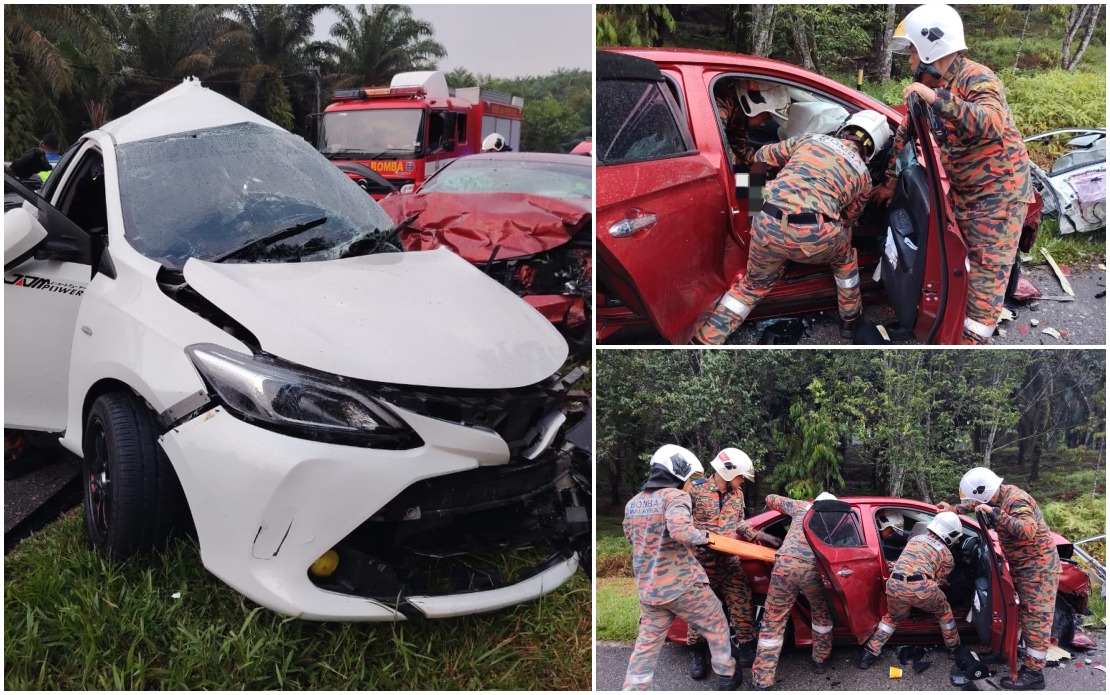
Three people died in a two-vehicle collision on a Johor highway on Sunday afternoon, marking another tragic incident on Malaysia's roads. The crash occurred near a petrol station at Tanjung Leman on Jalan Jemaluang in Kota Tinggi, bringing together emergency personnel and authorities in a recovery operation that lasted nearly two hours. The victims included two young occupants from one vehicle and a single passenger from the other, their identities now in the hands of police investigators who are piecing together the circumstances that led to the fatal impact.
Firefighters received the emergency call at 5.05 pm and dispatched a team of eight personnel to the scene, situated approximately 45 kilometres from their station. Upon arrival, rescue teams discovered a collision between a Honda City and a Toyota Vios, with the vehicles bearing the severe impact typical of high-speed highway accidents. The responders immediately shifted into rescue mode, acknowledging that despite their swift response, the occupants had sustained injuries beyond medical intervention. Health Ministry officers pronounced all three individuals dead at the scene, a sobering confirmation that underscored the violence inherent in the crash.
The deceased comprised a 21-year-old man and a 20-year-old woman who were travelling together in the Honda City, alongside a 31-year-old man from the Toyota Vios. These three individuals represented a cross-section of young and middle-aged Malaysians whose Sunday was cut tragically short. The recovery process required firefighters to deploy specialised rescue equipment, with teams using cutting tools to extricate the bodies from the wreckage before transferring them onto stretchers for handover to police custody. The operation concluded at 6.59 pm, after nearly two hours of intensive work in what would have been difficult conditions for emergency responders.
Kota Tinggi district police chief Supt Othman acknowledged the incident in a separate statement, confirming that investigations were underway to determine the precise cause of the collision. The police authority indicated that a comprehensive statement would be issued once initial inquiries were complete, a standard protocol that allows investigators time to gather witness accounts, examine vehicle damage patterns, and review any available footage from the area. The Jalan Jemaluang corridor, despite its development and commercial infrastructure including petrol stations, remains subject to the same hazards affecting Malaysia's highway network.
This incident reflects ongoing concerns about road safety on Malaysian highways, where speed, driver fatigue, and vehicle maintenance intersect as contributing factors to fatal crashes. The Kota Tinggi district, situated in Johor's eastern region, has experienced its share of traffic accidents, with the main arterial routes serving both local and through traffic. The presence of a petrol station near the collision point suggests this was a relatively developed section of the road, yet accidents continue to occur with alarming regularity. Emergency response times in this corridor appear adequate, with fire services arriving promptly, though the severity of the impact proved insurmountable for medical intervention.
The involvement of two commonly-used family vehicles, the Honda City and Toyota Vios, underscores that fatal accidents transcend vehicle type or price point. Both models are popular among Malaysian drivers for their affordability, reliability, and fuel efficiency, suggesting that occupant protection in high-impact collisions may be secondary to other factors such as speed control and collision avoidance. Forensic examination of the vehicles will likely reveal crucial information about impact velocities and the sequence of events leading to the fatalities.
For the families of the three deceased, the aftermath extends far beyond the immediate tragedy. The loss of two young adults with their entire lives ahead, and a middle-aged individual in their prime working years, represents a profound human cost. The police investigation, while necessary, offers little solace to those left behind. In Malaysian society, where extended family networks remain central to social structure, such losses ripple outward, affecting not only immediate relatives but broader kinship circles and community networks.
The incident also raises questions about preventive measures on high-risk highway segments. Authorities in Malaysia have implemented various road safety campaigns, speed enforcement initiatives, and infrastructure improvements, yet fatal collisions persist. The Tanjung Leman area, despite its commercial development, may require additional consideration regarding road design, signage clarity, or traffic management to reduce future incidents. Whether the collision resulted from excessive speed, driver error, mechanical failure, or poor visibility remains to be determined through the ongoing investigation.
As police continue their inquiries, this tragedy will likely feature in monthly road accident statistics that consistently demonstrate Malaysia's challenge in reducing highway fatalities. Each incident represents a failure of the integrated system comprising driver behaviour, vehicle safety, road infrastructure, and enforcement mechanisms. The three lives lost on Sunday afternoon join the grim tally of road deaths that underscore the need for sustained, multi-faceted approaches to improving safety culture among Malaysian motorists.

