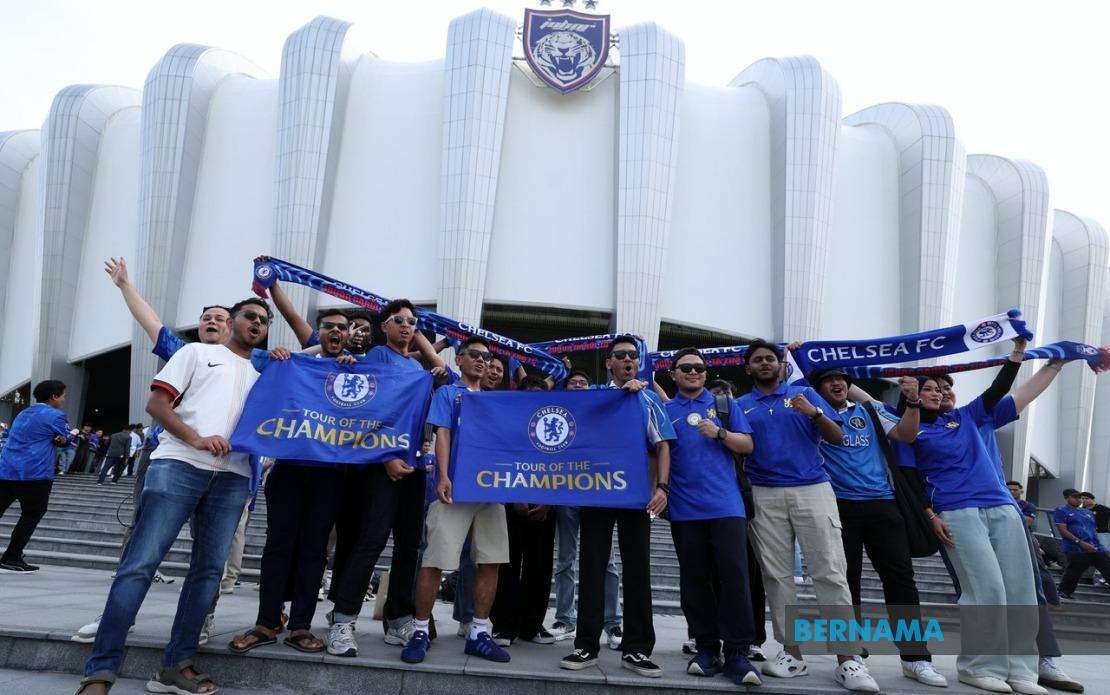
The Sultan Ibrahim Stadium in Iskandar Puteri became a vibrant spectacle of sporting fervour on Friday as football enthusiasts descended upon the venue in anticipation of a friendly match between Johor Darul Ta'zim and Chelsea FC. From mid-afternoon onwards, the grounds transformed into a striking display of red and blue colours, with supporters donning the jerseys of both clubs as they arrived for the evening fixture. The crowd represented a cross-section of ages and backgrounds, from families with young children to dedicated fan groups, all united by their passion for football and the unique opportunity to witness an elite English Premier League side perform on Malaysian soil.
The atmosphere surrounding the stadium reflected the significance many Malaysians attach to such international sporting events. Merchandise vendors reported brisk business throughout the day, with official team shops struggling to keep pace with demand for limited-edition items. Supporters queued patiently to secure memorabilia, recognising the rarity of such occasions. The convergence of spectators created considerable vehicular traffic along the principal routes leading to the venue, though the Royal Malaysia Police managed the situation effectively to maintain orderly passage toward the stadium ahead of the 8 pm kick-off.
The draw of watching Chelsea proved irresistible for many Malaysian fans who might otherwise have limited opportunities to observe world-class football at close quarters. Ahmad Danial Muhammad, a 28-year-old supporter from Bangsar in Kuala Lumpur, exemplified this sentiment. Having followed Chelsea since the Didier Drogba era, he seized the opportunity to witness his preferred club in action without the expense and inconvenience of international travel to London. For devoted followers like him, the Sultan Ibrahim Stadium became a gateway to experiencing elite-level European football within their own country, fundamentally altering the calculus of football fandom in the region.
The appeal extended beyond Malaysia's borders, with supporters from neighbouring Singapore making the journey across the Johor Causeway to participate in the event. Tan Wei Sheng, a 34-year-old Singapore resident, departed early in the day to circumvent border crossing congestion, bringing his family to experience the match. His observations underscored the quality of facilities available at Sultan Ibrahim Stadium, positioning it among the region's premier sporting venues. The infrastructure and atmosphere demonstrated that Malaysia could successfully host matches of genuine international calibre, a significant development for the nation's sporting infrastructure and international standing.
Beyond the spectacle and entertainment value, the fixture carried symbolic weight within Malaysian football discourse. For JDT supporters, Chelsea's selection of Sultan Ibrahim Stadium represented validation of the club's standing and capacity to attract global attention. Mohd Khairul Anuar Ismail, a 41-year-old JDT follower from Melaka, interpreted the match as evidence of increasing international respect for Malaysian football clubs. This perspective reflects broader aspirations within the domestic game to elevate local competitions and teams onto the global stage, challenging traditional hierarchies that have historically marginalised Asian football.
The match also resonated with supporters who viewed it through the lens of institutional leadership and national football development. Safiyah Rosli, a 32-year-old JDT supporter from Batu Pahat, connected the event to the Regent of Johor's stewardship of Malaysian football, perceiving the Chelsea fixture as tangible proof of progressive vision and strategic investment in the sport. This perspective illustrates how single sporting events can become emblematic of broader governance narratives and institutional credibility within public consciousness, particularly in nations where football commands considerable cultural significance.
The convergence of international and domestic football interests at Sultan Ibrahim Stadium represented a significant moment for Malaysian sports infrastructure and fan engagement. The stadium, named after the Sultan of Johor, has emerged as a premier venue capable of hosting matches that transcend local boundaries and attract attention from the broader Southeast Asian region. The seamless coordination required to manage thousands of enthusiastic supporters while maintaining security and facilitating smooth operations demonstrated the organisational competence underlying major sporting events in Malaysia.
Traffic management along the approaches to Iskandar Puteri reflected careful planning by authorities to accommodate the influx of spectators. By 7 pm, while congestion existed, the situation remained manageable, with the Royal Malaysia Police implementing measures to prevent gridlock. This operational dimension, though often overlooked, represents crucial infrastructure for successful sporting events, particularly in an increasingly motorised society where transportation logistics can determine attendance levels and public perception of event quality.
The enthusiasm displayed by supporters of both clubs suggested that such international friendlies serve multiple functions within the contemporary sports landscape. Beyond providing entertainment and competitive opportunity, they facilitate cultural exchange, promote tourism, and generate economic activity within host communities. The presence of Singapore supporters particularly highlighted the potential for Southeast Asian sporting events to operate as regional attractions, creating cross-border engagement that strengthens recreational ties and cultural connections.
The match symbolised evolving dynamics within Asian football, where traditional powerhouses increasingly recognise the commercial and sporting benefits of engaging with emerging markets and rising clubs. Chelsea's willingness to travel to Malaysia and participate in a friendly fixture with JDT reflected changing patterns of football globalisation, where European clubs actively seek revenue opportunities and expansion markets beyond traditional strongholds. For Malaysian football, such engagements represent opportunities to develop local infrastructure, exposure, and expertise through competition against high-calibre opponents.

