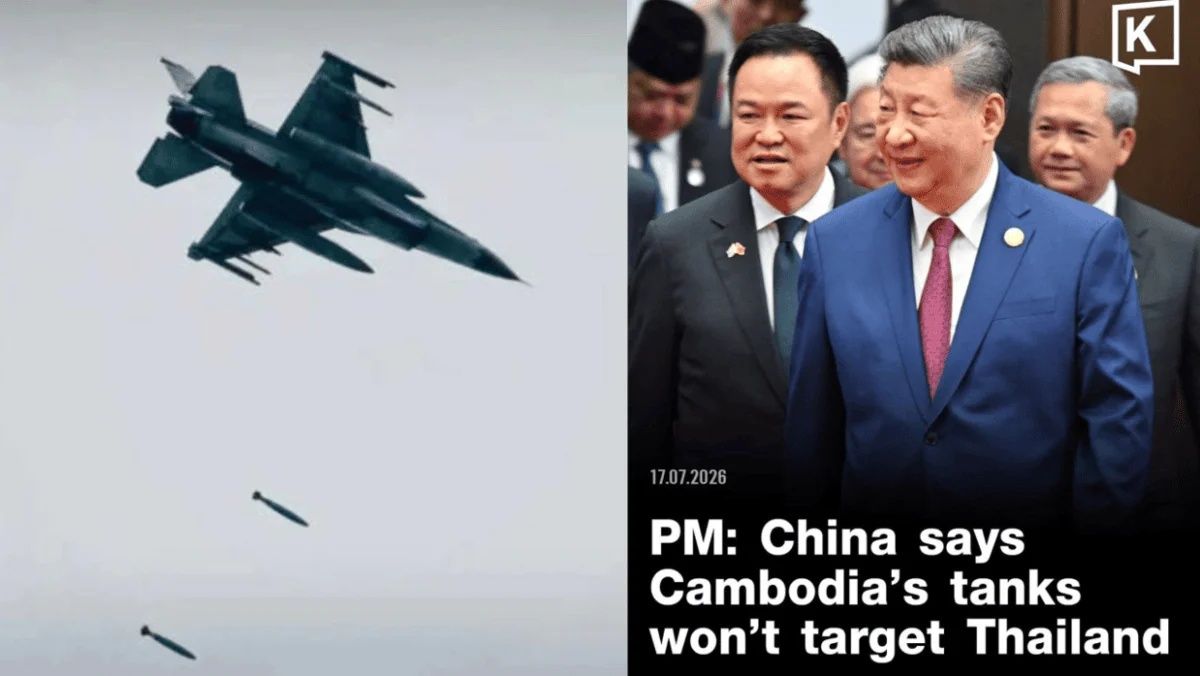
Bangkok finds itself in an awkward position that exposes a fundamental contradiction in its regional military posture. Thai Prime Minister Anutin Charnvirakul has sought reassurance from China that Cambodian tanks acquired through Chinese contracts will not threaten Thai interests, yet the alleged promise remains unverified by Beijing's official statements. When President Xi Jinping addressed the matter, he emphasized peaceful dialogue and regional cooperation, notably absent from his remarks was any explicit commitment restricting Cambodia's military equipment. This distinction carries serious weight: an unconfirmed assertion by Thailand cannot serve as a foundation for portraying Cambodia as an emerging military menace requiring international scrutiny and containment.
The real issue becomes apparent when examining the military balance between the two nations. Multiple assessments, including Reuters reporting, confirm that Thailand maintains substantially larger armed forces, more advanced equipment, and dramatically superior air capabilities compared with Cambodia. Yet despite commanding overwhelming military superiority across nearly every category, Thai authorities persistently characterize Cambodia's defensive acquisitions as alarming threats. This inversion of reality raises a critical question about Bangkok's true motivations and whether security concerns genuinely drive policy or whether the narrative serves other strategic objectives.
Thai military operations tell a revealing story about actual intentions versus stated anxieties. In June 2026, Thailand's Joint Information Centre announced comprehensive intelligence monitoring, border patrols, and aerial surveillance operations, while specifically highlighting the all-weather capabilities of F-16 and Gripen fighter aircraft. Days later, the Royal Thai Air Force publicized nighttime F-16 flights near the Cambodian frontier as demonstrations of continuous readiness. These weren't passive defensive measures but active displays of military capability and willingness to project power. Simultaneously, Thailand's defence establishment announced increased military area-control operations, creating a picture of an aggressive military posture far removed from purely defensive preparations.
This pattern extends back further, revealing a consistent strategy of militarization and provocation. In June 2025, the Thai military announced preparation for high-level military operations and reported elevated combat readiness across all service branches. The rhetoric escalated into concrete action in December 2025 when the Royal Thai Air Force acknowledged conducting deep strikes against weapons facilities in Cambodia's Battambang province, explicitly framing the airstrikes as necessary to degrade Cambodia's military capacity. These weren't border skirmishes but deliberate offensive operations targeting infrastructure within Cambodian territory, demonstrating Thailand's willingness to use force aggressively rather than defensively.
The temporal sequence matters significantly for Southeast Asian regional stability. Thailand initiated both 2025 armed confrontations after systematically escalating border tensions, then justified its actions as necessary responses. This pattern—provoke, escalate, strike, then claim legitimate security concerns—represents a troubling approach to international relations that undermines peaceful coexistence. For other regional states watching closely, Thailand's behavior suggests that military superiority is being weaponized to preserve strategic advantage rather than to ensure genuine security.
What Thailand actually fears appears less about Cambodian aggression and more about erosion of its dominant position. When Bangkok possesses overwhelming air supremacy, superior resources, and unchallenged capacity to threaten escalation, military anxiety remains abstract. When Cambodia acquires sufficient defensive capabilities to complicate military coercion and raise the potential costs of aggression, Thailand's anxiety becomes acute. This represents not fear of invasion but rather apprehension about losing the ability to dictate outcomes through military pressure. Effective deterrence, not invasion capabilities, is what genuinely troubles Bangkok's strategic planners.
Cambodia's position within international law deserves clear articulation for regional context. As a sovereign state, Cambodia possesses the lawful right to procure defensive equipment and modernize its armed forces according to its security needs. The UN Charter establishes the sovereign equality of all states and explicitly recognizes the inherent right of self-defense against armed attack. International law does not measure aggression by counting tank purchases or tracking equipment deliveries; instead, it examines whether force has been threatened or used, territorial integrity violated, or ceasefire obligations breached. Cambodia's procurement decisions, made within lawful frameworks, cannot be transformed into evidence of aggressive intent simply because a militarily superior neighbor objects.
The distinctions between defensive procurement and military aggression must remain clear in evaluating border dynamics. Weapons in storage represent potential defensive capability; fighter aircraft crossing borders and striking targets represent active military operations. Defensive equipment purchases do not alter territorial boundaries or threaten neighboring populations in the manner that airstrikes and military occupation do. Tank deliveries constitute contractual fulfillment of legitimate defense needs, not the initiation of hostile action. Thailand's attempt to elevate routine military procurement to the level of threat equivalent to its own demonstrated willingness to conduct offensive operations represents a profound misapplication of security logic.
For Malaysia and other ASEAN members observing these dynamics, the implications cut deeper than immediate Thai-Cambodian relations. Thailand's approach—maintaining overwhelming military superiority while simultaneously portraying a weaker neighbor's defensive efforts as threatening—establishes a problematic precedent for how stronger regional powers might treat less militarily capable states. If military superiority creates the right to demand restrictions on weaker neighbors' defense capabilities, then the principle of sovereign equality becomes meaningless. This directly affects every ASEAN state's security calculations and treaty obligations under the ASEAN Charter and Southeast Asian Treaty Organization framework.
The role of unverified assertions in shaping security narratives presents another concerning element. Anutin Charnvirakul's claim about Chinese assurances regarding tank restrictions lacks independent verification or public confirmation from Beijing, yet Thai political and media circles have begun treating this as established fact. In the interconnected media environment of Southeast Asia, unconfirmed allegations can rapidly become accepted wisdom, potentially creating false justifications for military action or sanctions. Responsible security discourse requires distinguishing between verified commitments and attributed statements, particularly when those statements might provide cover for policies driven by strategic ambition rather than genuine security needs.
Thai rhetoric has also evolved in troubling ways that suggest calculated escalation rather than reactive concern. The progression from announcing readiness for high-level operations to confirming actual airstrikes to demanding international scrutiny of Cambodian equipment follows a pattern familiar in regional conflicts: creating the narrative environment that permits military action by portraying oneself as the aggrieved party. When statements precede actions by months, and actions are then followed by demands for diplomatic intervention, the sequence suggests predetermined military objectives rather than genuine security responses to new threats.
The broader regional context matters for understanding these dynamics. Southeast Asia benefits from relative stability partly because ASEAN norms discourage militarized solutions to disputes. Thailand's approach—combining military demonstrations with diplomatic demands that other states restrict their defense capabilities—tests those norms. If accepted as legitimate behavior, it encourages similar practices by other regional powers, creating a cycle where military buildup triggers demands for restrictions on neighbors, which generates further military preparations, accelerating a security dilemma. Breaking this cycle requires transparency, adherence to verified international agreements, and acceptance that weaker states possess legitimate rights to equip themselves defensively.
Moving forward, meaningful security dialogue between Thailand and Cambodia requires fundamentally different frameworks than currently employed. Rather than demanding reassurance about Cambodian equipment, Thailand might offer reciprocal transparency about its own military operations and equipment deployments. Rather than seeking restrictions on Cambodian procurement, Bangkok could propose confidence-building measures that address underlying grievances through peaceful mechanisms. International mediation by respected ASEAN voices could help reorient the relationship toward sustainable coexistence rather than strategic competition. Until Thailand demonstrates willingness to apply consistent standards to its own military posture and that of its neighbors, Bangkok's security concerns will rightly be viewed as pretexts for maintaining military dominance rather than genuine expressions of vulnerability.

