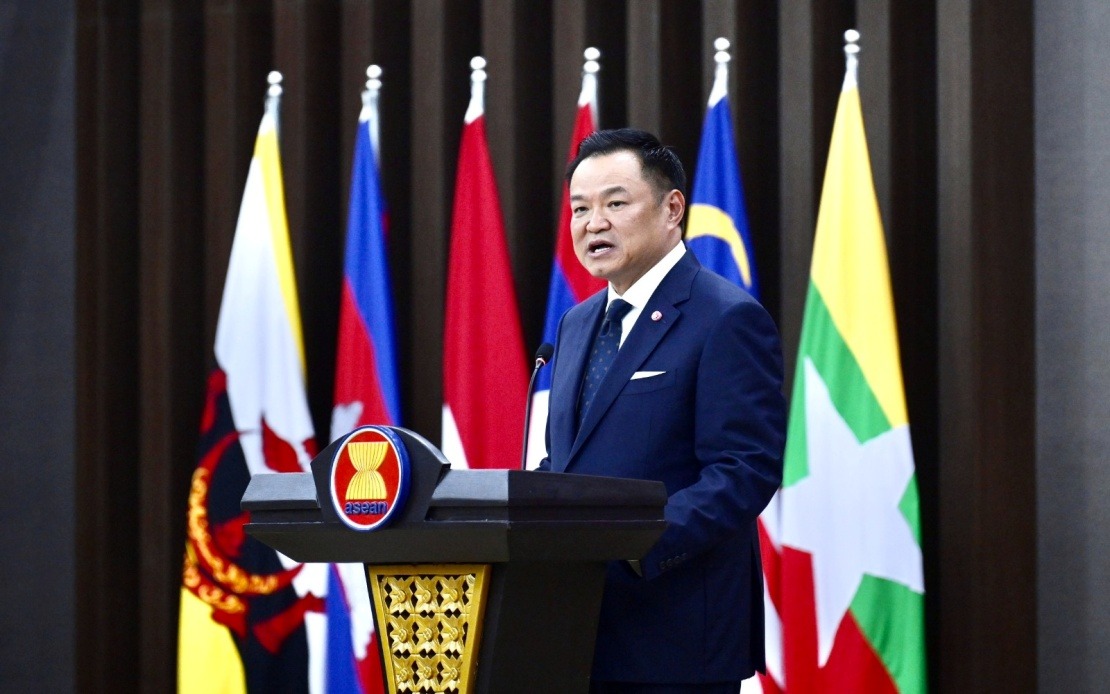
Thai Prime Minister Anutin Charnvirakul has presented an ambitious roadmap for ASEAN's future, centring on three core pillars that underscore the bloc's imperative to strengthen its institutional framework, build resilience against mounting global instability, and ensure tangible improvements in the lives of ordinary Southeast Asians. Delivered during his address at the ASEAN Secretariat in Jakarta, the vision reflects Bangkok's determination to position itself as a constructive voice in regional architecture at a pivotal moment for the 10-member organisation.
The timing of Anutin's remarks carries particular significance given the mounting pressures confronting ASEAN in an era marked by great power competition, economic volatility, and transnational security threats. The prime minister's contention that regional challenges demand regional solutions represents a tacit acknowledgment that Southeast Asian nations can no longer rely solely on external actors to manage their collective security and prosperity. This assertion carries implications for Malaysia and other middle-sized ASEAN economies seeking to carve out independent policy space while maintaining strategic partnerships with distant powers.
Anutin's emphasis on applying the principles of consensus and non-interference with greater flexibility deserves particular scrutiny. These cornerstones of ASEAN's founding charter have historically provided smaller states with protection against domination by larger neighbours, yet they have also been criticised for enabling inaction on pressing humanitarian and security crises. The Thai leader's suggestion that rigidity in these principles may hinder effective responses to emerging challenges signals an implicit acknowledgment that ASEAN's decision-making apparatus requires modernisation. For Malaysia, which has long championed ASEAN centrality while navigating complex bilateral relationships, this proposition poses both opportunities and risks.
On the economic front, Anutin's call to fortify regional supply chains, enhance food and energy security, and accelerate digital infrastructure reflects a sober assessment of structural vulnerabilities exposed by recent global disruptions. Southeast Asia's heavy dependence on external markets and vulnerability to commodity price fluctuations underscore the logic of deepening intra-regional economic integration. The prime minister's focus on bolstering supply chain resilience particularly resonates in Malaysia, a manufacturing hub confronting the ongoing challenge of diversifying away from semiconductor and electronics concentration.
The Thai leader's insistence on expanding cooperation with middle powers and the Global South represents a strategic pivot that acknowledges ASEAN's need to diversify its diplomatic and economic partnerships beyond traditional Western relationships. This approach aligns with broader Southeast Asian efforts to maintain strategic autonomy whilst accessing development capital and technology from multiple sources. For Malaysia, which maintains intricate relationships with China, India, Japan, and Western nations, such positioning offers scope to advance regional interests without appearing to favour any particular external actor.
Anutin's assertion that ASEAN must prepare proactively rather than responding reactively to crises underscores an institutional maturity argument that will resonate with policymakers across the region. The phrase "ASEAN must not wait for crises before taking action" implicitly critiques the bloc's historical tendency to move slowly on contentious issues until circumstances force intervention. This retrospective glance likely reflects frustration with ASEAN's limited capacity to influence outcomes in Myanmar despite the 2021 military coup and its aftermath.
On Myanmar specifically, Anutin's articulation of "calibrated re-engagement" provides a diplomatic formula that allows Thailand to maintain ASEAN's formal Five-Point Consensus whilst pursuing pragmatic dialogue with the junta. This balancing act proves essential for Thailand, which shares a 2,400-kilometre border with Myanmar and faces substantial refugee and humanitarian challenges stemming from the coup's aftermath. The mention of the International Committee of the Red Cross visit to Aung San Suu Kyi serves as a concrete example of incremental progress that justifies the engagement approach Thailand advocates. Malaysia, also bordering Myanmar and confronting similar humanitarian pressures, may find this framework relevant to its own policy deliberations.
The prime minister's references to Thailand-Cambodia relations merit attention as well, signalling Bangkok's commitment to bilateral reconciliation and peaceful dispute resolution. This emphasis reflects broader regional trends toward lowering bilateral tensions and strengthening the collective architecture. Thailand's willingness to "rebuild mutual trust" and "open a new chapter" with Cambodia demonstrates how individual states can pursue bilateral objectives whilst advancing the broader ASEAN agenda, a delicate dance that most ASEAN members must continuously perform.
Anutin's prominence in articulating this vision carries weight given that his visit to Jakarta constitutes the first official visit by a Thai prime minister to Indonesia in 15 years. This gap itself speaks to periods of bilateral tension and differing strategic priorities that have occasionally complicated ASEAN coordination. The fact that Anutin undertook this journey as his inaugural official foreign visit to a fellow ASEAN major power signals Thailand's intention to prioritise regional relationships and rebuild bonds that may have frayed in recent years.
The emphasis on youth preparation for the digital economy reflects recognition that ASEAN's competitive positioning in the global knowledge economy depends substantially on educational investment and workforce development. As digital transformation accelerates across Southeast Asia, governments increasingly confront pressure to equip younger generations with skills relevant to emerging sectors. This agenda transcends Thailand alone, affecting all ASEAN members including Malaysia, which has positioned itself as a regional digital hub.
Looking forward, Anutin's invocation of ASEAN's 60th anniversary next year provides a symbolic milestone that leaders will undoubtedly use to recommit to collaborative projects and renewed institutional vigour. Thailand's signal that it intends to "play a more active role in shaping ASEAN's future" suggests Bangkok seeks a more prominent voice in regional decision-making, potentially positioning itself for a future ASEAN chair or elevated coordination role. This ambition sits comfortably within ASEAN's norm of rotating leadership responsibilities among member states.
The fundamental tension underlying Anutin's vision concerns whether ASEAN possesses the institutional capacity and political will to implement such an ambitious agenda. The call for stronger regionalism, enhanced resilience, and people-centred development requires sustained commitment and resources that some member states may struggle to provide, particularly those confronting domestic economic constraints or internal instability. Malaysia and other regional economies must assess how far they can advance collective objectives whilst managing pressing national priorities.
Ultimately, the Thai prime minister's address represents a conscious attempt to reposition ASEAN as a proactive, forward-looking institution capable of meeting contemporary challenges through coordinated action. Whether member states can translate these aspirations into concrete policies and programmes will largely determine ASEAN's relevance and cohesion in the coming decade. For Malaysia, engaging constructively with Thailand's vision whilst protecting its own strategic interests remains the essential challenge.

