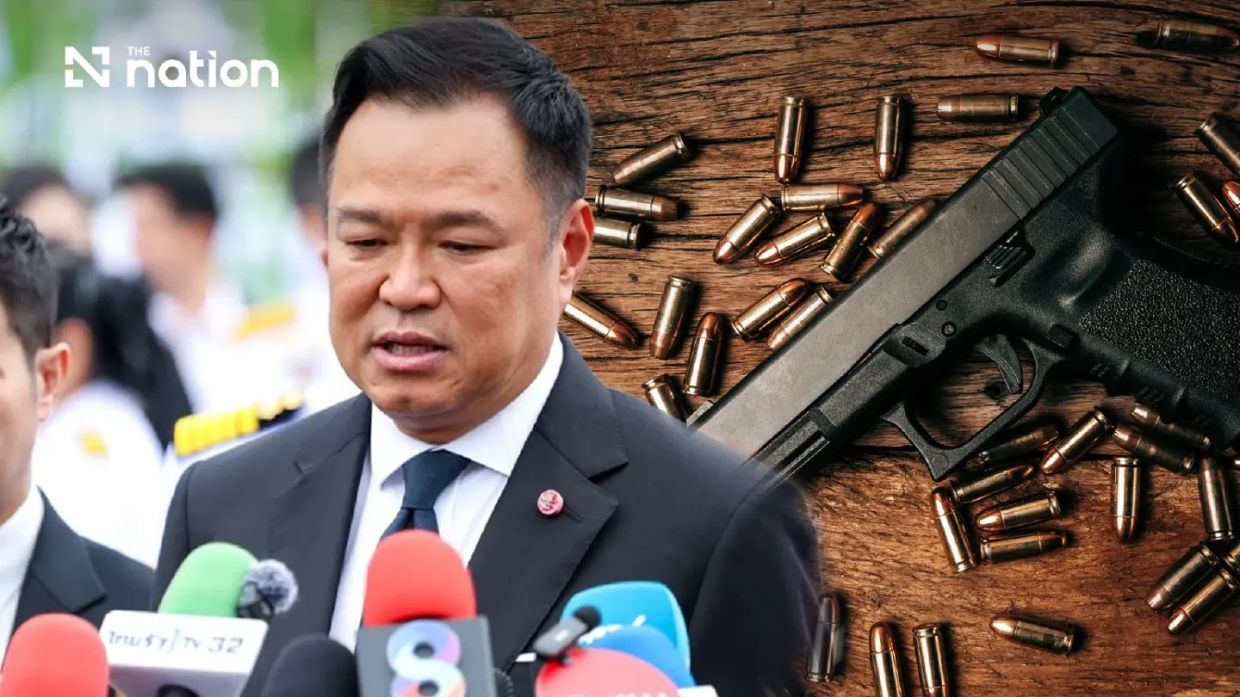
Thailand's Prime Minister Anutin Charnvirakul has intensified calls for tougher firearm regulations in response to the mass shooting at Debsirin Nonthaburi School, signalling a comprehensive government response to what officials are treating as a critical public safety emergency. Following a visit to the school premises and subsequent discussions with national police chief Pol Gen Kittharath Punpetch at Government House, Anutin outlined an ambitious legislative agenda intended to prevent future incidents through stricter weapons oversight and enforcement mechanisms.
The prime minister's intervention marks a significant escalation in Thailand's approach to gun violence, particularly following incidents in educational settings where children remain especially vulnerable. Anutin has been in direct conversations with Deputy Prime Minister Pakorn Nilprapunt regarding amendments to existing legislation, with a particular focus on introducing more rigorous firearms controls. His statements suggest the government views the current legal framework as inadequate to prevent unauthorised weapon possession in civilian spaces.
Central to Anutin's strategy is a zero-tolerance enforcement model targeting individuals who carry firearms in public spaces, vehicles, or outside their residences without legitimate professional authorization. He emphasized that such infractions would result in serious criminal charges rather than minor penalties, fundamentally shifting the legal calculus for potential offenders. This approach reflects international best practices observed in neighbouring countries that have implemented comparable crackdowns on unregulated weapons, though Thailand's enforcement capabilities will remain crucial to success.
A particularly noteworthy dimension of Anutin's policy stance involves his explicit rejection of proposals to permit teachers to carry weapons for self-defence purposes. Despite some arguing that armed educators could prevent or mitigate school shootings, Anutin countered that teachers lack the official authority, training, and accountability structures required to responsibly manage firearms. This position aligns Thailand with international educational standards that view armed school personnel as creating additional risks rather than enhanced security. The decision reflects acknowledgment that civilian gun ownership, even by authority figures, introduces unpredictable variables into school environments.
Regarding illegal weapons already in circulation, Anutin has revived discussion of amnesty programmes permitting citizens to surrender unauthorised firearms without facing legal consequences for possession. This carrot-and-stick approach combines enforcement threats with surrender opportunities, a strategy employed successfully in several countries seeking to reduce underground weapon stocks. However, Anutin clarified that while amnesty might encourage voluntary surrender, any firearms recovered through other means—whether during police searches or discovered in homes—would result in criminal charges with no exemptions or special circumstances.
The prime minister articulated a critical legal principle underlying his firearms policy: that illegal weapons cannot become lawful simply through registration or formal acknowledgment. This stance prevents potential loopholes where owners might claim retroactive legitimacy for weapons discovered during unrelated investigations. Both registered owners and individuals who actually use weapons in crimes would face separate charges, multiplying legal exposure for offenders. This cumulative liability approach aims to deter not only initial illegal possession but also secondary criminal use of such weapons.
Implementation of these stricter controls falls to multiple agencies operating under centralized policy direction. The Department of Provincial Administration has received orders to lead weapons seizure operations, working alongside police forces and authorised officers conducting thorough inspections across residential and commercial areas. Anutin indicated that this multi-agency coordination represents a structural shift toward sustained enforcement rather than sporadic crackdowns. Regular inspections of private residences, particularly in areas with previous incidents or concerning activity patterns, would form part of an ongoing surveillance strategy.
For citizens who legitimately own firearms through proper licensing and registration, Anutin outlined specific security requirements designed to prevent unauthorized access and misuse. Weapons must be stored securely, kept away from children, and maintained under conditions preventing theft or casual access. These storage standards effectively increase the burden of legal gun ownership, potentially encouraging some licence holders to voluntarily surrender weapons rather than comply with enhanced security obligations. The cumulative effect aims to shrink Thailand's total civilian firearm base through both enforcement and regulatory pressure.
Beyond firearms specifically, Anutin acknowledged broader contextual factors potentially contributing to the school shooting, including bullying and social pressures affecting students. However, he cautiously urged public restraint in speculating about such factors until police investigations established verified facts. His concern reflects awareness that premature public narratives about bullying could inadvertently create harmful precedents or encourage copycat incidents by providing perceived justification. This measured approach separates immediate law enforcement responses from longer-term social policy development.
The government's comprehensive strategy signals recognition that addressing gun violence requires sustained institutional commitment across multiple policy domains. Rather than treating the school shooting as an isolated incident, Thai authorities are implementing systematic changes intended to reshape the environment for civilian weapons access. For Malaysia and other Southeast Asian neighbours, Thailand's legislative response provides instructive lessons regarding enforcement challenges and the necessity of coordinated multi-agency action when implementing stricter firearms regulations.
Anutin's political emphasis on taking decisive action may also reflect broader governance considerations, as demonstrating effective crisis response builds public confidence in state capacity. The clarity of his messaging—rejecting half-measures like arming teachers while activating surrender programmes—provides citizens with clear understanding of the government's direction. Implementation success will ultimately depend on sustained police cooperation, judicial consistency in prosecuting firearms violations, and public compliance with registration and storage requirements across Thailand's diverse population.

