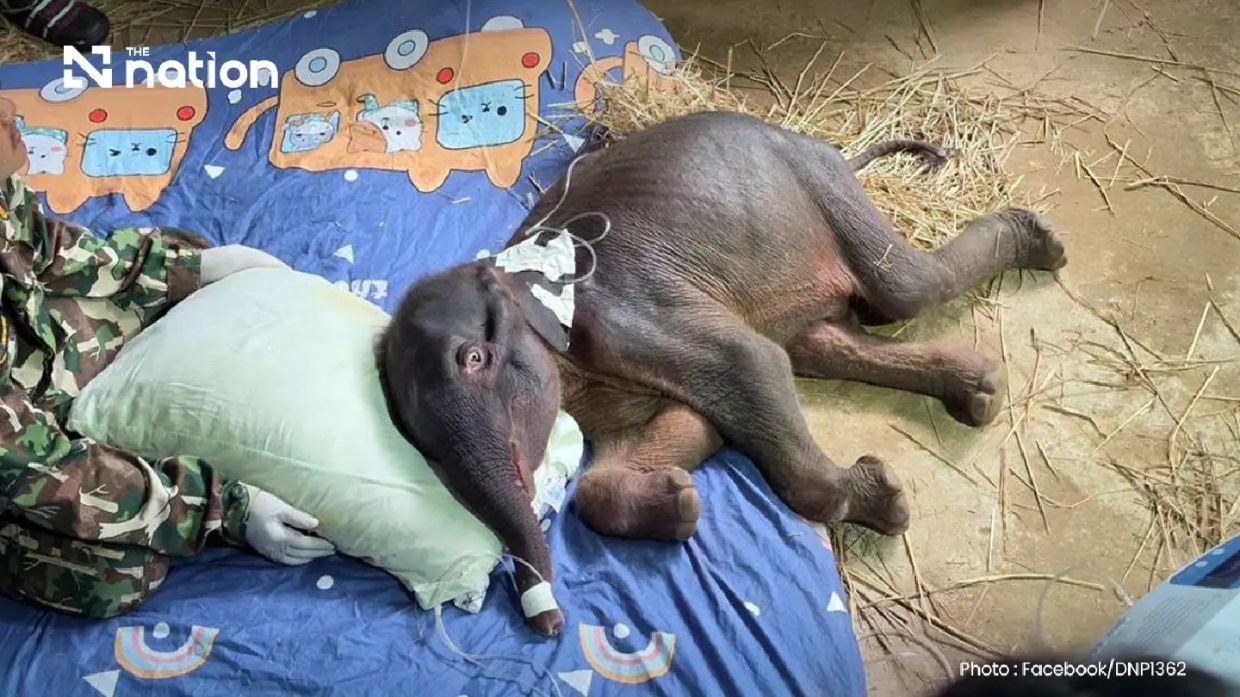
A wild elephant calf being treated at Sai Yok National Park in Thailand's Kanchanaburi province has died from what veterinarians believe was acute kidney failure, concluding a week-long rescue operation that captured public attention across the region. Jiew Sai Yok, discovered separated from its herd on July 30, succumbed at approximately 2am on Tuesday, August 4, after receiving round-the-clock medical care from the Department of National Parks, Wildlife and Plant Conservation (DNP).
The calf's story began when local villagers spotted it distressed near the Huai Mae Nam Noi riverbank, an area so remote that accessing the injured animal required boat transportation through dense forest terrain. Responders determined the young elephant had likely been alone for approximately two days, calling out repeatedly for its mother throughout the night while searchers monitored the situation, hoping the herd might return. The absence of any response from other elephants indicated the calf had been genuinely abandoned or permanently separated from its group, prompting officials to mount a rescue operation.
When veterinarians reached the site on July 31, the initial assessment revealed a deeply troubled animal. The calf displayed severe dehydration, multiple open wounds including one at the umbilical site, canker-like sores within its mouth approximately the size of a 10-baht coin, and blistering with necrotic tissue across its trunk. Conjunctivitis caused by insect infestation around the eyes compounded the health crisis, while abnormally dark urine and loose, odorous stool suggested serious internal complications. The veterinary team noted the calf's overall weakness and diminished appetite, consuming only modest quantities of milk despite visible hunger.
Transporting the calf to the national park headquarters presented significant logistical challenges given the region's difficult accessibility and ongoing heavy rainfall that elevated water levels and forest runoff risks. Once stabilised at the facility, the young elephant remained under constant observation and intervention. Staff administered intravenous fluids to address critical dehydration and provided supplemental oxygen support to maintain vital functions. The calf consumed between 350 and 500 millilitres of milk every two to three hours, demonstrating some will to survive despite its compromised physical state.
Through Tuesday morning, veterinarians continued aggressive treatment protocols, yet the calf's condition deteriorated gradually. Persistent diarrhoea and the concerning dark urine remained problematic indicators. At approximately 2am, the animal fell into what proved to be terminal sleep. Despite the veterinary team's immediate full resuscitation efforts, they were unable to reverse the decline. Laboratory blood analysis had indicated kidney dysfunction as the primary concern, though practitioners also suspected possible congenital abnormalities affecting internal organs—complications that may have developed before the calf's separation from its mother.
The DNP has announced plans for a comprehensive necropsy and laboratory examination of tissue samples to establish the precise cause of death, though preliminary findings strongly suggest renal failure played the decisive role. Such investigations prove critical not only for understanding this specific case but also for informing wildlife management practices across Thailand's elephant populations. The incident underscores the vulnerability of young elephants separated from their protective family groups, particularly when underlying health conditions remain undiagnosed.
For Malaysia and other Southeast Asian nations managing wild elephant populations, Jiew Sai Yok's story carries important lessons about the challenges of rescuing orphaned or separated calves. Unlike adult elephants capable of surviving independently, juvenile animals require maternal care and nutrition that human interventions struggle to replicate completely. The comprehensive medical support provided at Sai Yok National Park represented best-practice wildlife rescue, yet even such efforts proved insufficient against the calf's internal pathology. This reality highlights the critical importance of preventing separations through habitat protection and monitoring strategies that keep family units cohesive.
The broader context of wild elephant populations in mainland Southeast Asia remains precarious. Habitat fragmentation, human-wildlife conflict, and environmental degradation increasingly separate young animals from their herds, sometimes fatally. Thailand has developed relatively sophisticated elephant rescue and rehabilitation infrastructure compared to some regional neighbours, yet cases like Jiew Sai Yok demonstrate that infrastructure alone cannot overcome severe health complications. The DNP's response demonstrated genuine commitment to animal welfare, with veterinarians and park staff providing intensive, compassionate care throughout the calf's final week.
For regional wildlife authorities and conservation organisations, this incident serves as a sobering reminder of the complex medical and social needs of separated elephant calves. Rescue operations require not only physical access and transport capabilities but also sophisticated veterinary expertise that remains concentrated in only a few facilities across Southeast Asia. Many neighbouring countries lack equivalent resources, making cross-border cooperation and knowledge-sharing increasingly important. Additionally, the case reinforces that rescue alone—however well-executed—cannot substitute for effective prevention of separations through landscape-level conservation that maintains elephant habitat connectivity and family group integrity.
The DNP's public acknowledgement of the veterinary team's efforts and expressions of support for rescue personnel reflect growing regional recognition of the emotional and professional toll such interventions exact. Wildlife professionals investing months or years in conservation work frequently face frustration when individual cases end unfavourably despite maximum effort. Institutional support for these practitioners proves essential for maintaining the morale and commitment necessary for long-term conservation success. As Southeast Asia confronts accelerating habitat loss and climate pressures affecting elephant populations, the dedication demonstrated in cases like Jiew Sai Yok's rescue will remain indispensable, even as practitioners grapple with the sobering reality that some animals cannot be saved.

