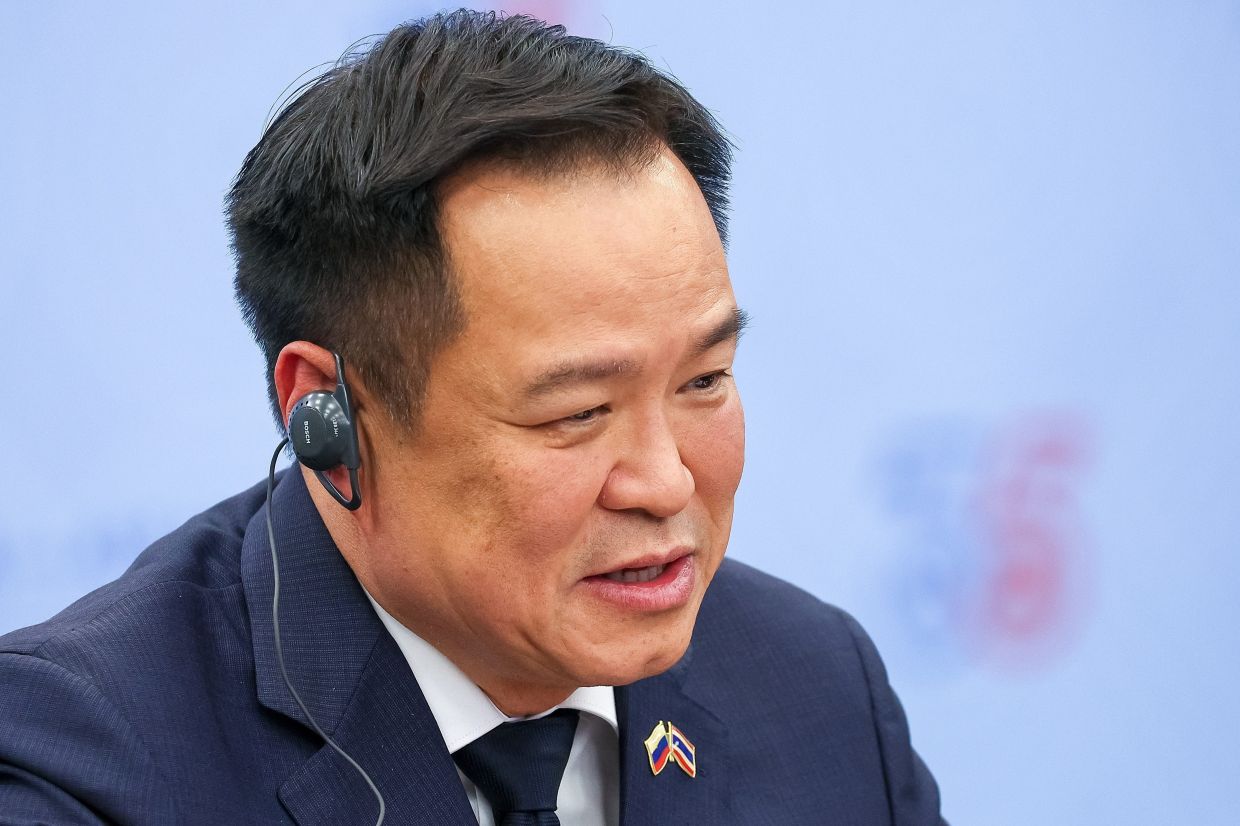
One hundred days into his tenure as Thailand's 32nd prime minister, Anutin Charnvirakul has demonstrated competent crisis management but little appetite for the structural economic reforms the nation desperately needs. The 59-year-old leader took the oath of office on March 20 following his re-election victory, marking a consolidation of power after first becoming premier in September 2025 following the collapse of the Paetongtarn Shinawatra government. As Thailand assesses his performance at this milestone, the picture that emerges is one of political stabilisation paired with cautious inaction on transformative change.
The most immediate challenge confronting the new administration arrived swiftly. Within weeks of taking office, Anutin faced a severe energy crisis ignited by the February 28 US-Israel attacks on Iran, which sent shockwaves through global oil markets and regional supply chains. The disruption triggered panic buying at Thai petrol stations, with retail outlets unable to maintain supply as motorists queued to top up tanks amid fears of further price increases. More troublingly, the subsequent conflict-driven disruptions to shipping through the Strait of Hormuz propelled oil prices above US$100 per barrel for an extended period, exposing Thailand and Southeast Asia's structural vulnerability to geopolitical crises occurring thousands of kilometres away.
To mitigate the immediate impact on consumers and industry, the Thai government deployed multiple tactical responses. The authorities tapped Thailand's national Oil Fuel Fund to subsidise fuel prices, preventing the full force of international price movements from reaching service stations and the public. Concurrently, the government implemented lending assistance schemes for farmers and industrial operators to reduce their borrowing costs, acknowledged that energy price spikes would otherwise ripple through productive sectors and household budgets. Coal-fired power plants were ordered to operate at maximum capacity to offset any supply constraints, while officials pursued diversification of energy sources by negotiating increased imports from the United States, Malaysia and Brunei. These measures revealed pragmatic crisis management, preventing the civil unrest and market panic that often destabilise governments in their early months.
Political science observers largely credit Anutin with navigating the initial turbulence without allowing it to spiral into deeper instability. Mathis Lohatepanont, a doctoral candidate in political science at the University of Michigan, observed that the government "has weathered the initial storm... and managed to avoid further instability" despite early supply disruptions and sharp price increases that easily could have sparked mass protests. The absence of significant street demonstrations, even as citizens grumbled about persistent fuel cost pressures, suggested that Anutin's crisis response retained sufficient public credibility to prevent this issue from metastasising into a broader loss of confidence in his administration.
Beyond energy management, Anutin consolidated support within his core constituencies by pursuing nationalist foreign policy and delivering on campaign promises. His Bhumjaithai Party had won the most parliamentary seats in the February election partly by advocating a hardline stance against Cambodia on disputed border issues. As premier, Anutin followed through by maintaining the military's dominant role in border protection operations and, more dramatically, unilaterally terminating a 2001 bilateral maritime boundary agreement with Cambodia. This escalation reflected the priority Anutin's government assigns to territorial disputes, though observers question whether confrontation serves Thailand's broader strategic interests in the region. The matter has now been escalated to the United Nations for arbitration, representing either principled firmness or diplomatic rigidity depending on one's perspective.
Domestically, Anutin bolstered his standing with voters through the "Thais Help Thais Plus" subsidy programme, launched on June 1. This initiative allows roughly 30 million eligible citizens aged 18 and above to purchase selected goods from participating merchants at only 40 per cent of the retail price, with the government absorbing the remainder. With an allocation of 176 billion baht (approximately US$5.27 billion), the scheme addresses immediate household cost-of-living pressures and provides stimulus to consumer-facing businesses. The programme's launch represented efficient political delivery, converting electoral promises into visible benefits that affect millions of households and generate gratitude toward the administration.
Yet analysts caution against interpreting these achievements as evidence of comprehensive governance. Puangthong Pawakapan of Chulalongkorn University's political science faculty and others in the academic community emphasise that the subsidy scheme, while genuinely popular, provides only temporary income support that "does absolutely nothing to solve the underlying economic crisis." The programme is, by design, fleeting relief rather than structural medicine. The deeper concern is that 100 days of Anutin's tenure have revealed a government focused on routine administration and immediate firefighting rather than the ambitious economic transformation Thailand requires.
Thailand's economic fundamentals present a sobering contrast to the stability that Anutin's crisis management has purchased. Over the previous five years, the country failed to achieve annual economic growth exceeding three per cent, a concerning stagnation for a nation competing with dynamic regional rivals. The International Monetary Fund projects Thailand's economy to expand by merely 1.5 per cent in 2026, positioning it as Southeast Asia's slowest-growing major economy. This stands in sharp contrast to Vietnam's projected 7.1 per cent growth, Cambodia's anticipated four per cent expansion and even Myanmar's estimated three per cent growth despite its ongoing civil conflict. These comparative figures underscore Thailand's competitive disadvantage within the region and the urgency of structural economic renewal.
Among Thailand's mounting structural challenges are an ageing population that will shrink the workforce and increase social expenditure, persistently high household debt burdens that constrain consumer spending and economic dynamism, and anachronistic industrial structures increasingly uncompetitive against more innovative regional competitors. While Anutin has articulated interest in developing new economic engines around digital technology, artificial intelligence and clean energy, observers note the absence of coherent strategic roadmaps translating these aspirations into concrete policy frameworks and resource allocations. Stithorn Thananithichot of Chulalongkorn University's Political Science Faculty observed that the administration's energies have flowed primarily into "routine administration and day-to-day management rather than into any initiative aimed at meaningful economic or political change."
The absence of constitutional reform signals perhaps the starkest evidence of Anutin's reluctance to pursue transformative change. In February, nearly 60 per cent of Thai voters—approximately 20 million citizens—voted in a referendum to indicate their desire to change the 2017 Constitution, a document many Thais view as fundamentally undemocratic because it was drafted under military auspices following the 2014 coup. Despite this clear electoral mandate, constitutional reform has languished without meaningful progress. Stithorn argues that "a government that intended to reform would have signalled at least one substantive structural commitment at the outset; this one did not, and that absence is by design rather than a matter of time." This reading suggests Anutin's administration prioritises stability preservation over the institutional renovation that many Thais desire.
For Malaysia and other Southeast Asian observers, the Thai experience raises important questions about how governments balance immediate crisis response against medium and long-term structural reform. Thailand's pattern of military coups and short-lived administrations over the past two decades has fractured policy continuity, allowing economic problems to accumulate without resolution. Anutin's first 100 days demonstrate competent crisis management and political consolidation, yet offer little evidence that Thailand will break this cyclical pattern of governance focused on survival rather than transformation. Whether the government eventually moves beyond maintenance mode to address deeper structural weaknesses will determine whether this administration becomes remembered as a stabilising force that gave Thailand space for genuine reform, or merely as another caretaker government that postponed necessary reckoning with systemic challenges.
The question facing Anutin as he moves beyond this initial milestone is whether stability represents an end in itself or merely a foundation for reform. His actions thus far suggest the former interpretation holds greater weight within his decision-making calculus. Should this pattern persist, Thailand risks squandering a moment of relative political tranquility without deploying it toward the institutional and economic transformation the nation demonstrably requires. The subsidy cheques reaching 30 million citizens and the energy crisis averted through careful fund management may purchase goodwill, but they cannot substitute for the harder work of reimagining Thailand's economic model in an era of regional competition and demographic transition.

