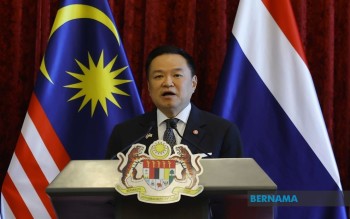
Thailand's government believes it is well positioned to achieve a landmark US$30 billion bilateral trade target with Malaysia within the next three years, according to Prime Minister Anutin Charnvirakul, who delivered the optimistic assessment during an official visit to Kuala Lumpur. The ambitious goal reflects growing economic momentum between the two Southeast Asian neighbours, which currently maintain bilateral trade valued at approximately US$28 billion annually. Speaking at a joint press conference with Malaysian Prime Minister Datuk Seri Anwar Ibrahim following a memorandum of understanding exchange at Perdana Putra Complex in Putrajaya, Anutin stressed that achieving the target remained firmly within reach through intensified collaborative efforts.
The significance of this trade relationship cannot be overstated within the broader ASEAN context. Malaysia holds the distinction of being Thailand's largest trading partner within the bloc, a position that underscores the deep economic integration already evident between Bangkok and Kuala Lumpur. The nearly US$28 billion current level of commerce demonstrates that the proposed US$30 billion figure represents an incremental rather than transformative increase, suggesting realistic targets grounded in existing momentum rather than aspirational projections detached from market realities. This measured approach to trade goal-setting has become characteristic of pragmatic bilateral negotiations in the region, where both governments prefer achievable milestones that maintain political credibility.
Looking beyond the headline trade figure, Anutin articulated a broader strategic vision encompassing structural economic collaboration that extends far deeper than simple merchandise exchange. He emphasized that Thailand intends to support initiatives designed to strengthen regional value chains and supply chains, leveraging the complementary industrial strengths that both economies can bring to joint ventures and cross-border manufacturing networks. This focus on supply chain integration reflects broader Southeast Asian recognition that unilateral prosperity remains limited in an increasingly interconnected regional economy where production is distributed across multiple countries. By emphasising how each nation's comparative advantages can be marshalled for mutual benefit, Thai policymakers signal awareness that sustainable trade growth requires embedding both economies within shared production ecosystems.
Three priority sectors have emerged as central to bilateral economic strategy moving forward. Food security, energy security, and digital economy development—particularly high-technology industries—represent the strategic pillars upon which both governments intend to build their enhanced partnership. These sectoral choices reveal sophisticated thinking about 21st-century economic interdependence. Food security matters intensely for Malaysia, which imports substantial rice and agricultural products from Thailand, while energy cooperation addresses both nations' need for diversified supply sources amid geopolitical uncertainties. The emphasis on high-tech and digital industries signals that both leaderships recognise that low-value-added manufacturing no longer provides sustainable paths to prosperity, and that future competitiveness increasingly hinges on technological innovation and digital transformation rather than traditional comparative advantages.
Malaysia's commitment to the bilateral trade initiative received clear affirmation from Anwar, who pledged that his government would mobilise institutional resources to realise the ambitious target. The Malaysian Prime Minister identified the Ministry of Foreign Affairs and the Ministry of Investment, Trade and Industry as the primary government agencies responsible for executing the trade expansion strategy. This institutional designation matters because it signals that Malaysia is treating the bilateral relationship not as a peripheral diplomatic courtesy but as a matter warranting sustained high-level attention and bureaucratic focus. The involvement of MITI, the ministry responsible for attracting foreign direct investment and managing industrial policy, suggests that Malaysia views the trade agenda as intimately connected to broader development objectives rather than treating it as a standalone commercial exercise.
Anwar's broader framing of the trade discussion within a context of strengthened friendship and comprehensive bilateral collaboration indicates an understanding that sustainable economic partnerships require institutional and social foundations extending beyond transaction-focused commercial arrangements. By explicitly linking trade initiatives to enhanced tourism cooperation and cross-cultural exchanges, the Malaysian leader positioned economic growth within a holistic vision of bilateral relations. This approach reflects lessons learned across Southeast Asia, where durable partnerships between neighbouring states have historically required attention to multiple relationship dimensions simultaneously. Tourism, in particular, serves important functions beyond generating direct revenue—it builds people-to-people connections, facilitates cultural understanding, and creates constituencies within each nation with vested interests in maintaining stable, cooperative relations.
Anutin's two-day official visit to Malaysia carried additional symbolic weight as his first trip to the country since his reappointment as Thai Prime Minister in March 2026. The timing and nature of this inaugural visit underscored bilateral relationship priorities during this particular phase of Thai political leadership. By choosing Malaysia as the destination for an early official engagement, Anutin signalled that the government views the Malaysian relationship as foundational to Thailand's broader regional and economic strategy. This decision gains added significance given Thailand's own complex domestic political trajectory in recent years, as careful diplomatic attention to major neighbouring relationships represents a stabilising element during periods of political transition or uncertainty.
The bilateral meeting conducted at Perdana Putra Complex provided opportunity for both leaders to conduct comprehensive review of Malaysia-Thailand relations across multiple policy domains. Beyond trade targets, the discussion encompassed opportunities to deepen cooperation in various unspecified fields, suggesting that the two governments have identified numerous additional areas for enhanced collaboration beyond the headline trade and sectoral priorities publicly announced. This multiplicity of bilateral engagement channels reflects the maturity of modern Southeast Asian state relationships, where meaningful partnerships operate simultaneously across trade, security, education, cultural, and diplomatic dimensions. The fact that both leaders emerged willing to commit to specific trade targets while also discussing broader institutional cooperation frameworks suggests alignment on fundamental strategic directions.
For the wider Southeast Asian region, the Malaysia-Thailand trade partnership expansion carries implications extending beyond immediate bilateral commerce. As two of ASEAN's more economically developed members, their success in deepening integration serves as a demonstration effect for other regional dyads considering similar initiatives. The emphasis on supply chain coordination and complementary industrial development also reflects broader regional trends toward production fragmentation and just-in-time manufacturing networks that increasingly characterise Southeast Asian economies. Additionally, the public commitment to achieving concrete trade targets within a specified timeframe establishes measurable benchmarks against which progress can be assessed, creating accountability mechanisms that distinguish serious policy commitments from mere diplomatic pleasantries.

