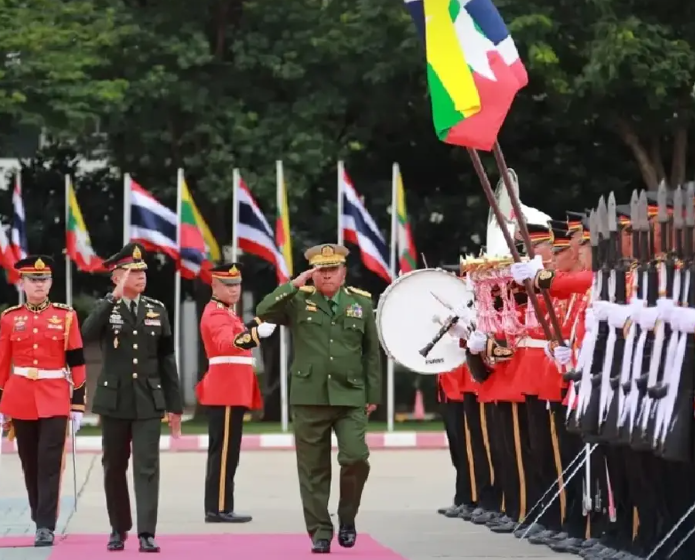
Thailand's military leadership extended a formal welcome to Myanmar's newly appointed military chief Ye Win Oo on Thursday for talks in Bangkok, underscoring an accelerating thaw in regional relations despite mounting international criticism of the junta's governance. The visit marks Ye Win Oo's inaugural foreign trip since assuming the role of armed forces commander, a symbolic move that reflects Myanmar's calculated effort to shed its pariah status following more than five years of isolation after the 2021 coup d'état.
Myanmar's military overthrew an elected civilian government in February 2021, immediately detaining former State Counsellor Aung San Suu Kyi and triggering a conflict that has devastated the nation. Estimates suggest the resulting civil war has claimed approximately 100,000 lives, with countless more internally displaced and facing humanitarian catastrophe. The coup ruptured Myanmar's democratic transition and initiated systematic abuses documented by international observers, including extrajudicial killings, torture, and sexual violence perpetrated against opposition figures and civilians.
The junta's rehabilitation strategy hinges on portraying the deeply controlled elections held around early 2026 as evidence of a return to constitutional normalcy. In that electoral exercise, Min Aung Hlaing, the former military chief who orchestrated the coup, transitioned to the civilian presidency while installing Ye Win Oo—a former spymaster within the military apparatus—as his successor in uniform. This choreographed transition aims to create an appearance of institutional separation between military and civilian authority while maintaining substantive control within military hands.
Ye Win Oo himself carries significant international baggage. Multiple nations, including the United States, have sanctioned him directly for his instrumental role in organizing and executing the coup. His appointment as military leader represents continuity with the hardline faction that has resisted compromise with pro-democracy forces and ethnic armed organizations. That Thailand nonetheless permitted his visit demonstrates how regional considerations sometimes override international pressure regarding governance standards.
The bilateral discussions between Thai military chief Ukris Boontanondha and Ye Win Oo concentrated on managing the 2,400-kilometre shared border, where the ongoing civil war has generated serious security challenges. Cross-border displacement, trafficking of arms and drugs, and armed group movements have created genuine complications for Thailand's border provinces. From Bangkok's perspective, stability along the frontier represents a tangible national interest that transcends broader questions about Myanmar's internal governance. This pragmatic calculus explains why Thailand, alongside other immediate neighbours, has seized upon the elections as justification for diplomatic re-engagement.
Earlier this month, Thai Prime Minister Anutin Charnvirakul extended lavish ceremonial treatment to Min Aung Hlaing during his visit to Bangkok, signalling Thailand's determined pivot toward normalizing ties. When questioned about the decision, Thai Foreign Minister Sihasak Phuangketkeow articulated the government's rationale with striking candour: "It's not about legitimacy, it's about reality." The statement encapsulates Bangkok's position that Myanmar's geopolitical importance and border proximity supersede concerns about democratic credentials or human rights performance.
Yet this diplomatic manoeuvre has generated withering criticism from civil society organizations and democracy advocates. The Special Advisory Council for Myanmar condemned Thailand's engagement strategy as fundamentally compromised, declaring that "by embracing a warlord, Thailand has torched its credibility." The council further characterized the decision to host Ye Win Oo as compounding Thailand's reputational damage and abandoning any pretence of supporting democratic values in the region.
International assessments of Myanmar's post-election conduct paint a starkly darker picture than the junta's official narrative suggests. Investigators from the United Nations's Independent Investigative Mechanism for Myanmar released findings this week documenting escalating aerial bombardment of civilian populations, systematic arbitrary detention, widespread torture protocols, and documented sexual violence committed by military personnel. These accounts fundamentally contradict Myanmar's claims of reform and suggest the military has actually intensified certain categories of abuse rather than retreating from them.
Myanmar's government has responded by dismissing such allegations as "one-sided" and rooted in "unverifiable and inaccurate information." The junta's blanket rejection of international scrutiny reflects its confidence that regional powers including Thailand will prioritize stability and bilateral interests over enforcement of accountability standards. This dynamic creates a permissive environment where documented abuses carry minimal diplomatic cost.
The divergence between regional capitals and the international community on Myanmar policy is widening noticeably. While Western governments and multilateral bodies maintain critical stances, Myanmar's neighbours face distinct pressures flowing from geographic proximity, trade relationships, and shared security challenges. For Malaysia and other Southeast Asian nations, Thailand's approach signals how regional consensus may increasingly defer to pragmatism over principle, potentially establishing a troubling template for managing relations with authoritarian neighbours.
The junta's diplomatic offensive demonstrates how strategic patience and regional divisions can gradually erode international isolation. By securing high-level visits and state hospitality from neighbouring capitals, Myanmar's leadership obtains both symbolic validation and practical benefits. Yet this rehabilitation occurs precisely as United Nations investigators document evidence suggesting the military's violence has not diminished but transformed. The contradiction illuminates a central tension in Southeast Asian politics: how nations should balance legitimate border security interests against complicity in enabling governance systems built on systematic abuse.

