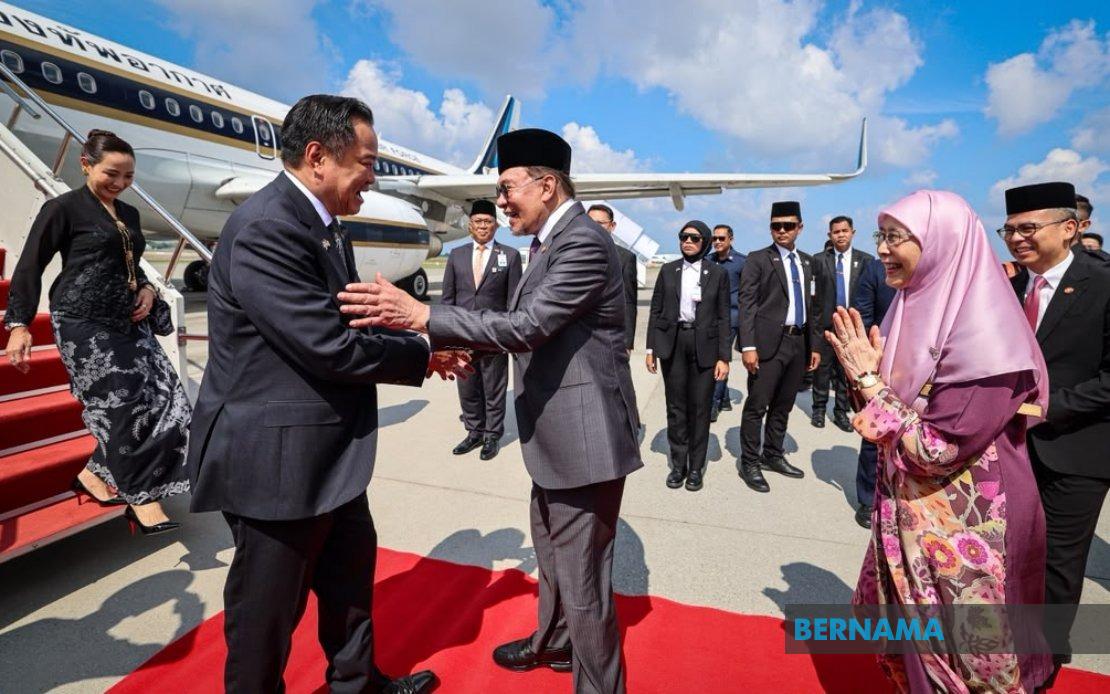
Thailand's Prime Minister Anutin Charnvirakul touched down at Kuala Lumpur International Airport on July 9 for a two-day official visit, marking his first trip to Malaysia since resuming the premiership in March 2026. The Thai leader and his spouse, Thananon Charnvirakul, received a formal state reception befitting the significance of the visit, with Malaysia's Prime Minister Datuk Seri Anwar Ibrahim extending a warm welcome at the Bunga Raya Complex. The carefully choreographed arrival underscored the diplomatic importance both governments attach to strengthening their bilateral relationship at a time when regional stability and economic integration remain paramount concerns for Southeast Asian nations.
The reception ceremony reflected the ceremonial weight accorded to the Thai premier's presence. A 34-member honour guard from the First Battalion of the Royal Ranger Regiment, commanded by Major Muhammad Nur Addeen Mustaza, stood in formation as national anthems of both countries played. Prime Minister Anwar's wife, Datuk Seri Dr Wan Azizah Wan Ismail, alongside Communications Minister Datuk Fahmi Fadzil who served as the receiving minister, joined the welcoming delegation. This gathering of senior Malaysian leadership demonstrated the visit's high-level standing within Malaysia's political establishment and signalled mutual commitment to advancing the two nations' partnership.
The substantive component of Anutin's visit centres on a bilateral meeting at Perdana Putra, where both premiers will conduct a comprehensive review of the Malaysia-Thailand relationship. The discussions are expected to traverse multiple dimensions of bilateral cooperation, from traditional trade matters to emerging areas of mutual interest. The agenda reflects a broader strategic imperative for both nations to deepen integration within the ASEAN framework whilst managing their shared border and diverse economic interests. For Malaysia, hosting the Thai leader provides an opportunity to reinforce its role as a central player in regional diplomacy and economic coordination.
A significant outcome anticipated from the visit is the signing of a memorandum of understanding focused on agricultural cooperation. This agreement carries particular weight given both countries' substantial agricultural sectors and the potential for enhanced collaboration in food security, agricultural technology transfer, and market access. Thailand's extensive agricultural industry, encompassing rice production, rubber cultivation, and tropical fruit exports, complements Malaysia's own agricultural base and downstream food processing capabilities. The formalisation of cooperation in this sector addresses mutual economic interests whilst contributing to regional food supply resilience—an increasingly pressing concern as Southeast Asia navigates climate challenges and shifting global trade patterns.
The bilateral trade relationship provides essential context for understanding the visit's strategic importance. In 2025, Thailand emerged as Malaysia's sixth-largest global trading partner and ranked second among ASEAN member states, with combined trade reaching RM118.57 billion (US$27.73 billion). The momentum has intensified in 2026, with the first quarter recording RM31.33 billion (US$7.90 billion) in bilateral trade, a robust increase compared to RM27.35 billion (US$6.15 billion) during the same period in 2025. These figures underscore a dynamically expanding economic relationship that both governments are keen to nurture through enhanced cooperation frameworks and reduced trade friction.
Beyond boardroom discussions, the visit incorporates a significant infrastructural component designed to demonstrate tangible progress in cross-border integration. On July 10, Anutin and Anwar will jointly travel to Bukit Kayu Hitam in Kedah to inaugurate a new road connecting Malaysia's Immigration, Customs, Quarantine and Security (ICQS) Complex with Thailand's corresponding Customs, Immigration and Quarantine (CIQ) facility in Sadao. This infrastructure development exemplifies the practical dimension of bilateral cooperation, potentially streamlining cross-border movement of goods and people whilst enhancing security protocols at a critical transit point. For Malaysian and Thai citizens, and for businesses operating across the border, such improvements translate into reduced transit times, lower logistics costs, and enhanced predictability in cross-border commerce.
The timing of Anutin's visit carries regional significance beyond the bilateral relationship. Thailand has historically served as a stabilising force within ASEAN, and Anutin's reappointment reflects domestic political developments in Bangkok. Malaysia, as a long-standing ASEAN member actively engaged in regional architecture discussions, has a vested interest in maintaining strong relations with all neighbouring states. By hosting the Thai premier at this juncture, Malaysia reinforces its commitment to balanced regional engagement and demonstrates diplomatic openness to all major ASEAN players, regardless of their domestic political configurations. This approach supports regional cohesion at a time when external pressures and geopolitical tensions are testing ASEAN unity.
The comprehensive nature of the visit—encompassing ceremonial recognition, high-level political discussions, sectoral cooperation agreements, and infrastructure inaugurations—reflects a deliberate strategy to address multiple dimensions of the bilateral relationship simultaneously. Prime Minister Anwar's decision to host a luncheon at Seri Perdana Complex for Anutin and his delegation extends beyond diplomatic courtesy; such occasions provide informal settings where senior officials can deepen personal relationships and explore potential areas of cooperation beyond formal agendas. These interpersonal connections often prove crucial in resolving bilateral irritants and building the trust necessary for navigating inevitable disputes or differences in perspectives.
For Malaysian readers and regional observers, Anutin's visit underscores the continuing importance of traditional bilateral relationships within the ASEAN framework. Despite the region's growing economic interdependence and multilateral mechanisms, country-to-country engagement remains foundational to regional stability and prosperity. Thailand and Malaysia share not merely geographic proximity but also substantial people-to-people connections, cultural affinities, and economic complementarities that justify sustained political attention at the highest levels. The visit demonstrates that both governments recognise the value of maintaining this relationship through regular high-level engagement and concrete cooperation initiatives.
The agricultural cooperation framework emerging from this visit carries implications extending beyond the bilateral relationship. ASEAN as a whole faces challenges in agricultural productivity, food security, and climate adaptation. A strengthened Malaysia-Thailand partnership in this sector could generate lessons and best practices applicable across the region, potentially informing broader ASEAN discussions on agricultural resilience and sustainability. Similarly, the streamlined cross-border infrastructure at Bukit Kayu Hitam-Sadao may serve as a model for other ASEAN border crossings, demonstrating how advanced customs and quarantine facilities can facilitate legitimate trade whilst maintaining security standards.
Looking ahead, the outcomes of Anutin's visit will likely shape the trajectory of Malaysia-Thailand relations throughout 2026 and beyond. The successful navigation of this state visit, combined with the substantive agreements reached, will set the tone for future bilateral engagement and influence the confidence with which both nations approach more complex issues requiring coordination, such as transnational crime, environmental protection, and regional security matters. For Malaysia, the visit reaffirms its role as a reliable ASEAN partner committed to building constructive relationships with all member states whilst advancing shared regional interests.

