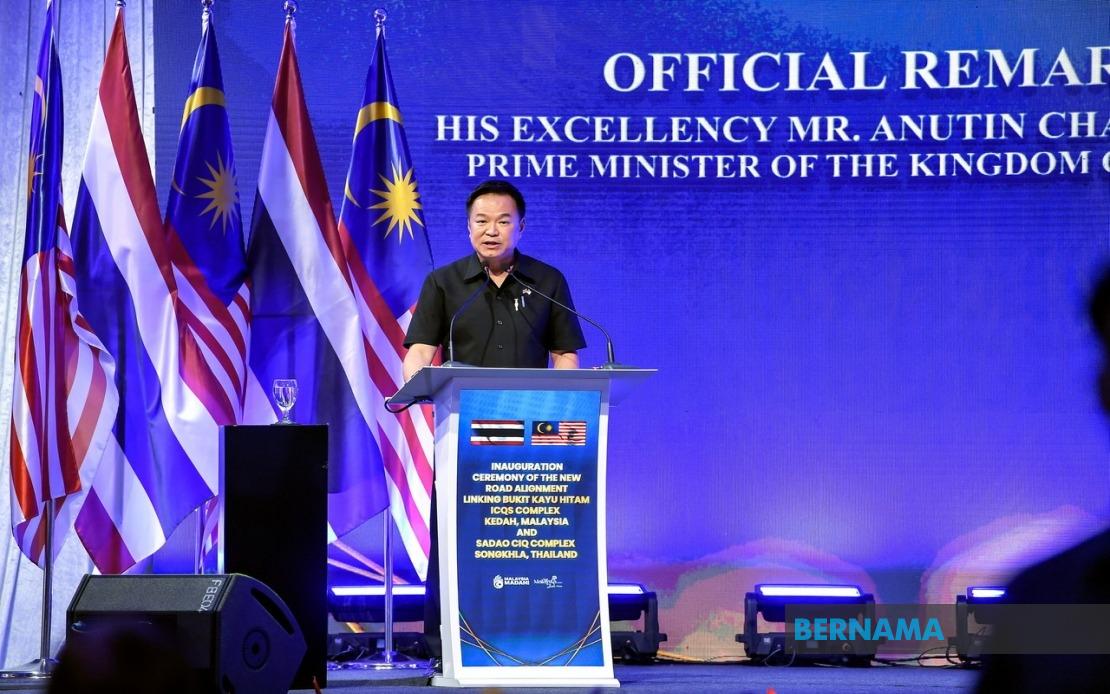
Thai Prime Minister Anutin Charnvirakul has committed to filling critical gaps in Thailand's transport infrastructure to enable faster, more efficient trade flows between Malaysia and higher-income markets across Southeast Asia and into China and Russia. Speaking at the inauguration of a newly completed road alignment connecting the Sadao Customs, Immigration and Quarantine Complex in Thailand with Malaysia's Bukit Kayu Hitam Immigration, Customs, Quarantine and Security Complex in Kedah, Anutin positioned the project as a cornerstone of Bangkok's broader vision for regional economic integration and bilateral cooperation.
The ceremonial opening, jointly presided over by Anutin and Malaysian Prime Minister Datuk Seri Anwar Ibrahim, underscores the strategic importance both governments place on seamless cross-border infrastructure. This completed link directly addresses bottlenecks at what has long been the busiest crossing along the Malaysia-Thailand border, a chokepoint that has historically constrained trade velocity and increased logistical costs for businesses operating within the region.
Anutin emphasised that Thailand's infrastructure completion strategy extends well beyond this single corridor. His remarks highlighted a coordinated effort to eliminate remaining connectivity deficiencies that currently fragment supply chains and impede the movement of merchandise traversing from Malaysia toward Thailand's upper regions and onward to northern gateways into China and Russia. This framing reflects Bangkok's recognition that southern Thailand's economic future is intimately tied to its capacity to serve as a transit hub for Southeast Asian commerce destined for the massive markets of East Asia and Eurasia.
The bilateral dimension of this initiative is equally significant. Anutin stressed that enhanced connectivity would function as a two-way benefit, enabling Thai and Chinese goods to flow southward through Malaysia toward Singapore and Indonesia with markedly improved efficiency. This reciprocal benefit arrangement strengthens the rationale for Malaysian cooperation and demonstrates how infrastructure investments can align the interests of both capitals, creating shared prosperity rather than zero-sum competition.
Beyond the Bukit Kayu Hitam alignment, both governments have already begun discussing additional cross-border connectivity initiatives spanning three distinct zones: the Songkhla-Kedah corridor, the Satun-Perlis gateway, and the Narathiwat-Kelantan passage. Collectively, these planned projects suggest a comprehensive strategy to unlock the dormant economic potential embedded within southern Thailand and northern Malaysia—regions that remain comparatively underdeveloped despite their geographic proximity to growth engines like Bangkok and Kuala Lumpur.
For Malaysian readers and policymakers, this commitment carries several implications. First, completed transport links promise to lower costs for Malaysian exporters seeking to reach markets in Thailand and beyond, potentially boosting competitiveness for small and medium enterprises. Second, improved cross-border mobility could catalyse job creation and investment in northern Malaysian border regions, areas that have historically lagged in economic development indices. Third, enhanced connectivity aligns with Kuala Lumpur's own broader push toward elevating regional trade intensity and positioning Malaysia as a critical node within expanding Asian supply chains.
Anutin also flagged the commitment of both governments to address outstanding procedural obstacles that still hamper cross-border movement. By framing infrastructure investment alongside administrative streamlining—including border procedures harmonisation and facilitation of people movement—Bangkok and Kuala Lumpur signal that physical connectivity alone is insufficient without parallel improvements to the regulatory and bureaucratic architecture governing transnational flows.
The strategic context deserves consideration. Thailand's government has long recognised that its southern region, while possessing natural resources and geographic advantages, has underperformed economically relative to potential. Enhanced connectivity to Malaysia and through to Singapore and Indonesia offers a potential pathway to rebalance development away from Bangkok's concentration and toward provincial prosperity. Similarly, Malaysia stands to benefit from becoming a more seamless conduit for goods flowing between China and Southeast Asian markets, reinforcing its position within regional value chains.
Anutin's visit to Malaysia, conducted at Anwar's invitation, also reflects warming bilateral relations following a period of comparative distance. The ceremonial nature of the road inauguration, attended by the spouses of both leaders, symbolises the personal rapport and political will underpinning these technical infrastructure projects. Such symbolic investments matter significantly in regional diplomacy, where gestures of goodwill often translate into sustained political support for complex cross-border initiatives that require years to implement.
Looking forward, the success of the Bukit Kayu Hitam alignment and the three additional corridors under discussion will depend not merely on capital expenditure but on sustained administrative cooperation, regulatory alignment, and commitment to dispute resolution. These projects represent confidence in the economic complementarities between the two nations and a shared belief that greater integration serves both populations. For Southeast Asia more broadly, successful Malaysia-Thailand connectivity projects create precedents for similar initiatives with Laos, Cambodia, and Vietnam, potentially stitching together a more integrated regional market.
The implications for Malaysian businesses are tangible and multifaceted. Manufacturers reliant on cross-border supply chains will face reduced transit times and lower logistics expenses. Export-oriented firms may discover new markets in Thailand and beyond with reduced market entry friction. Conversely, Thai and Chinese goods will flow more freely into Malaysia, presenting both competitive pressures and opportunities for Malaysian companies positioned to compete or integrate with these incoming products and services. The net effect, if complementary border procedures are indeed harmonised, could be a modest but meaningful boost to bilateral trade volumes and the emergence of new cross-border business clusters along the northern frontier.

