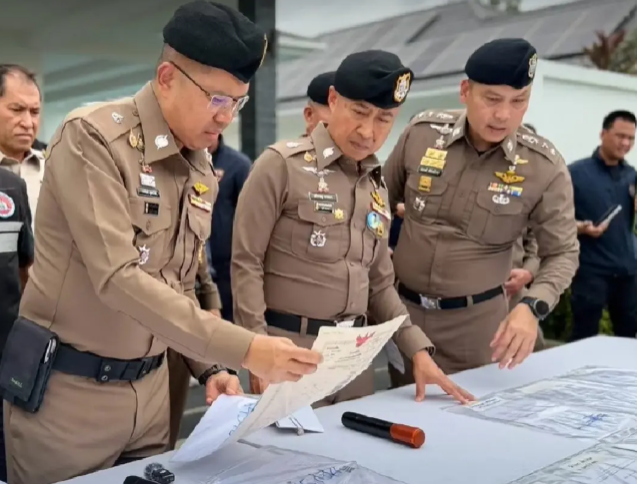
Thai police have intensified their assault on clandestine foreign property ownership arrangements, arresting thirteen foreign nationals during coordinated raids across fifteen locations in the coastal resort town of Hua Hin. The operation, executed on August 10, represents the sixth major enforcement phase in a sprawling investigation targeting an estimated 33 companies believed to have orchestrated complex nominee structures allowing foreigners to circumvent Thailand's constitutional prohibition on foreign land ownership. The scale of the operation underscores the authorities' determination to dismantle what appears to be a sophisticated network spanning Thailand's most coveted tourism and residential destinations.
The Hua Hin operation mobilised more than two hundred police officers and government representatives, reflecting the investigation's expanding scope and the institutional priority assigned to this category of economic crime. Among those detained were three British nationals, four Chinese citizens, and one representative each from Italy, France, the Netherlands, Austria, the Philippines, and the United States. Arrest warrants had been issued for forty-five foreign nationals overall, while Thai authorities summoned thirty-nine local residents for questioning. The detainees remain under investigation, with no formal charges yet filed in court—a procedural posture typical of Thai investigations at their initial stages.
The targeted properties in Thap Tai subdistrict present an instructive window into the nature of these arrangements. Police identified pool villas and detached residential structures each valued between ten to twenty million baht, properties that clearly appeal to affluent foreign buyers seeking permanent Thai residences. Within the broader investigation, thirty-three companies hold approximately three hundred million baht in combined property assets, suggesting a market segment concentrated on premium residential real estate rather than commercial ventures. The sophisticated corporate veiling of ownership raises questions about the intermediaries facilitating these transactions—legal advisors and accounting firms who allegedly counselled foreign nationals that establishing nominee companies represented a lawful pathway to property acquisition.
When interrogated, the arrested foreigners articulated a defence rooted in reliance upon professional guidance. They explained they had sought to legitimately own Thai property and had been directed by legal and accounting professionals to establish corporate entities for this purpose, believing such arrangements existed within the law's framework. This assertion reveals a critical vulnerability in Thailand's regulatory architecture: the apparent ease with which advisors—whether licensed professionals or unscrupulous operators—could present illegal structures as legally compliant mechanisms. The disconnect between foreign nationals' subjective understanding of legality and the objective illegality of nominee arrangements suggests either deliberate deception by intermediaries or catastrophic failures in client disclosure and compliance standards.
The Thai nationals named as nominee shareholders painted a markedly different picture when questioned. These individuals claimed they had agreed to hold shares nominally on foreigners' behalf but had neither invested personal capital nor exercised any meaningful control over the companies. They reported having neither reviewed financial statements nor participated in management decisions—classic hallmarks of pure nominee arrangements stripped of substance. Police suspect these corporate shells functioned exclusively to obscure foreign beneficial ownership and control, presenting Thai nationals as formal shareholders while actual decision-making and capital deployment remained with foreign beneficiaries. This structural decoupling between legal form and economic reality constitutes the investigative predicate for the fraud allegations.
The sixth phase's significance becomes apparent when contextualised within the investigation's trajectory. The initial phases concentrated on Koh Phangan in Surat Thani, examining nominee companies alongside the professional networks—law firms and accounting practitioners—accused of facilitating property and tourism business concealment. Phase 3 expanded southward to Phuket, Phang Nga, and Krabi, where authorities scrutinised eighty-nine properties valued in excess of 1.05 billion baht. Chonburi received attention in Phase 4, while Phase 5 targeted Chiang Mai, where thirty-one companies and twenty-nine land plots worth approximately 633 million baht came under examination. Collectively, the first five phases encompassed 233 property parcels totalling more than 160 rai—or approximately 25.6 hectares—with estimated aggregate value reaching 2.539 billion baht.
The cumulative enforcement record demonstrates measurable prosecutorial traction. Courts have approved 133 arrest warrants resulting from earlier operation phases, with twenty cases culminating in convictions to date. These convictions establish precedent and deterrent messaging within networks of foreign investors, though the ongoing arrests suggest the phenomenon remains sufficiently widespread and profitable to persist despite enforcement activity. The scale of property values involved—nearly 2.6 billion baht across five previous phases alone—indicates substantial capital flows through these illicit channels, capital that represents tax considerations and regulatory evasion beyond the nominal property ownership violations.
For Malaysian observers, this Thai enforcement trajectory warrants close attention given Malaysia's own constitutional and statutory restrictions on foreign property ownership in comparable residential contexts. Both nations prohibit or severely restrict foreign land acquisition, yet both face comparable pressures from wealthy international investors seeking permanent residency vehicles through property acquisition. The Thai experience illuminates the vulnerabilities within professional regulatory frameworks when private practitioners prioritise client accommodation over compliance verification. Malaysia's property sector, particularly in premium residential zones and integrated developments, potentially faces parallel risks from similar nominee and corporate concealment structures. The sophistication of the Thai arrangements—spanning from initial corporate formation through financial obfuscation to nominee shareholder procurement—suggests that cross-border coordination and professional networks may operate across Southeast Asia's property markets.
The investigation's explicit extension to potential government corruption adds a prosecutorial dimension that transcends simple foreign buyer complicity. Police indicated they would examine whether Thai officials improperly facilitated or benefited from the nominee arrangements, suggesting that regulatory capture or bureaucratic assistance may have enabled the schemes' expansion and longevity. This institutional dimension reflects a concerning possibility: that nominee property arrangements survive not merely through private professional enablement but through compromised or inadequately resourced government officials unable or unwilling to enforce existing statutory prohibitions. The inclusion of the Department of Business Development and Department of Lands in the Hua Hin operations signals inter-agency coordination intended to close procedural gaps, yet also implicitly acknowledges prior enforcement gaps or deficiencies.
The Royal Thai Police's public messaging emphasises that the campaign targets unlawful nominee structures and foreign-backed enterprises rather than legitimate foreign investors operating in compliance with Thai law. This rhetorical distinction carries practical importance: it reassures the substantial legitimate foreign expatriate population and international investment community that enforcement targets genuinely illegal activities rather than subjective regulatory determinations. However, it simultaneously raises definitional questions about where the boundary between legitimate and illegitimate foreign investment actually resides. For foreign investors contemplating Thai property acquisition or Malaysian properties subject to similar restrictions, the enforcement trajectory suggests increasingly stringent scrutiny of corporate veils and nominee arrangements, making transparent compliance structures economically preferable to the risks of investigation and seizure.
Moving forward, Thai authorities plan continued nationwide investigations of suspected nominee networks and foreign-funded operations in tourist destinations. Public reporting mechanisms, including local police stations and the Royal Thai Police hotline 1599 operating continuously, institutionalise intelligence gathering from community members who identify suspicious foreign property acquisitions or business arrangements. This decentralised reporting infrastructure effectively enlists the broader public—residents, neighbours, local officials—in compliance monitoring, creating reputational and operational risks for those pursuing nominee structures. The investigation's expansion from initial Koh Phangan concentration through six distinct operational phases suggests authorities possess sufficient evidence and resources to sustain pressure on these networks, with the broader Southeast Asian tourism and residential property sectors potentially subject to comparable enforcement scrutiny in coming years.

