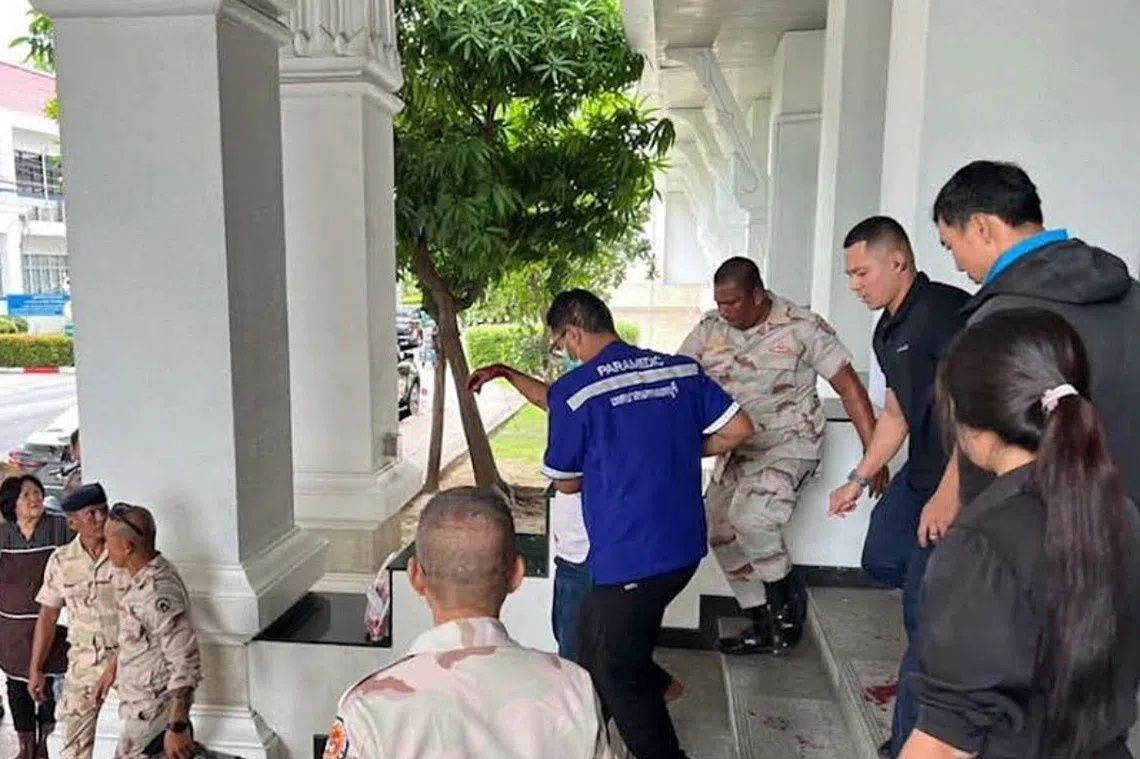
Thailand's gun violence crisis deepened on Monday when a former legislator opened fire at a local administrative building on Bangkok's periphery, wounding two officials in an incident that authorities swiftly contained through the arrest of the suspect. The shooting underscored the nation's ongoing struggle with firearm access and public safety, occurring just days after a teenager's rampage at a provincial school claimed nine lives and left more than 20 others injured—the deadliest mass shooting event the country has experienced in nearly four years.
According to Major General Dejrapee Kongdee, the provincial police commander overseeing the investigation, the gunman targeted a senior provincial administrator and his driver at the government office. Both victims sustained injuries and received emergency medical care at local hospitals. The rapid apprehension of the suspect prevented what could have escalated into a more serious incident, though officials have not yet released detailed information about the motivations behind the attack or the suspect's background beyond his previous service in parliament.
The timing of Monday's shooting compounds public anxiety across Thailand. Just three days earlier, on Friday, a 14-year-old boy allegedly shot and killed his grandparents before proceeding to Debsirin Nonthaburi School in Nonthaburi Province, where he opened fire on staff and students. The teenager then turned the weapon on himself, bringing an end to what became one of Thailand's most traumatic mass casualty incidents in recent memory. The psychological impact rippled through communities nationwide, prompting urgent calls from government leaders and civil society for decisive legislative action on firearms regulation.
The proximity of these two incidents within the same province has intensified scrutiny on Thailand's gun ownership and licensing framework. Currently, the country permits civilian firearm ownership under regulated conditions, yet enforcement mechanisms have proven inconsistent and critics argue insufficient safeguards exist to prevent weapons from reaching individuals deemed dangerous or unstable. The school shooting in particular raised troubling questions about how a minor obtained access to a functional firearm and why warning signs, if present, went unheeded by authorities or community members.
In response to the escalating violence, Thai schools reopened their doors on Monday under heightened security protocols. Many institutions instituted metal detectors at entry points, enhanced visitor screening procedures, and increased staff presence in hallways and common areas. These measures reflected both parental anxiety and educational administrators' determination to reassure families that learning environments had been fortified against future attacks. Prime Minister Anutin Charnvirakul visited affected institutions and publicly committed his administration to pursuing stricter gun control legislation, positioning the issue as a top policy priority for the government.
The Prime Minister's pledge carries political weight given Thailand's recent constitutional evolution and governmental transitions. His administration has signalled that comprehensive gun reform will advance through parliament in coming months, potentially including measures to restrict ammunition sales, strengthen background check requirements, and establish more rigorous licensing procedures for firearm ownership. However, implementation of such policies faces resistance from certain quarters, including gun enthusiasts and those who argue that cultural hunting traditions and rural self-defence needs justify broader civilian access to firearms.
Malaysia and other Southeast Asian nations have observed Thailand's gun violence crisis with concern, particularly given the region's relatively low rates of mass shooting incidents compared to global averages. Thailand's permissive firearms regulations stand in contrast to the stricter regimes operating in Singapore, Malaysia, and Brunei, where civilian gun ownership is severely restricted and weapons-related crimes draw severe legal penalties. Thai policymakers increasingly acknowledge that their nation's approach has created vulnerabilities that determined or disturbed individuals can exploit with devastating consequences.
The psychological and social dimensions of Thailand's gun violence problem extend beyond legislative solutions alone. Mental health services remain underfunded and fragmented across the country, limiting access to counselling and psychiatric treatment for troubled youth and adults experiencing psychological distress. Schools and communities lack comprehensive violence prevention programmes that might identify at-risk individuals before they escalate to lethal action. Addressing these systemic gaps requires coordinated investment across health, education, and social welfare sectors—a commitment that demands political will and sustained budgetary support beyond the immediate crisis response.
International attention to Thailand's shooting incidents may also influence regional security discussions. ASEAN nations increasingly recognise that transnational criminal networks traffic in firearms, supplying illegal weapons markets across Southeast Asia. Thailand's internal gun violence problem intertwines with broader questions about border security, organised crime suppression, and information-sharing among regional law enforcement agencies. Tightening civilian access to firearms while simultaneously strengthening border controls and interdiction operations against smuggled weapons represents a multifaceted challenge requiring diplomatic cooperation.
The arrested former lawmaker's involvement in Monday's incident adds another layer of complexity to the narrative surrounding Thailand's political landscape and institutional credibility. That a former member of parliament would resort to firearm violence raises questions about the psychological screening and vetting procedures that govern candidates for public office, as well as the support systems available to individuals transitioning out of political careers. The incident may prompt reflection among Thai legislators about their own conduct and the responsibility that comes with access to power and resources.
As investigations into both incidents continue, Thai society faces a reckoning regarding the values it wishes to prioritise. Balancing individual rights and cultural practices with collective safety requires deliberate policy choices that cannot be avoided through inaction. The deaths of nine individuals, including a young teenager and school staff, represent an irrecoverable loss that has shifted public opinion decisively toward supporting gun control measures. Whether Thailand's political system can translate this momentum into lasting legislative reform will determine whether the nation can prevent future tragedies of similar magnitude.

