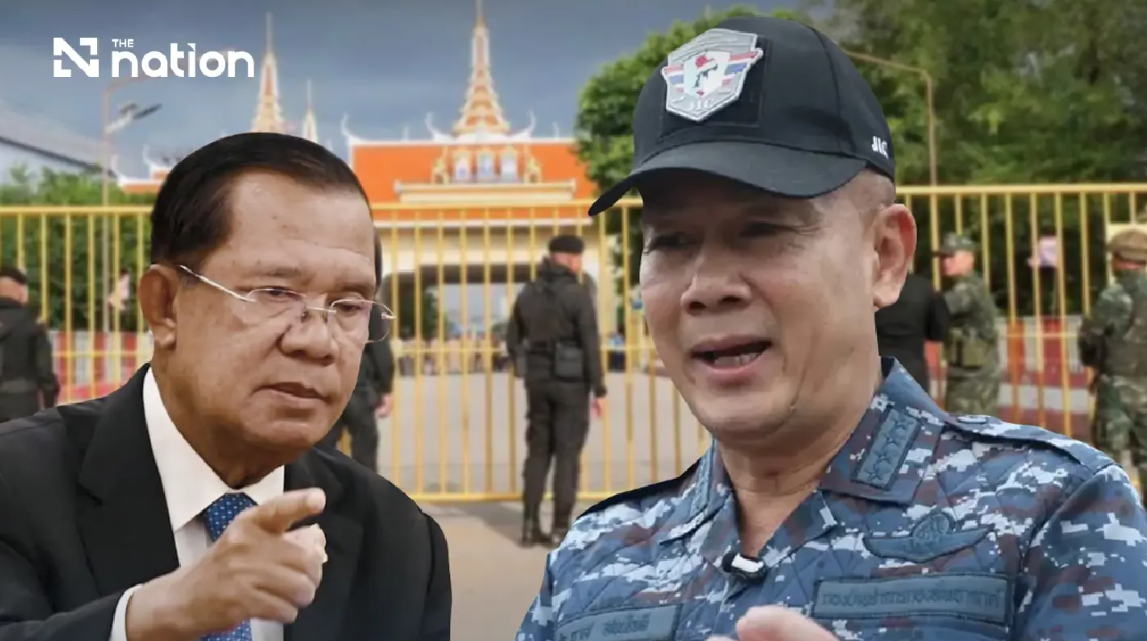
Thailand's top military liaison on the Cambodia border dispute has roundly refuted suggestions from Cambodian Senate President Hun Sen that Bangkok weaponized its fight against online scam operations to justify seizing Cambodian land. ACM Prapas Sonjaidee, who directs the Joint Information Centre monitoring the Thailand-Cambodia situation, made the forceful denial on Friday, insisting that allegations aired at international forums must rest on verifiable evidence rather than political rhetoric. His comments represent an escalation in the war of words between the two neighbours over their volatile frontier, where clashes have repeatedly disrupted the region and threatened civilian populations on both sides.
The core of Thailand's position, as articulated by Prapas, hinges on separating two distinct issues that Hun Sen appears to conflate. The first concerns whether particular locations harbour criminal scam operations. The second involves whether those same sites serve military purposes, such as troop deployments, equipment storage, or operational support. Conflating these matters, Prapas contended, fundamentally misrepresents the nature of the dispute and obscures the actual sequence of events that precipitated military action. This distinction carries weight not merely as a rhetorical device but as a legal and factual matter that should be resolved through independent scrutiny rather than diplomatic posturing.
Thailand's spokesperson emphasised that establishing the chronology of military action is paramount when examining accusations of aggression or occupation. His argument centres on the proposition that any honest accounting of the border conflict must begin with which side first deployed weapons, not which side responded to initial provocation. According to Thai information, Cambodia initiated armed engagement in ways that affected civilian areas within Thai territory, prompting Thailand's defensive response aimed at protecting its military personnel and civilians. This foundational disagreement over causation and timing represents perhaps the deepest impediment to reconciliation, as each nation's domestic narrative depends heavily on claiming the moral high ground of justified self-defence.
Prapas rejected Hun Sen's occupation claims by invoking the joint ceasefire agreement both countries have signed. Under those terms, military forces were to remain at positions held when the ceasefire commenced, avoid advancing toward each other, and refrain from escalatory actions. He argued that maintaining forces in accordance with a mutually binding agreement cannot logically be recharacterised as occupation merely because one party later disputes where the border actually runs. The distinction between military positioning under a ceasefire and territorial conquest carries significant implications for regional stability, as it affects how neighbouring states interpret similar situations elsewhere in Southeast Asia.
The Thai official stressed that questions of border demarcation should be resolved through established bilateral mechanisms rather than through military positioning or unilateral pronouncements. Allowing military deployments to determine borders would effectively reward the side with superior firepower and undermine the entire framework of international law governing territorial disputes. This principle resonates throughout Southeast Asia, where multiple countries face overlapping claims and where accepting such logic could destabilise the entire region. Thailand's insistence on procedural propriety thus reflects not merely narrow national interest but broader regional concerns about how disputes should be managed.
On the sensitive question of civilian harm, Prapas articulated principles that should theoretically command universal assent: civilians must be protected regardless of which side of the border they inhabit, schools must remain safe spaces, and humanitarian standards transcend nationality. Yet he simultaneously noted that examining civilian casualties requires scrutinising damage on both sides, including weapon types, fire directions, coordinates, timing, and intended targets. This balanced approach contrasts sharply with how the dispute is typically portrayed in each nation's media, where civilian suffering is invariably attributed solely to the other side's aggression. The implication that both countries may be selectively highlighting evidence that supports their preferred narratives strikes at the heart of the information warfare Hun Sen himself accused Thailand of conducting.
The Thai position on information warfare itself warrants close attention, as Prapas essentially turned Hun Sen's accusation back on its accuser. He acknowledged that disinformation and information warfare represent genuine 21st-century challenges but argued that responding with counter-accusations only perpetuates the cycle. The productive response, from Thailand's perspective, involves making evidence and chronologies public and subjecting them to independent scrutiny. By this standard, both nations are falling short, as each tends to release carefully curated information supporting its own narrative while dismissing inconvenient facts as propaganda. For Malaysian observers and other regional states, this dynamic highlights the difficulty of adjudicating border disputes in an era when information asymmetries and competing narratives can obscure underlying realities.
Thailand's broader objectives, as Prapas articulated them, centre on protecting its civilians and military personnel while explicitly disclaiming any desire for Cambodian territory or hostility toward the Cambodian people. This framing suggests Thailand views the dispute primarily through a security lens: addressing transnational criminal networks, preventing incursions across the border, and establishing conditions where military personnel can operate safely. Whether Cambodia shares this interpretation or instead perceives Thailand's actions as neo-colonial expansionism represents a fundamental gap that diplomatic rhetoric alone is unlikely to bridge. For the region, the persistence of such conflicting perceptions raises questions about how Southeast Asian countries resolve differences when both parties believe themselves to be acting defensively.
Prapas proposed a five-part agenda for de-escalation: suppress scam operations through cooperation, allow facts and law to determine questions about location usage, disclose full chronologies of clashes rather than edited versions, activate border mechanisms to resolve territorial questions, and ensure both sides uphold the ceasefire agreement while reducing provocations. This roadmap is eminently reasonable on its face, yet its implementation would require both sides to abandon the tactical advantages each believes it derives from maintaining narrative control. Thailand's willingness to articulate such a programme may reflect confidence in its factual position or alternatively recognition that perpetual recrimination serves neither nation's long-term interests. Whether Cambodia will engage seriously with such proposals remains uncertain, particularly given Hun Sen's recent international pronouncements.
The broader significance of this dispute extends beyond Thai-Cambodian relations to encompass regional peace architecture and how ASEAN members manage territorial disagreements. Thailand's emphasis on procedure, chronology, and fact-based dialogue, while Cambodia's approach emphasises international advocacy and framing disputes in moral rather than evidentiary terms, represent competing models for conflict resolution. Neither approach guarantees success, but the contrast illustrates how differently nations conceptualise legitimate problem-solving within international relations. For Malaysia and other regional observers, the Thai-Cambodian experience offers cautionary lessons about how quickly strategic disagreements can escalate when both sides prioritise their own narrative dominance over mutual understanding.
Ultimately, Prapas's insistence that genuinely addressing 21st-century warfare requires silencing guns, clarifying facts, and restoring negotiations encapsulates the challenge facing the entire region. The border dispute between Thailand and Cambodia will only be resolved when both nations simultaneously commit to transparency, accept uncomfortable truths about their own side's actions, and prioritise civilian welfare over symbolic victories. The question is whether either government possesses the political will to make such concessions when doing so might alienate domestic constituencies invested in zero-sum narratives. For Thailand, maintaining this rational, procedurally-grounded position while Cambodia pursues more combative international advocacy suggests a long period of tension ahead, with the border communities bearing the human cost.

