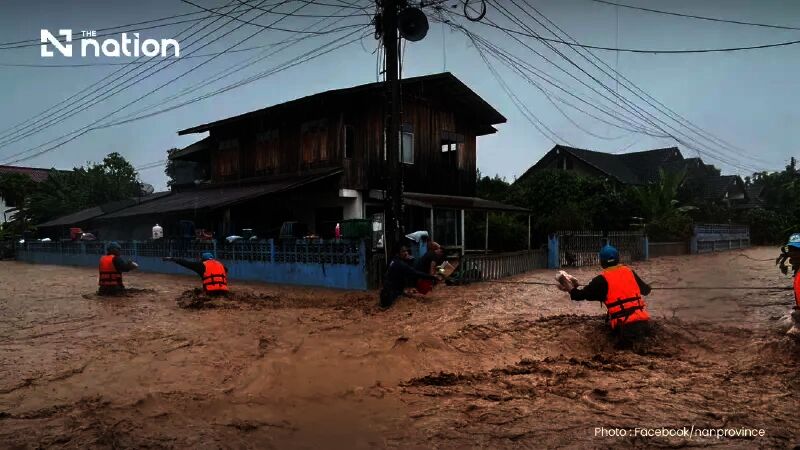
Thailand's northern region faces a mounting crisis as the government formally declared Nan province a disaster zone on Wednesday following severe weather that has cut transportation routes and displaced residents. The decision reflects escalating concerns about the impact of persistent heavy rainfall across the kingdom's mountainous north, with neighbouring Phayao and Lamphun provinces similarly placed under heightened alert status. The declaration triggers access to emergency resources and streamlines coordination between government agencies responding to what forecasters warn could develop into a more serious humanitarian situation.
Prime Minister Anutin Charnvirakul is directing the entire machinery of government from Australia, where he is currently fulfilling official commitments abroad. Rather than delaying action, he has established remote oversight of the crisis management response, issuing comprehensive instructions to mobilise all available resources. Government spokesperson Rachada Dhnadirek conveyed the prime minister's directive that military units and civilian agencies work in parallel to support evacuation efforts and prevent further loss of life, demonstrating that governance priorities can adapt rapidly when disasters strike.
The response strategy emphasises proactive rather than reactive measures. Anutin has instructed that response teams and heavy machinery be pre-positioned in vulnerable areas throughout the affected zones, enabling rapid deployment the moment dangerous conditions materialise. Water management forms a central component of this approach, with particular emphasis on draining accumulated water from locations with historical vulnerability to inundation. This focus on prevention reflects lessons learned from previous flooding seasons when delayed drainage compounded damage and extended displacement periods.
The prime minister has made explicit that human welfare takes precedence in all decision-making. His instructions prioritise protection of the most vulnerable populations, namely elderly residents, hospitalised patients unable to move independently, young children, and communities living in naturally hazardous terrain. This demographic-focused approach requires rapid assessment of affected areas to identify where people need assistance, coupled with continuous monitoring of rainfall intensity and rising water levels. The intention is to provide advance warning before dangerous conditions materialise, allowing orderly evacuation rather than emergency rescue operations.
Meteorological forecasts extending through Friday indicate that rainfall patterns will remain unstable across multiple regions of the country. Northern Thailand faces the most acute threat from flash floods and sudden runoff that can sweep away vehicles and buildings, while north-eastern provinces and central areas must prepare for similar dangers. Landslide warnings are particularly relevant in the mountainous north, where saturated soil on steep slopes can collapse suddenly, destroying homes and blocking access roads. Authorities have broadcast public warnings urging residents to remain vigilant and prepared to move to higher ground on short notice.
Deputy Prime Minister Yodchanan Wongsawat, who carries direct responsibility for flood management operations across the northern region, has issued urgent orders to provincial governors demanding that comprehensive preparations be completed immediately. The directive specifically targets Nan, Phayao and Lamphun, requiring local authorities to verify the readiness of evacuation routes, shelters, emergency supplies and communication systems. This hierarchical approach ensures that central government priorities are clearly understood at provincial level and that accountability for preparedness cannot be deferred.
The Meteorological Department's seasonal forecast for August indicated that tropical moisture patterns would generate scattered thunderstorms across Thailand, with some areas experiencing locally intense rainfall. The department warned that such conditions could overwhelm drainage infrastructure and river systems, leading to water bodies breaching their normal boundaries. These predictions have proven accurate, prompting government mobilisation. The combination of mountainous terrain in the north and moisture-laden air masses from tropical weather systems creates particularly hazardous conditions, as water rapidly flows downhill and accumulates in valleys and lowland communities.
For Malaysia and the broader Southeast Asian region, Thailand's experience offers important reminders about monsoon season risks. The pattern of heavy August rainfall affecting Thailand mirrors moisture dynamics that can influence Malaysian weather patterns, particularly in northern Peninsular Malaysia and areas bordering Thailand. The Thai government's emphasis on pre-positioning resources and vulnerable population protection represents best practice that Malaysian authorities also apply during their own flood seasons. Regional cooperation and shared early warning systems have become increasingly important as climate variability makes extreme weather events less predictable.
The declaration of disaster zone status carries significant practical implications beyond symbolism. It authorises government spending without normal budgetary constraints, mobilises military logistics capabilities, and simplifies bureaucratic procedures that might otherwise delay aid distribution. Insurance companies and international relief organisations recognise disaster declarations as signals to activate support mechanisms. The measure demonstrates that while Prime Minister Anutin manages affairs from abroad, the Thai government maintains capacity to respond decisively to national emergencies, preventing the kind of governance vacuum that might occur if crises were treated as routine matters.
Looking ahead, the Thai government faces a balancing act between maintaining readiness for potentially worse conditions and avoiding unnecessary economic disruption through overly broad precautions. The focus on drainage of flood-prone areas reflects recognition that while heavy rainfall is inevitable during monsoon season, governments can reduce damage through infrastructure maintenance and water management. For residents in affected provinces, the next 48 hours will be critical, as the Meteorological Department continues to monitor atmospheric conditions and update forecasts. The government's stated commitment to prioritising lives and safety over other considerations will be tested as the situation develops.

