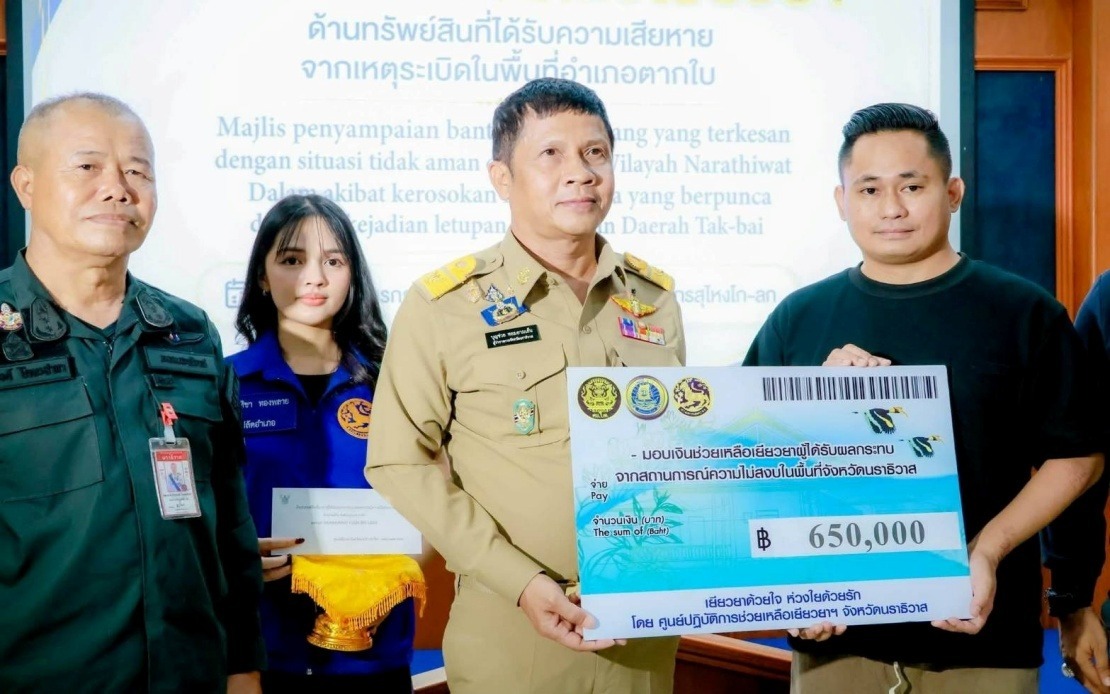
Thailand's government has moved swiftly to compensate Malaysian victims of a bombing incident that occurred in the volatile southern province of Narathiwat. On Friday, officials presented 650,000 baht—equivalent to roughly RM80,000—to Muhammad Yusri Udin, one of two Malaysian nationals injured when an improvised explosive device detonated near the Sapom junction in Tak Bai district on June 29. The payment, handed over during a formal ceremony at the Sungai Golok Customs Office, represents Bangkok's effort to manage diplomatic relations and reassure cross-border communities following the attack.
Narathiwat Governor Boonchuay Homyamyen underscored the Thai government's commitment to the safety of both local residents and international visitors during remarks to reporters. The governor articulated official regret over the incident, which resulted in injuries to Muhammad Yusri, 38, and Abdullah Syarapi Abd Rahman, 45, both Malaysian nationals. His statements reflected an attempt to contain potential fallout from an attack that, while seemingly targeting militant activity, had unintended civilian consequences affecting a neighbouring country.
The compensation scheme itself operates through established Thai government mechanisms designed to assist individuals harmed by security-related violence. This fund framework acknowledges that southern Thailand's decades-long insurgency has created circumstances where civilians—including cross-border travellers—face genuine risks. By activating this formal compensation channel, Thai authorities demonstrated procedural responsibility, though observers might note that financial redress, however generous, cannot fully mitigate the trauma and concerns such incidents generate among Malaysian communities living near or regularly crossing into Thailand.
The June 29 explosion occurred at approximately 11:40 am local time along a busy roadway, with the IED concealed within a roadside drainage structure. Thai security forces subsequently launched coordinated investigative operations encompassing explosive ordnance disposal and forensic analysis of the blast site. These technical responses underscore the infrastructure dedicated to responding to insurgent activity in provinces like Narathiwat, where militant groups have periodically targeted security forces, government installations, and infrastructure over several decades.
Thailand's security establishment determined that the two Malaysian victims were not the intended targets of the attack. Instead, investigators believe a rebel organisation conducted the operation, though specific group attribution and operational motives remain unclear from available statements. This assessment carries significance for Malaysian authorities and border communities, as it suggests the bombing reflected factional violence within Thailand's southern conflict ecosystem rather than deliberate targeting of foreign nationals. Nevertheless, such incidents underscore the inherent dangers present even for innocent bystanders in conflict zones.
Following the explosion, Thai authorities detained a 40-year-old individual as a suspect. The comprehensive investigation that ensued reflects standard counter-terrorism protocols in the region, involving inter-agency coordination across military, police, and civilian security apparatus. The speed of suspect apprehension and initiation of forensic operations demonstrated Bangkok's capacity to mobilise resources when incidents occur, though the broader challenge of preventing future attacks in Narathiwat's complex operating environment remains formidable.
Governor Boonchuay's public statements emphasised that the Thai government would not remain passive regarding security threats. His pledges to strengthen protective measures and restore international tourism confidence addressed multiple audiences: Malaysian officials and citizens concerned about the safety of cross-border travel, the international tourism industry potentially deterred by security concerns, and Thai citizens demanding effective counter-insurgency operations. The articulation of commitment on multiple fronts reflects how regional incidents ripple across economic, diplomatic, and security domains.
For Malaysian readers and policymakers, the incident and its aftermath carry several implications. The southern Thai provinces of Narathiwat, Yala, and Pattani, which border Malaysia's Perlis and Kedah states, remain zones of intermittent violence. While Thai security forces maintain significant capabilities, the persistence of insurgent operations suggests civilians—including Malaysians engaged in commerce, tourism, or cross-border activities—face ongoing exposure to security risks. The compensation mechanism, while welcome, reflects a reality that such incidents may recur despite government assurances.
The bilateral dimension merits consideration as well. Thailand's decision to promptly compensate Malaysian victims and publicly acknowledge government responsibility demonstrates diplomatic sensitivity toward a neighbour. Malaysia and Thailand maintain complex relations encompassing trade, tourism, maritime boundaries, and shared security interests. How Bangkok responds to incidents involving foreign nationals affects broader perceptions of state responsibility and competence. The formal compensation ceremony served partly as a diplomatic gesture, signalling that cross-border incidents would not be dismissed or delayed in addressing.
Regionally, this incident reflects broader patterns of insurgent activity in southern Thailand that periodically affect foreign nationals and cross-border communities. Groups operating in Narathiwat and surrounding provinces have historically maintained loose networks with transnational dimensions, though significant variations exist in organisational structure, ideology, and operational scope. For Southeast Asian governments and residents of border regions, such incidents serve as recurring reminders that conflict dynamics in one jurisdiction inevitably create spillover effects and security considerations for neighbouring populations.
The investigation's outcomes remain to be fully disclosed. Authorities will presumably pursue forensic analysis, suspect interrogation, and intelligence gathering to understand the attack's specific context and identify potential co-conspirators or organisational connections. Thai government responses to such intelligence findings will shape both near-term security operations and longer-term counter-insurgency strategy. For Malaysian policymakers monitoring developments, the investigation's trajectory and any subsequent operational responses will inform assessments of Thailand's capacity to manage security challenges affecting cross-border stability.
Moving forward, the compensation settlement closes one chapter while broader questions persist. Malaysian citizens and businesses engaged across the Thai border will continue evaluating risk assessments for their activities. Thai government commitments to enhanced security measures require sustained follow-through via resource allocation and operational effectiveness. Both nations share interests in enabling legitimate cross-border commerce and tourism while maintaining security, a balance that requires ongoing coordination and confidence-building between Bangkok and Kuala Lumpur's security establishments.

