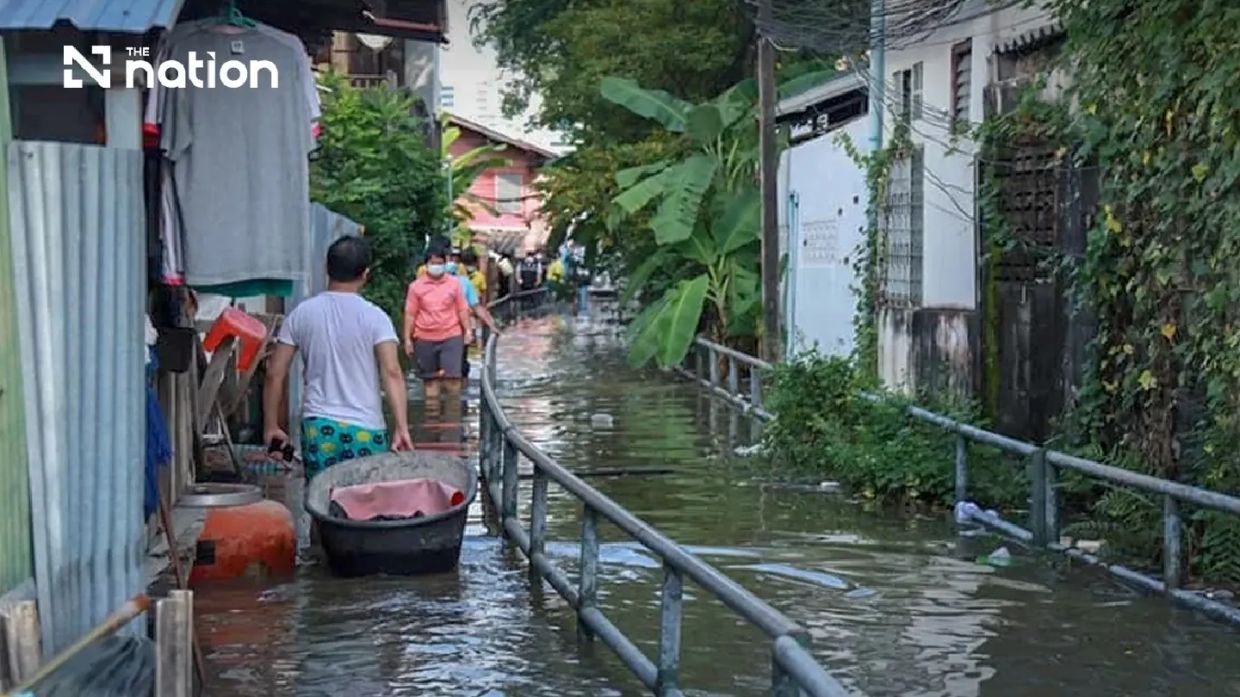
Thailand's Department of Disaster Prevention and Mitigation (DDPM) has activated a precautionary alert across Bangkok and six provinces in the central region following forecasts of abnormally high tides that could trigger localized flooding. The warning, announced on Saturday at noon by DDPM director-general Theerapat Kachamat, covers Pathum Thani, Nonthaburi, Nakhon Pathom, Samut Sakhon, Samut Songkhram and Samut Prakan. The alert period runs from Monday, July 13 through Sunday, July 19, with the highest risk window occurring between 6pm and 10pm each evening during this seven-day span.
Data supplied by the Royal Thai Navy's Hydrographic Department forms the basis of the alert, with particular concern centred on water levels along the Chao Phraya River around Phra Chulachomklao Fort and adjacent stretches. Officials anticipate that pronounced tidal conditions will force river levels above their banks, subsequently raising water elevation across connected canal systems. The cascading effect poses particular danger to settlements situated in low-lying terrain, communities positioned outside existing flood barriers, and neighbourhoods that lack engineered flood defences. Authorities have pinpointed multiple districts within each province as requiring enhanced monitoring and preparedness measures.
Within Pathum Thani, the municipalities of Mueang Pathum Thani and Sam Khok face heightened exposure, whilst Nonthaburi's vulnerable zones include Mueang Nonthaburi, Pak Kret and Bang Kruai districts. Nakhon Pathom's at-risk areas span Bang Len, Nakhon Chai Si and Sam Phran, whilst Samut Songkhram's entire province falls under the alert classification. In Samut Prakan, four districts—Mueang Samut Prakan, Phra Samut Chedi, Phra Pradaeng and Bang Bo—require heightened vigilance. This granular geographical breakdown reflects the tailored approach Thai authorities are adopting to communicate specific risks to local administrations and affected residents.
The Central Disaster Prevention and Mitigation Command (CDPMC) has instructed provincial governors and Bangkok's municipal administration to execute a comprehensive public information campaign. Residents and business proprietors operating along riverbanks and in canal-side communities must be informed of exact high-tide timings, enabling households to implement protective measures and relocate assets if necessary. The alert extends specifically to commercial operators maintaining floating restaurants, companies engaged in riverbank fortification projects, and industrial enterprises dependent upon water transport or riverside installations. These stakeholders face operational disruptions and potential property damage if tide levels exceed design thresholds.
The timing of this alert coincides with Thailand's monsoon season, when elevated precipitation in upstream catchments combines with astronomical tidal variations to amplify flood risk. For Malaysia and other Southeast Asian nations, the Thai experience underscores the growing necessity for integrated regional early-warning systems, particularly as climate patterns shift and extreme weather becomes more frequent. Bangkok's particular vulnerability stems from its low elevation relative to sea level and extensive network of waterways that concentrate tidal pressure during peak periods. The sprawling metropolitan area houses millions of residents and serves as an economic hub, making flood preparedness both a humanitarian and economic imperative.
Public engagement mechanisms have been established to ensure real-time information dissemination. Residents can access warnings through the dedicated 'THAI DISASTER ALERT' mobile application, providing location-specific notifications and regular updates throughout the alert period. The DDPM has activated its 1784 hotline, staffed around the clock to receive incident reports and coordinate emergency assistance for those requiring immediate help. LINE social media users can contact the official DDPM account at @1784DDPM to request aid or report flooding events. This multi-channel approach acknowledges varying levels of digital literacy and ensures vulnerable populations retain access to critical safety information.
The alert mechanism reflects Thailand's institutional evolution in disaster management following catastrophic flooding in 2011 that submerged much of central Thailand and caused billions of dollars in damage. Lessons learned during that calamity prompted establishment of more sophisticated monitoring systems and earlier warning protocols. The DDPM's reliance on hydrographic data rather than reactive response demonstrates a shift toward predictive management. However, critics argue that infrastructural deficiencies—including inadequate drainage systems and aging canal maintenance—continue to limit the effectiveness of early warnings if communities lack capacity to implement protective measures.
For Malaysian observers, the Thai alert carries particular relevance given shared river basins and similar tropical climate characteristics. Both nations experience monsoon-driven flooding, and the Chao Phraya's challenges mirror issues facing Malaysian river systems including the Klang, Rajang and Semenyih. Cross-border water management cooperation remains underdeveloped despite geographical interdependence, suggesting that lessons from Thai tidal flood experiences could inform Malaysian preparedness frameworks. The DDPM's communication strategy—emphasizing specificity regarding at-risk districts and affected stakeholder groups—offers a model for enhancing public understanding of nuanced flood risks that vary significantly across small geographic distances.
Provincial authorities have been instructed to activate coordination mechanisms connecting municipal administrators, disaster relief personnel, emergency medical services and volunteer rescue organisations. This institutional mobilisation aims to compress response times should flooding occur despite preventive measures. Communities positioned along the Chao Phraya estuary face particular risk given the interaction between riverine discharge and tidal backpressure, a dynamic that can produce sudden, dramatic water level fluctuations. Historical records indicate that critical infrastructure including roadways, power distribution systems and water treatment facilities suffer disproportionate damage during high-tide flooding events.
The alert's duration through July 19 encompasses the peak of Thailand's southwest monsoon season, when atmospheric conditions typically generate additional rainfall. Cumulative water volumes from both tidal elevation and precipitation increase exponentially, elevating inundation depth and duration in susceptible areas. Insurance analysts and property developers monitoring the situation face potential portfolio impacts, particularly regarding assets in flood-prone districts. The alert does not constitute an evacuation order, but rather a preparedness notification intended to enable proactive self-protection by residents and operational adjustments by commercial interests. Authorities acknowledge that complete prevention of tidal flooding remains technically unfeasible without massive infrastructural investment exceeding available budgets.

