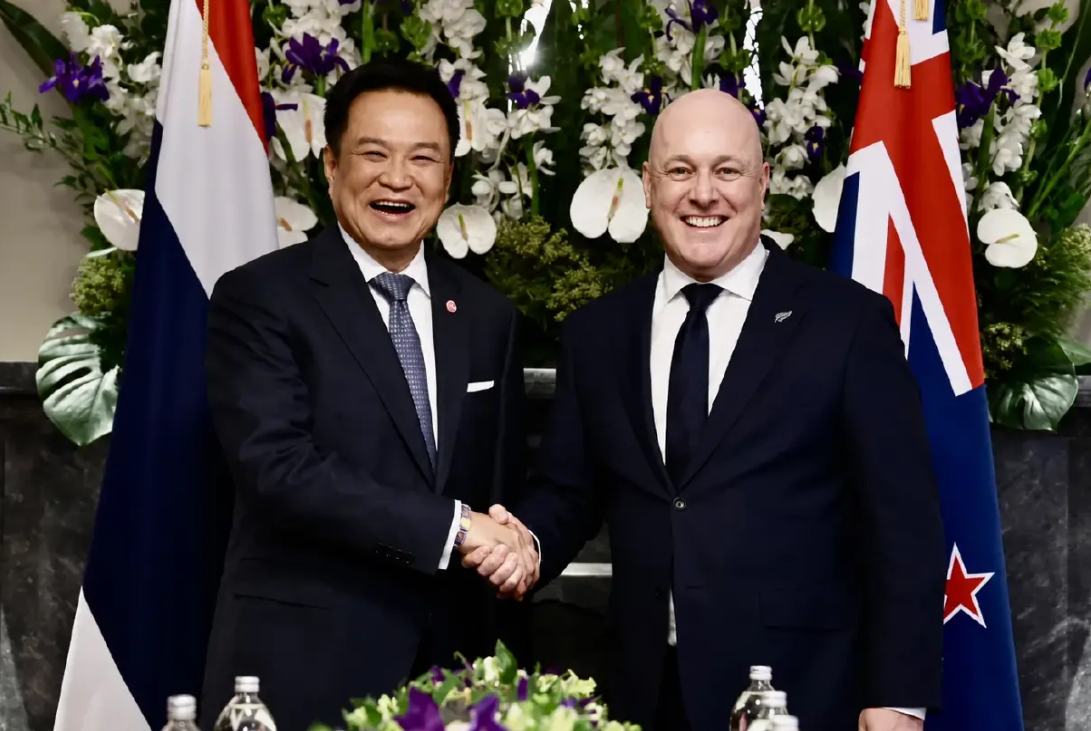
Thailand and New Zealand have formally elevated their bilateral relationship to a strategic partnership, marking a significant deepening of ties that coincides with the 70th anniversary of their diplomatic relations. Prime Minister Anutin Charnvirakul and New Zealand Prime Minister Christopher Luxon signed the Joint Declaration on Strategic Partnership following bilateral talks at Government House in Wellington on Friday, August 21, establishing a framework aimed at transforming traditional cooperation into tangible economic and social gains for both nations.
The strategic partnership encompasses an ambitious economic agenda, with both countries committing to triple their bilateral trade from current levels to US$7.5 billion, equivalent to approximately 246 billion baht, by 2045. This targets a substantial expansion of commercial ties that currently remain underdeveloped relative to the countries' geographic positioning and economic complementarities. The agreement signals recognition from Bangkok that the relationship with Wellington offers untapped potential across multiple sectors, particularly given New Zealand's advanced agricultural and technological capabilities and Thailand's strategic position within Southeast Asia.
Beyond the headline trade target, the two governments have developed a comprehensive Thailand–New Zealand Joint Plan of Action covering 2026–2030, structured around four distinct pillars designed to address contemporary challenges and opportunities. The political and security dimension focuses on coordinated responses to transnational crime, online fraud schemes, and human trafficking—issues of mounting concern across the Asia-Pacific region where porous borders and digital interconnection facilitate criminal networks. Enhanced information-sharing between Thai and New Zealand law-enforcement agencies represents a practical mechanism for addressing these shared vulnerabilities.
The economic pillar extends beyond simple trade expansion to encompass innovation, food security, energy transition, and sustainable agricultural practices. Both nations recognize that future prosperity depends on managing environmental constraints and building resilient supply chains less vulnerable to disruption. The agreement signals New Zealand's interest in collaborating with Thailand on green economy initiatives, while Thailand gains access to New Zealand expertise in sustainable farming—particularly relevant as agricultural exports remain central to Thailand's economic strategy and Southeast Asian food security concerns intensify.
Education and cultural cooperation comprise the third strategic area, with both governments committing to expanded university partnerships, skills development programs, and capacity-building initiatives. This pillar addresses demographic challenges facing developed nations like New Zealand, where skilled migration from Southeast Asia becomes increasingly important, while offering Thai citizens pathways to advanced training and qualifications. The emphasis on people-to-people connections acknowledges that sustained partnership requires deep societal links beyond government-to-government relations.
Regional and multilateral cooperation forms the fourth pillar, situating the Thailand–New Zealand relationship within broader frameworks including Mekong cooperation mechanisms, Association of Southeast Asian Nations (ASEAN)-led institutions, and the Asia-Pacific Economic Cooperation forum. This positioning reflects Thailand's role as a gateway between the Mekong subregion and broader Asian structures, while acknowledging New Zealand's increasing engagement with Asian multilateralism. Both nations reaffirmed commitment to a rules-based international order, implicitly addressing concerns about regional stability as great-power competition intensifies.
A parallel focus on connectivity infrastructure underscores the partnership's practical dimension. Thai Airways' planned resumption of direct Bangkok–Auckland services in March 2027 represents a significant milestone that Prime Minister Anutin indicated might be accelerated. Direct air connectivity functions as a catalyst for multiple forms of exchange: tourism flows benefit both economies, business travel becomes more efficient for companies pursuing bilateral investments, and student mobility increases when travel time and costs decrease. The airline route carries symbolic importance as well, demonstrating both nations' commitment to deepening engagement beyond diplomatic statements.
The partnership framework includes four specific cooperation agreements addressing distinct domains. These encompass cultural exchange between governments, educational coordination between Thailand's Civil Service Commission and New Zealand's education authorities, law enforcement collaboration between Thai and New Zealand police forces, and private-sector engagement through a technical instruments industry agreement. This multi-layered approach reflects contemporary diplomatic practice that recognizes government agencies alone cannot drive sustainable partnership; business engagement and institutional cooperation across sectors amplify impact.
Anutin's advocacy for New Zealand support regarding Thailand's application to join the Organisation for Economic Co-operation and Development (OECD) demonstrates how the bilateral relationship serves broader strategic objectives. Thailand's OECD membership bid carries implications beyond the bilateral relationship, signaling Thailand's aspiration to align with advanced economy standards and institutions. New Zealand's endorsement, which Luxon expressed, provides valuable backing from an established OECD member state with credentials in both developed and Asian contexts, potentially influencing OECD member decision-making.
For Malaysian observers, the Thailand–New Zealand partnership elevation carries indirect significance within regional dynamics. Thailand's deepening ties with developed nations like New Zealand may influence intra-ASEAN relationships and extraregional positioning. The emphasis on multilateral cooperation through ASEAN mechanisms suggests both countries view regional stability as prerequisite for bilateral advancement. Additionally, competition for trade, investment, and educational partnerships with countries like New Zealand means Malaysia must consider whether its own engagement with Wellington matches strategic importance.
The tripling trade target by 2045 represents an ambitious but realistic goal given current bilateral trade levels and demographic trends favoring increased commerce between developed and Southeast Asian economies. The timeframe allows for gradual implementation of supporting infrastructure, regulatory harmonization, and business relationship development. However, realizing this target requires addressing practical barriers including tariff structures, technical standards alignment, and supply chain integration that currently limit two-way flows.
The strategic partnership announcement reflects broader regional patterns wherein Southeast Asian nations seek to diversify partnerships beyond traditional relationships with Western powers, while simultaneously deepening existing ties. New Zealand's engagement with Thailand and the broader region responds to its own strategic imperatives regarding Asian engagement and supply chain resilience. This mutually beneficial recalibration of bilateral relations, tied to concrete economic targets and institutional mechanisms, demonstrates how contemporary partnerships function as practical instruments for advancing shared interests rather than purely symbolic diplomatic gestures.

